Communications between the Trump administration and Alberta’s separatist movement raised alarm at the highest levels in Canada last week. It also raised questions about Washington’s possible intentions.
Some even see dangerous parallels between American efforts to inflame Alberta separatism and the Russian campaign to gin up a separatist movement in eastern Ukraine a decade ago.
Last week, an Alberta separatist group revealed that it was hosted at three meetings by the U.S. State Department.
“Rumour [is] that they may have a referendum on whether they want to stay in Canada or not,” U.S. Treasury Secretary Scott Bessent told right-wing channel Real America’s Voice following those meetings.

“People want sovereignty. They want what the U.S. has got.”
“The department regularly meets with civil society types,” a U.S. State Department spokesperson confirmed to CBC News. “As is typical in routine meetings such as these, no commitments were made.”
Alberta separatist Jeffrey Rath says least one of those meetings was held in a Sensitive Compartmented Information Facility (SCIF), a room purpose-built to defeat sophisticated foreign intelligence eavesdropping.
Destabilization tactics
Maria Popova, a political science professor at McGill University and author of two books on Russian-Ukrainian relations, sees the meetings as evidence that “we’re now under hybrid attack from the U.S.”
She says the meetings are part of a larger strategy of “repetitive denials of our existence as an independent state.”
Patrick Lennox, a former RCMP intelligence manager and author of the book At Home and Abroad: The Canada-U.S. Relationship and Canada’s Place in the World, says U.S. interference efforts can also take less visible forms.
“The U.S. has declared a form of information warfare against us. They’re going to use everything that they can to destabilize our country, to disrupt us, potentially to break us apart in order to execute on their national security strategy,” he said.

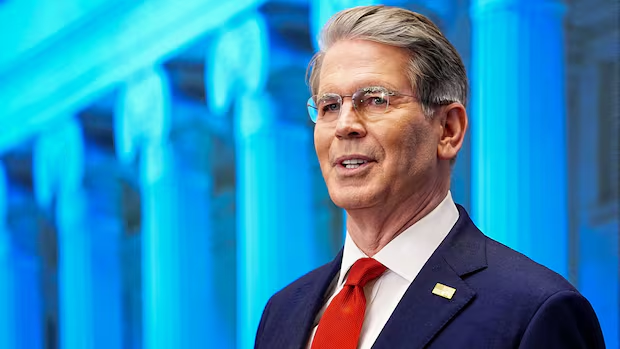
U.S. Treasury Secretary Scott Bessent commented Thursday on the separatist movement in Alberta — making him the highest-ranking member of the Trump administration to weigh in on the province’s politics.
Beyond direct U.S. government interference is a more amorphous campaign of influencers in U.S. President Donald Trump’s Make America Great Again (MAGA) movement such as Matt Wallace (2.3 million followers on X), who lend support to homegrown Alberta separatists online.
“It makes sense that you go for the low-hanging fruit, seeing Alberta as a province that you could peel off based on the supposedly surging separatist sentiments there,” said former Canadian diplomat and international lawyer Sabine Nölke.
Nölke was Canada’s permanent representative to the international courts at The Hague as well as ambassador to the Netherlands until 2019.
She says MAGA’s embrace of Alberta separatism doesn’t necessarily mean the U.S. has a concrete plan to annex the province, “but to sow confusion, doubt and discomfort … the sense that Canada is fragile.”
“I would like to suggest that the government do a bit of research into this, just to gauge how much of an astroturfed, artificial threat this whole separatist operation is, in the model of the Donbas,” Nölke said.
A fringe movement storms to power
The Donbas is the eastern Ukrainian region where, in 2014, Russian agents and Russian money leveraged a small homegrown separatist movement to take over Ukraine’s industrial heartland.
Politicians in the Donbas had no real intention of separating, but thought they could use separatist agitation to extract concessions from Kyiv, said Popova — “a dramatic miscalculation.”
The separatists seized power and declared the Donetsk and Luhansk people’s republics, following votes overseen by armed militiamen. In 2022, a second round of coerced voting annexed the Donbas to Russia.
Popova sees parallels between the Donbas and the Alberta government’s approach.
Alberta Premier Danielle Smith has repeatedly said that the fate of Alberta rests with Albertans — while also passing legislation making it easier for a referendum question on separation to succeed.

After B.C.’s premier called the Alberta separatist meetings in Washington “treason,” Smith said she would not “demonize or marginalize a million of my fellow citizens when they’ve got legitimate grievances.”
“That’s the danger here,” said Popova. “If they think ‘we’re powerful enough, we have legitimacy, we’ve been elected, we are the leaders of this province, so we can play this game with Ottawa.'”
Meetings in Washington
Rath, co-founder of the Alberta Prosperity Project, told CBC News that the Americans “are extremely enthusiastic about the prospect of a free and independent Alberta.”
In his meetings with officials who he refused to name, Rath said “all they want is North American security. They want China out of the Alberta oilpatch.”

As for meeting in a SCIF: “It was only the available meeting room, it’s not a big deal,” he said.
Lennox doesn’t buy that explanation.
“I’ve been in American SCIFs. You don’t get in there by accident. You shed all your electronics. It’s a secret meeting,” he said.
‘Texans of the north’
Last week, MAGA-affiliated social media accounts pushed a vision of Alberta as oppressed and exploited by the rest of Canada.
Similar memes and messages are created and shared by accounts based in Canada and the U.S.
“You can see artificial intelligence being used to drive narratives about Alberta being almost like Texas,” said Lennox. “Memes and other AI-generated nonsense that suggests there’s a large Texan immigrant population in Alberta that’s yearning to be free.”
Those claims echo Russian propaganda in 2014 that pushed the idea that eastern Ukrainians were culturally more Russian than Ukrainian, and would be more at home with people like them.

They are effective partly because Canadians, including Albertans themselves, tend to overestimate how conservative Albertans really are, at least on social issues.
Texans and Albertans may share a love of rodeo, but their politics have little in common.
For example, a 2022 poll suggested eight per cent of Albertans believe that abortion should be banned except to save a woman’s life, compared to 11 per cent of British Columbians and Quebecers, and 13 per cent of Ontarians. In Texas, 42 per cent believe abortion should be illegal in all or most cases.
“There are generationally deep conservative elements to the province,” says Lennox, who lives in Edmonton, but the claim that Alberta is a Texas of the north “is a psyop [psychological operation] in many ways.”
Canada ‘controlled by communist China’
The main justification for separatism advanced by Russian propaganda in 2014 was that Ukraine had been taken over by Nazis, and was becoming a satellite of NATO and the West.
In the information war for Alberta, Chinese communists play a similar role.
Rath told CBC News his American counterparts merely seek to prevent a Chinese takeover.
“After Carney’s bizarre New World Order speech,” Rath said, “we don’t know that he’s not an agent of communist Chinese.”
On Jan. 25, Trump posted on his Truth Social account: “China is successfully and completely taking over the once Great Country of Canada. So sad to see it happen.”
Trump has twice in recent days warned that Canada is at risk of a Chinese takeover, saying both times that takeover would be followed by a ban on hockey.
Gaslight and overwhelm
The disinformation war unleashed on Ukraine in 2014 aimed to create a sense of inevitability around the breakup of the country
“[It’s] essentially a gaslighting strategy telling you you’ve already lost your state, there’s nothing to fight for,” said Popova. That’s also part of the rhetoric here.”
Separatist social media messaging aims not only at an Albertan or Canadian audience, but also at persuading a U.S. audience that Albertans are oppressed and really do want out. If conflict ever did arise, outside audiences might be more likely to see it as a dispute between Canadians, rather than a reaction to foreign interference, said Popova.

That was what Russian propaganda achieved in the takeover of the Donbas, she said.
When armed separatists seized government buildings, “at that point the Ukrainian state had to respond within what they called an anti-terrorist operation. And that’s the moment at which the rest of the world said, well, this is a civil war,” Popova said.
She says Ukraine in 2014 was very different from the tough adversary Russian troops encountered in 2022.
“They had not prepared. They did not expect this.” Ukrainians found it hard to imagine that their neighbours could turn on them so aggressively, Popova said.
“And that’s another parallel.”
History suggests it can be difficult to resist a determined effort by a superpower in conjunction with a small, but real, separatist movement.
“I don’t know,” said Lennox. “Based on my experience in the machine, if we have the capacity to pivot on something this profound, I hope we do.”