
Listen to this article
Estimated 5 minutes
The audio version of this article is generated by AI-based technology. Mispronunciations can occur. We are working with our partners to continually review and improve the results.
Engineers following the case of four people who face criminal charges for storing materials that police allege could be made into explosives say it’s ‘not unusual’ for scientists to have home labs, but cite a slew of safety concerns about what they’ve seen.
Jerry Tong, Zekun Wang, Fei (Frank) Han and Feiyang (Astrid) Ji are charged with possessing high explosives and manufacturing firearms, among other things, following a days-long search of their London, Ont., home.
The probe began after a trespassing call that police received from Western University on Jan. 24, 2026, which led them to the house in the nearby University Heights neighbourhood.
In a video posted to YouTube three months ago, Tong, Wang and Han explained they were in the process of designing a military system meant to prevent drone attacks and that they were seeking funding.
“We’re taking on the challenge of stopping weaponized drones,” said Tong in the video titled MORSLAB Pitch Presentation. “MORSLAB is in the right place at the right time, and we hope you can join us.”

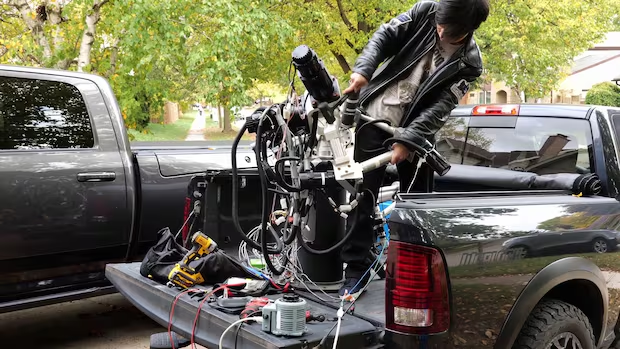
Tong goes on to say that the team runs a garage CNC mill and has its own “chemical lab on site.” The video also includes clips of Wang working on the system in the bed of a pickup truck that CBC News has verified was parked at 212 Chesham Pl., where police have been investigating.
Ji does not appear anywhere in the video.
“I think I can speak for engineers who are new grads. It’s pretty usual to start from your own garage, building whatever you need to build,” said Parth Mahendru, who is the co-founder and CEO of Toronto-based Prandtl Dynamics, which also creates drone defence technology.
Mahendru said he started his company out of his small condo when he was in his final year of engineering at the University of Toronto, before moving the project into a co-founder’s home garage in Oshawa.

“If you want to save money, you start small and validate the idea, and as soon as you get a product market fit or you gain traction with customers, you move into a facility,” he said.
“Having said that, it is definitely not usual for you to keep firearms or chemicals in your garage. That’s just not very safe in my opinion.”
What was the London trio developing exactly?
Mahendru said there is an appetite for anti-drone technology, and there are many different techniques that engineers are using to create them.
The MORSLAB pitch video contains multiple renderings and animations of the weapons system, and the accused claim that it is capable of tracking and dispatching the drones by destroying their on-board electronics with bursts of microwaves radiation.
Kyle Davidson, who served in the Canadian Army for 15 years and is now the founder of Ottawa-based counter-drone company Agile Electromagnetics, watched the London trio’s pitch video and said the explanation checks out.
“It’s not too dissimilar from your microwave oven at home, where if you were to put metal in the microwave … it sparks,” he said.

Davidson said that wave weapons can be projected at a drone and interact with the tiny copper wires inside, either confusing the computer system or physically melting the wires.
“Your little computer doesn’t work anymore and that drone falls from the sky.”
Mahendru agrees that the MORSLAB team’s explanation of their microwave technology sounds legitimate, but he said that it doesn’t explain why they allegedly had explosive chemicals or firearms in the residence.
“That perplexed me a little bit,” he said. “In my opinion, there’s no real use for them having those chemicals for their anti-drone systems. I think that might’ve been a side project of some sort.”
“You [also] would not need bullets for any of those, so it doesn’t really make a lot of sense for them to have firearms,” Mahendru said.
Safety questions and concerns
Davidson, who also started his company in his apartment, said defence materials are “highly regulated” and said there are concerns if the accused did not follow safety protocols.
“I’m glad that the police or someone else has interfered and put a stop to this because those three students, regardless of the criminality associated with it, were probably doing things that were putting their safety at risk,” he said.

CBC News reached out to the Department of Defence, as well as Innovation, Science and Economic Development Canada, about safety regulations but did not receive a response from either before publication.
Davidson said he had to provide 60 days of notice to the Department of Defence to test his company’s systems, and get approval.
All four of the accused remain in police custody, with bail hearings scheduled in London court in the coming days.
London police are expected to provide an update on the investigation at a media conference Friday morning.