
Listen to this article
Estimated 4 minutes
The audio version of this article is generated by AI-based technology. Mispronunciations can occur. We are working with our partners to continually review and improve the results.
The explosive success of Bad Bunny has brought Puerto Rican Spanish, a Caribbean dialect known for its musical rhythm, to global attention.
The dialect has been looked down on in the past, but some experts say the popularity of the Grammy Award-winner’s music may be changing that.
In the weeks leading up to Sunday’s historic Super Bowl halftime performance, which he’s set to deliver entirely in Spanish, dozens of tutorials have popped up on social media and YouTube about Puerto Rican Spanish terms and how they show up in Bad Bunny lyrics.
Even Duolingo is getting in on the fun, with an Instagram post showing translations of some Bad Bunny lyrics.
WATCH | YouTuber breaks down Puerto Rican phrases in Bad Bunny lyrics:
The use of Puerto Rican Spanish is all over the musician’s Grammy Award-winning album DeBÍ TiRAR MáS FOToS and can be seen just by looking at the track list, said Ramón Antonio Victoriano-Martinez, an assistant professor of Spanish at the University of British Columbia.
Several of the song titles are spelled how they would be pronounced phonetically in the dialect, such as the song VeLDÁ, which would typically be spelled “verdad” in Spanish, he explained. Verdad translates to true or truth in English.
“This is a very, very Puerto Rican album,” Victoriano-Martinez said.
In the last 10 years, Victoriano-Martinez said he’s seen more students become interested in learning Spanish because of reggaeton artists who perform in Puerto Rican Spanish.
Victoriano-Martinez, who’s from the Dominican Republic, said he found it encouraging to see the Caribbean dialect featured on such a large scale.
“For us Caribbeans, it’s great to have our variant of Spanish being, if not legitimized, but recognized all over the world,” he said.
Linguistic differences
Looking at the dialect more closely, there are some specific characteristics that set it apart from the Spanish you would hear elsewhere in Latin America or Spain, said Cristina Cuervo, an associate professor of linguistics and Spanish at the University of Toronto.
The most salient feature is the use of the “l” sound in place of “r” in certain words, Cuervo said.
“This is a phenomenon that is typical from Puerto Rico, but it’s also found … in some parts of Spain, particularly in the south,” she said.
For example, the phrase “mi amor” (“my love” in English) might be pronounced “mi amol,” something that can be heard in some Bad Bunny songs, she said.
Another characteristic of the dialect is dropping the “s” sound at the end of certain words, she said.
Historically looked down on
In the past, Puerto Rican Spanish has often been maligned in the Spanish-speaking world as being unrefined or inauthentic, said Petra Rivera-Rideau, an associate professor of American studies at Wellesley College and the co-author of P FKN R: How Bad Bunny Became the Global Voice of Puerto Rican Resistance.
That is partly rooted in the history of colonialism of Puerto Rico, which is a self-governing territory of the United States, and the consequent interjection of English terminology in Puerto Rican Spanish, she said.
In addition, Rivera-Rideau, who has Puerto Rican roots, said she remembers how words she learned at home were left out of Spanish textbooks at school.
“So I think it’s really great to see people learning a type of Spanish that’s not so intimately tied to Spain, because the majority of the Spanish speakers in the United States are not from Spain.”
‘An advocate for linguistic tolerance’
Ana Celia Zentella, a professor emeritus at the University of California San Diego’s ethnic studies department, said she hopes Bad Bunny’s popularity helps promote tolerance and encourages people from Spanish-speaking countries to be proud of their background.

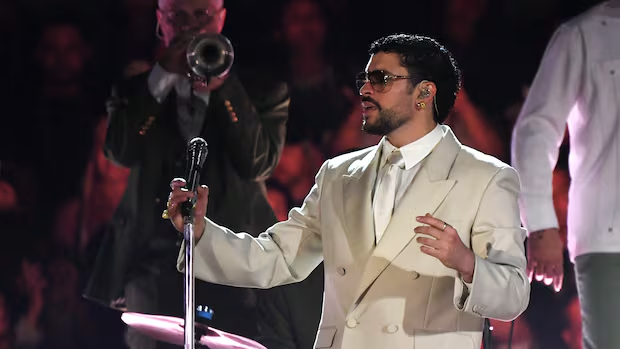
Puerto Rican musician Bad Bunny was a big winner at this year’s Grammy Awards and used the opportunity to speak out against U.S. President Donald Trump’s immigration policies.
That’s especially important at a time when the Trump administration’s immigration enforcement campaign has many people in the Spanish-speaking community living in fear, she said.
“It’s much broader than just asking somebody to be able to understand what he’s saying at the midpoint in the football game. He’s really an advocate for linguistic tolerance and linguistic justice, and we are assuming that that goes much beyond learning Spanish,” Zentella said.
“It’s about respecting all of the different languages that have come into the United States and that have created this extraordinary country with all of its contributions.”