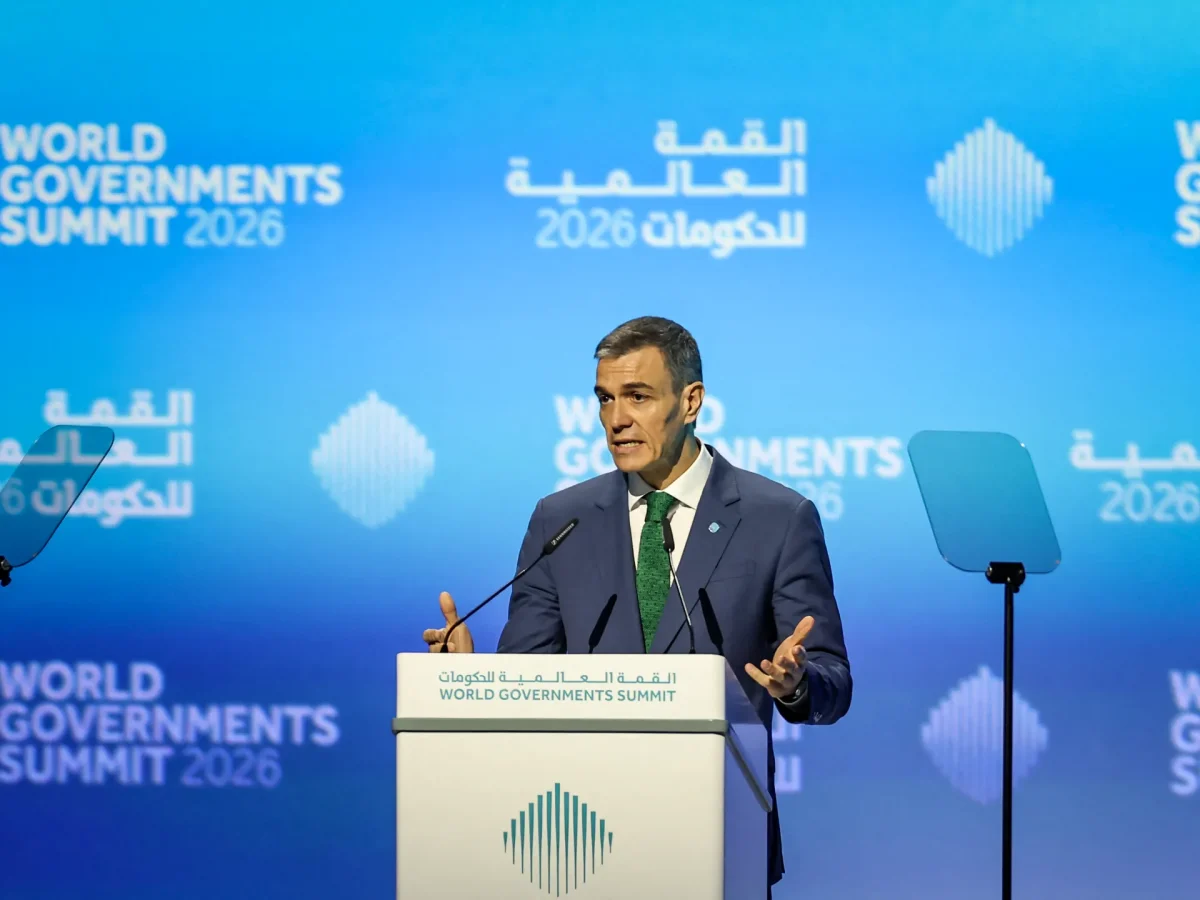
Spanish Prime Minister Pedro Sanchez has clashed with social media platform owners over plans to ban social media for under-16s in the country.
Describing social media platforms as the “Wild West”, Sanchez announced plans to hold platform executives responsible for criminal or harmful content.
Social media executives, including tech billionaire and X owner Elon Musk and the Russian Telegram founder Pavel Durov, hit back, with Elon Musk calling Sanchez a “true fascist totalitarian” over the proposed measures this week.
Then, in an open Telegram message to all users in Spain, Durov accused Sanchez’s government of “pushing dangerous new regulations that threaten your internet freedoms”.
He claimed the measures would turn Spain “into a surveillance state under the guise of ‘protection’”.
In response, unnamed government sources told the media: “Telegram founder Pavel Durov used his unrestricted control of the app to send a mass message to all users in Spain, spreading several lies and making illegitimate attacks against the government. This is the first time this has happened in our country’s history.
“Spaniards cannot live in a world where foreign tech oligarchs can flood our phones with propaganda at will simply because the government has announced measures to protect minors and enforce the law.”
So what is the dispute about, and why has it become so heated?
What has Sanchez announced?
Speaking at the World Governments Summit in Dubai on Tuesday, Sanchez said that by banning social media for children under 16, Spain aimed to “protect them from the digital Wild West”.
Currently, social media platforms such as Facebook and TikTok require users to be at least 13 years old.
Sanchez said, “Our children are exposed to a space they were never meant to navigate alone … We will no longer accept that.”
Sanchez added that Spain would also devise a law to hold social media company executives responsible for the illegal, hateful or harmful content on their platforms.
“The power of the state is there to protect democracies from the attacks they suffer and also children and adolescents from that toxic, unpunished world that social media has unfortunately become,” Sanchez said.
“They won’t break us, because the voice of reason … will not be silenced by these techno-oligarchs of the algorithm.”
Sanchez also announced that Spain has joined a group of five European countries, which he termed the “Coalition of the Digitally Willing”, to discuss cross-border regulation of social media.
Sanchez did not provide details of what this collaborative effort could entail, nor did he name which countries would participate, but added that they would meet in the upcoming days.
“We know that this is a battle that far exceeds the boundaries of any country,” he said.
The proposed ban would be introduced as an amendment to an existing bill on digital protection for minors that is currently being debated in parliament, the Reuters news agency reported, quoting an unnamed government spokesperson.
Furiously. On Tuesday, Musk responded to a video of Sanchez’s speech on X, writing: “He is a traitor to the people of Spain.”
He then reposted the video of the speech, writing, again: “Dirty Sanchez is a tyrant and traitor to the people of Spain.”
Grok, which is the AI platform on X, was the number one mobile application in Spain last month, Musk claimed.
However, Musk has been accused of platforming the far-right and white supremacists, particularly in Europe. He addressed a political rally of the far-right Alternative for Germany (AfD) party in the German city of Halle last year.
On Wednesday, Telegram founder Pavel Durov also lashed out at Sanchez in a message on Telegram, writing: “These aren’t safeguards; they’re steps toward total control. We’ve seen this playbook before – governments weaponizing ‘safety’ to censor critics.”
Durov was arrested in Paris in August 2024 for failing to curb alleged criminal activity on the messaging app and was charged with 12 offences. He denied any wrongdoing in a statement last March. He was allowed to leave France in March under judicial supervision, but the case remains open.
What do people in Spain want?
The Ipsos Education Monitor 2025, published in late August 2025, reported that 82 percent of people in Spain support banning social media for children under the age of 14, a rise from 73 percent in 2024.
The survey was conducted in 30 countries, and a majority of respondents in all 30 countries supported banning social media for children under 14.
While social media has long provided easy access to unregulated graphic content, misinformation and hate speech, the recent explosion of AI‑generated material poses new risks to the wellbeing of children and young people, experts say.
The American Psychological Association published an advisory last year warning that generative AI systems can amplify harmful content such as violent or sexual videos.
It also added that adolescents are less likely than adults to question the accuracy of AI-generated content. “They may also be unaware of the persuasive intent underlying an AI system’s advice or bias,” the advisory stated.
AI can also amplify pre-existing societal prejudices, according to Ayo Tometi, co-creator of the US-based antiracist movement Black Lives Matter.
Children worldwide are also worried about the misuse of AI for online child sexual exploitation and “deepfakes”, according to UNICEF research on children’s perspectives and AI published in October 2025.
Governments appear to be taking this seriously.
Musk’s Grok recently came under fire for allowing users to generate sexually explicit fake images of women and minors. This triggered an investigation by the European Commission last month.
On Tuesday, French prosecutors raided X’s offices in France as part of an investigation into allegations including spreading Child Sexual Assault Material (CSAM).
On the same day, the United Kingdom’s Information Commissioner’s Office (ICO) opened a formal investigation “in relation to the Grok artificial intelligence system and its potential to produce harmful sexualised image and video content,” the office noted.
In December 2025, Australia banned children under 16 from social media, becoming the world’s first country to do so. Under the law, 10 of the biggest platforms will face $33m in fines if they fail to take “reasonable steps” to purge Australian-based users younger than 16.
As of January 16, social media companies revoked access to about 4.7 million accounts identified as belonging to children in Australia, according to officials.
“We stared down everybody who said it couldn’t be done, some of the most powerful and rich companies in the world and their supporters,” Australian Communications Minister Anika Wells told reporters last month.
Days after Australia’s ban took effect, Reddit, which was one of the 10 platforms required to purge minors, lodged a challenge to the ban in the High Court, while still complying with it.
In 2023, France adopted a law mandating that social media platforms obtain parental consent before children under 15 could open accounts. However, local media report that technical difficulties have hampered enforcement.
In Germany, children aged between 13 and 16 require parental consent to be able to use social media platforms. In Italy, children under 14 need parental consent to set up social media accounts.
Last year, the Chinese internet regulator Cyberspace Administration of China (CAC) introduced a “minor mode” that applies device‑level controls and app-specific rules to limit screen time by age.
In November 2025, Denmark said it would introduce a ban on social media platforms for children under 15. Most parties said they would back this move in a parliamentary vote.
In the same month, Malaysia said it would ban social media for people under the age of 16, starting from 2026.
In January, UK Prime Minister Keir Starmer announced that his country was considering a ban similar to the one in Australia.
Greece will also announce a similar social media ban to the Spanish one for children under the age of 15, Reuters reported on Tuesday, quoting an unnamed senior government source.