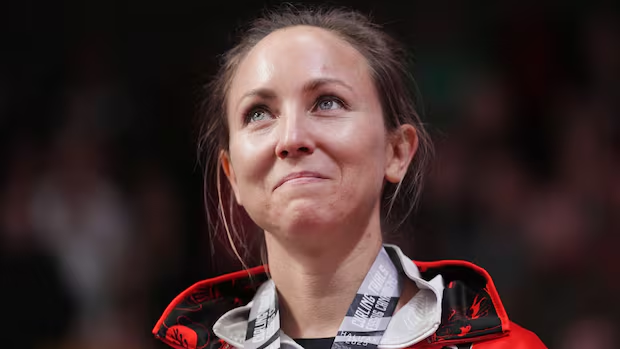
The Milan Cortina Winter Olympics will be the most gender-balanced Olympic Winter Games in history, a feat being celebrated by Canada’s sports organizations and Olympians.
Women are set to make up 47 per cent of the athletes on a program with 50 women’s events — both Olympic Winter Games records.
Canada’s 206-member team in Italy includes 107 female athletes.
A spokesperson for the International Olympic Committee said in an email that 12 of the 16 disciplines on the program will feature full gender parity, another Olympic first.
“This shows the International Olympic Committee’s continued commitment to fostering gender equality in sport,” the spokesperson said, adding that the full and exact gender breakdown will only be available after the Games are over.
The Games will feature four new women’s events. They include freestyle skiing’s dual moguls, luge doubles, ski jumping’s large individual hill and ski mountaineering sprint.
Women and men are also set to compete over the same distances in cross-country skiing for the first time.
Lauren Gale, two-time Olympian and Canadian record holder in the indoor 200-metre sprint, told The Canadian Press that improving gender equality shows people “the best of the best of both genders.”
“Knowing that we have the chance to compete and have the world value both performances equally is an amazing feeling,” said Gale.

Veteran Olympic skiers Mikaël Kingsbury and Marielle Thompson have been named Canada’s flag-bearers for the Milano-Cortina Games opening ceremony on Feb. 6.
‘An honour’
Gale, who competed at the Paris 2024 Summer Olympics, which was the first Olympic Games in history to achieve numerical gender parity, said it was “an honour” being part of history.
“It feels extremely special to be a part of a team that so many athletes before us worked so hard to create,” said Gale. “It’s bigger than just sport; it sets a standard for what the future of everything should look like.”
Adam van Koeverden, sprint kayaker, Olympic gold medallist and Canada’s secretary of state for sport, said that for most of the time he was on the national team, there was only men’s canoeing at the Olympic Games.
Women’s canoe events debuted at the Tokyo 2020 Olympic Games, 84 years after men began competing in the sport at the Olympics.
“When you provide opportunity, people will rise to the occasion, and women are doing better than ever on the world stage and in global competitions,” said van Koeverden.
“It is super important, and I know the Canadian Olympic and Paralympic Committee has been very, very strong in their advocacy for this, so I thank them for that.”
Van Koeverden said some events have yet to achieve gender equity at the Olympics, highlighting monobob, which is a women’s event, and Nordic combined ski and four-person bobsled, which are men-only events.
He said balance in numbers “has to be found somewhere,” but that he hopes to see opportunity for everybody.
“I’m less concerned with the Olympic program and more concerned with access and opportunity, participation rates across the country,” said van Koeverden, who will attend the Winter Games.
“I know that we need to have equity at the Olympics and on those programs in order to provide those opportunities, but then in the community, we want to see more women coaches, more women in positions of admin and leadership roles within sport.”
Correcting inequity
Allison Sandmeyer-Graces, CEO of Canadian Women & Sport, said the International Olympic Committee has made a sincere commitment to correcting decades of inequity and “that is to be celebrated.”
“When we talk about gender equity, it is a matter of progress over perfection; there is always more work to do,” Sandmeyer-Graces said. “This Olympics has a lot to celebrate.”
Sandmeyer-Graces said that just over 100 years ago, only about five per cent of athletes at the Olympics were women.
“There’s obviously been a lot of progress; it’s taken a long time,” she said. “Let’s celebrate this moment, let’s keep pushing.”
Sandmeyer-Graces said improvements to gender equity at the Olympics can have positive ripple effects on the entire “sports ecosystem,” increasing respect, funding and visibility of women’s sports.
“For a long time, women have shown up, have trained hard, have competed hard, but ultimately just had fewer spots, fewer opportunities,” said Sandmeyer-Graces. “For the athletes who have a chance to compete in ways that they literally didn’t four years ago —what a game changer.”
“For the athletes coming behind them, those next-gen. athletes, they’re entering into a very different landscape, and they themselves will be a step towards even more change.”