What On Earth27:16Climate change makes rats a ‘ticking time bomb’ in cities
In Chicago’s Lincoln Park neighbourhood, researchers are watching rats closely using hidden cameras in alleyways to see if the rodents will take the bait — because inside those tasty peanut butter pellets is a tool that might keep rat populations in check.
Climate change – along with urbanization and density – is one of the reasons certain cities are seeing an uptick in the number of rats, many scientists found in peer-reviewed research. And there’s a reason rats are considered vermin: they can spread illness to humans and their presence can also negatively affect mental health, issues that prompted research on controlling their population.
Birth control may be part of that solution, says Maureen Murray, the assistant director at Lincoln Park Zoo’s Urban Wildlife Institute, who is leading the study in Chicago’s alleys.
“We’re evaluating whether contraception can be an effective way to manage rats in cities,” says Murray.
Rat poisons, in particular anticoagulant rodenticides, have proven to be deadly to other species, killing off a family of celebrity owls in Chicago, while in New York City, toxic levels were found in Flaco the owl. Now, some researchers and municipal governments hope to find pest control methods that are less harmful to the environment.
Climate makes rats a ‘ticking time bomb’
Winters in more northerly North American cities in the U.S. and Canada pose one of the bigger threats to a rat’s survival, which “they counter by shutting off reproduction during the wintertime almost completely,” said rodentologist Bobby Corrigan, who is based in New York. But climate change’s effect on weather patterns is giving rats a chance “to eke out just one more litter or even a half a litter” before shutting down for the colder months.
And just that small increase is enough to create a “ticking time bomb” for easier spread of disease from rats to humans.
“They’re active in sewers and they’re active in slaughterhouses and areas where there’s a lot of areas for bacteria and viruses to get a foothold,” says Corrigan, who has been studying rats for decades, getting his start as a teenager hanging bait traps in New York City’s sewers.

In Chicago, there’s a public health alert about leptospirosis — a disease caused by leptospira bacteria that can live in floodwaters and is spread to humans if they come into contact with rat urine. (Rats worldwide can carry the bacteria.) Historically, it’s been more common for people to contract leptospirosis in flood-prone, tropical parts of the world, but that’s changing, says Murray, the manager of The Chicago Rat Project but who is based in P.E.I.
Instead, places like Chicago are seeing “an uptick in cases and somebody died of leptospirosis just this past fall,” she said. “It seems to be increasing, maybe partly due to climate change.”
In Canada, leptospirosis is not a reportable disease, so there is no public record of cases.

Testing out rat birth control, one alley at a time
Testing out rat birth control is not an easy task. Murray’s team is using a non-hormonal product, Wisdom Good Bites, which includes an extract from the root of the Thunder God vine. The root, used in Chinese medicine and sold as a natural health product, contains compounds that Murray says lowers the fertility of rats by affecting sperm production in males and egg release in females.
Because it doesn’t sterilize the rats, the majority of the population would have to consistently eat the bait — and its hidden birth control — for numbers to go down.
Murray and her colleagues run the study in Chicago’s alleys, distributing peanut butter pellets laced with birth control. Because rats are hard to count, the team relies on the cameras to monitor the uptake of the bait and the amount of “rat activity” in the alleys.
The team’s control alleys have the same setup, only with placebo peanut butter pellets, which means they don’t contain contraceptives.
“Any difference we see in rat activity over the course of the study, we can attribute that to the contraception — and not anything else that’s happening in the environment,” Murray says.
Wisdom Good Works, the non-profit that developed Good Bites, sold the pellets at cost to the Lincoln Park Zoo and did not provide any funding for the study.
The pellets Murray and her colleagues are testing are not commercially available in the U.S., but there are other non-hormonal products that are on the market. There are no rat contraceptive products registered by Health Canada under the Pest Control Products Act, which means they cannot legally be used by individuals, municipalities or researchers in this country.

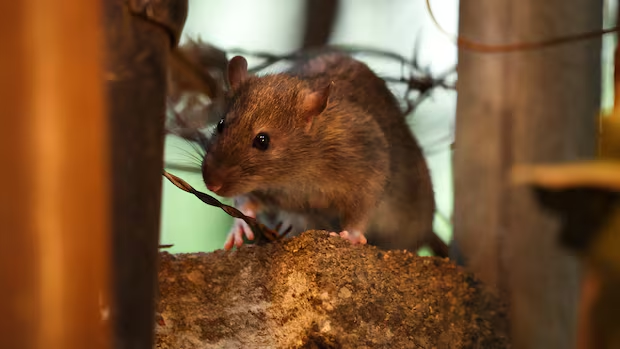
Rats are on the rise in cities around the world, and Chicago is no exception. In Lincoln Park, researchers are watching rodents via hidden cameras to see if they’ll bite into a new kind of bait to test a new approach to controlling growing rat populations caused by climate change and denser cities.
But cities across North America are toying with the idea; Ottawa’s city council considered it and Toronto’s rat response plan mentions contraceptives, but neither applied to Health Canada for an exemption.
New York City has a pilot project underway using two non-hormonal contraceptive products, while Boston abandoned using birth control for rats after a pilot project in its Jamaica Plain neighbourhood. Baltimore and Washington, D.C., have also tested or started using contraception to slow the growth of rat populations.
Does science support rat contraception?
But some scientists are skeptical that these products do the job, at least not in larger cities.
“We need more evidence that these things work,” says Steven Belmain, a professor at the University of Greenwich in London.
While Belmain says there is “good evidence” that some non-hormonal rodent control products can be effective in a laboratory setting, he doesn’t “think there is very good evidence that it works in the field.”
“I fear at the moment people are making money out of it, and they don’t want to question it too carefully because it’s their business,” he says.

In an email, Loretta Mayer, the co-founder of Wisdom Good Works, says the non-profit has “a mission of improvement of our environment by reducing the use of poison for rodents as a result of rigorous scientific testing” unlike the commercial suppliers of other products sold in the U.S.
The particular compounds from the Thunder God Vine in Good Bites have been shown in peer-reviewed research to be effective as a contraceptive in some rodents.
Belmain’s own research has focused on using hormonal contraception for various rodent species, including studies in Tanzania and Zambia, where he says pest outbreaks lead to crop loss and food insecurity.
Corrigan said that even if rat contraception works in theory by reducing the number of rat babies, there are other factors at play.
For example, this type of tool might work best in a contained setting, like a farm dealing with a rodent infestation. In a city like New York, with different populations of rats in parks, alleys, sewers and subways, the rodentologist says it could become a game of Whack-A-Mole.
“How do we get contraceptives to all the different fragmented populations?”
He says a more lasting solution in cities includes securing garbage, which New York City has started to do with a pilot project to keep trash in containers rather than being set on the curb in plastic bags.
After all, rats kick any dirt filled with feces or urine out of their burrows every few weeks “to keep their house clean,” says Corrigan.