
Listen to this article
Estimated 5 minutes
The audio version of this article is generated by AI-based technology. Mispronunciations can occur. We are working with our partners to continually review and improve the results.

Follow Winter Olympic SportsPersonalize Your Feed
Chris Jones reports from Milan.
San Siro either had empty seats, or it was nearly full. Because there were four parades of athletes across northern Italy, Milan’s was thin, or it was intimate. The pleas for peace were either naïve or necessary. The dance routines were mystifying, or they were spectacular.
The opening ceremony for these Winter Olympics was all those things because it was watched by millions, and they saw in it whatever it was they decided to see.
We know we have agency over our actions. We teach our children to make good choices. We can use rockets to deliver warheads into living rooms and blow babies out of their cribs, or we can use them to ferry ourselves to the moon and send satellites deep into space.
The tool doesn’t change. What changes is how we use it, and that’s up to us.
Sometimes we forget that we have the same dominion over how we perceive the actions of others, how we regard people and their capabilities.

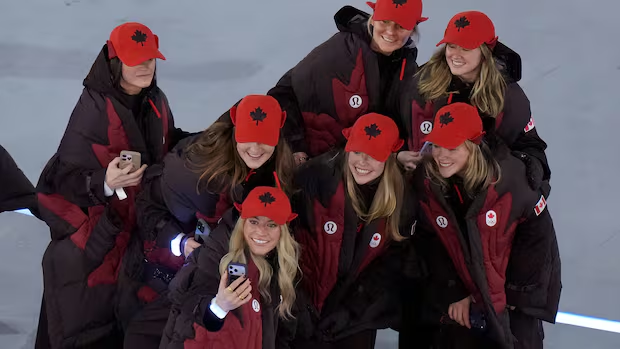
206 Canadian athletes receive a warm welcome at the opening ceremonies at Milano-Cortina 2026 Olympics.
That’s become the more difficult exercise in some ways. Our feelings and judgments can seem increasingly hard-wired. It takes a moment, sometimes, to stop and check that baked-in perception: to take a breath and decide to see things in a more hopeful way, through a different lens than the one we’ve been using.
Before the Olympics began and the lights shined at San Siro on Friday night, Abi Strate, a 24-year-old Canadian ski jumper, talked about the view from the top of her sport.
Strapping on skis and launching yourself off a ramp seems like a mistake to most of us. Why not tie yourself to the hood of a car? Why not climb into a cannon?
Strate sees ski jumping differently. She sees it as one of the most beautiful things we do.
She hasn’t always. Her belief has been tested. She’s crashed badly, suffered horrific injuries, felt “terrified” — her word — at the prospect of pitching herself off the ramp.
But she has worked hard to remember the gifts of her affection, of life itself, rather than its curses.
“I don’t do it because I have to,” she said. “I do it because I want to.”
When everything works, when all the pieces fit, she can feel it in her chest. She’s flying. She’s defying gravity. She’s defying fear. She’s defying cynicism. She’s defying all the sinister forces that keep the rest of us from doing what we want to do, including our best.
“It is majestic,” she said.
By the time the Olympic flame arrived at San Siro to a heart-swelling rendition of “Nessun dorma,” it was hard not to stare into that fire and resolve to reject easier impulses and fight to feel more of what Abi Strate feels instead.
Like a rocket, defiance is neither good nor bad innately. Context matters. Who and what we are defying, and for what reason, dictates whether we’re on the right side or the wrong one.
We can choose to see the worst of us. Sadly, there are times we must. There are people who do bad things for vile reasons. Sometimes we need to let them know that we’re watching, the way the crowd did when the big screens flashed to U.S. Vice-President JD Vance.
There are also people who do stunning things for moving reasons. That’s how they resist, and we can encourage them by cheering them on, the way the loudest ovation of the night, other than Italy’s, was reserved for Ukraine.
“The best of humanity is found in courage, compassion, and kindness,” Kirsty Coventry, the IOC president, said to loud applause.
The heroes are harder to see sometimes, because often they are quiet about their work. We don’t see the nurse helping a family prepare to say goodbye. We don’t see the tow truck driver with a blanket in his cab for his cold passenger. We don’t see the social worker who loves a child who needs love.
Except for every four years, we don’t see the speed skater or luger or ski jumper much, either.
For the next 16 days, we can choose to make a correction. We can choose to see the best in us, in some of the best of us. They are here in Milan, in Livigno, in Cortina, cast in firelight, poised to take their places in starting huts and dressing rooms and at the centre of fresh sheets of ice.
They are ready to remind us of who we can be and what we can do when we decide to see good.