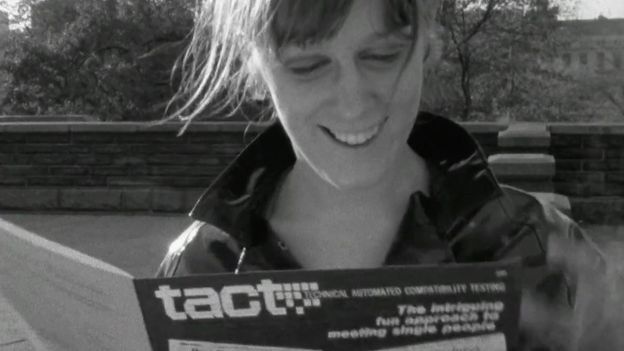
In 1965, computers were still novel. Operation Match had to rent one of the university’s computers for $100 an hour. It quickly proved popular, with thousands of students sending in questionnaires. “You thought the computer was god, and the computer knew all,” co-creator Jeff Tarr told the BBC’s Witness History in 2014. Coincidentally, Tarr’s daughter would go on to marry one of the creators of Match.com, one of the first internet dating sites. The computer provided reassurance: instead of relying on luck when finding your partner, you could be algorithmically matched to your soulmate.
The 1960s were a time of revolution. In the United States, the civil rights and second wave feminism movements were in full flow. Social norms were changing, and technology was developing quickly, too: the arrival of the computer coincided with society’s increased permissiveness. By 1969, computer dating – or at least the idea of it – was mainstream enough to feature as a storyline in Bewitched, the supernatural sitcom. Samantha’s cousin Serena (Elizabeth Montgomery plays both characters) signs up to a computer dating service to find a mortal to marry, only to be matched with a warlock. Even Bob Ross himself found love through Tact – although it wasn’t thanks to the computer. According to a New Yorker article published in the New Yorker in 2011, he eventually married a journalist who interviewed him about the project.
Tact’s thousands of willing customers signalled a shift away from the more formal courtship culture of the first half of the century, and towards more modern attitudes. However, these early computer matchmaking services did not last long. While some people found their perfect partners, the services had a few fatal limitations. Because the services were primarily aimed at middle-class college students and graduates, there was a finite pool of potential matches. Also, the system was inefficient – it could be weeks between sending off your questionnaire and receiving your matches, who you then had to contact by phone or post. The parties organised by Tact were an attempt to get matches to mingle despite the distances that might be involved. Even then, it could still be awkward. The BBC’s report pointed out that even “a public relations man present couldn’t get this party going until after dark,” despite a prize of “a big night out on the town” for the most compatible couple present. Possibly the paper sign hung between two bins did not inspire confidence in the service.
True love and artificial intelligence
The questions left something to be desired, too. As well as all the basic demographic and attraction-related queries, the form’s “dislikes” section had options such as “homosexuals” and “interracial couples”. The questionnaire also played to stereotypes: according to the New Yorker, men were asked to rank women’s hairstyles, whereas women could specify where they could find their ideal man: chopping wood, painting in a studio, or in a garage.
More like this:
• The risqué romcom that defined a genre
• The man behind the puzzle that 99% can’t solve
• Gloria Steinem on the trailblazing Ms Magazine
While the creators were proud of the detail in their “three levels” of compatibility testing, their Cupid’s arrows weren’t always on target. “We matched an older brother with his younger sister,” admitted Ross. “That didn’t work out too well.” He also said they’d had “a number of people who weren’t too satisfied after they’ve gone out”. On Tomorrow’s World, one potential client quizzed Dr Didato on the robustness of the matching computer, after a bad experience with another service. “She specified an age limit and gets some guy 20 years older!”