tl;dr: I tested whether framing an LLM evaluator as
a “safety researcher” changes how it classifies AI failures. After
measuring noise baselines across 25 models, 9 showed frame effects
entirely explained by randomness. Where real effects exist, they operate
through vocabulary flooding, not improved evaluation. Without baseline
correction, I would have come to the opposite conclusion.
How this started
I use AI coding agents as part of my work environment. I started
instrumenting them, logging every tool call, tracking failures,
documenting what went wrong, and built an adversarial review framework
that has now recorded 23,000+ tool invocations across 490+ sessions and
250+ tagged failures. Each failure gets a taxonomy label and a
detected_by field recording who caught it: the
user, an automated check, or the agent itself.
During a routine retrospective, while the agent was analysing past
failures, it committed the same type of failure it was reviewing. That
made me look more carefully at the logs. The same failure type, logged
in different operational contexts (development versus policy work), got
entirely different descriptions: different vocabulary, different
emphasis, different framing of what went wrong. The failure categories
themselves had been shaped by the perspective of whoever was logging
them. The instrument was contaminated by the observer.
That raised a harder question: if the human-defined taxonomy
was observer-shaped, what about model-generated
classifications? When I ask an LLM to evaluate a trace, is the result a
property of the trace or a property of the evaluator?
The experiment
I took 23 traces from the MAST dataset (Multi-Agent System failure
Taxonomy), annotated examples of multi-agent coordination failures with
a clean taxonomy. Each trace is a concrete record of what happened in a
multi-agent system, with human-annotated failure categories.
For each model, I ran every trace through a three-stage evaluation
process:
- Observation: Describe what happened in the trace
(free text) - Interpretation: Analyse whether and what went wrong
(free text) - Classification: Assign a failure category from the
MAST taxonomy
Each model evaluated each trace twice: once with a neutral frame
(“evaluate this trace”) and once as a “safety researcher”, but otherwise
same traces, same taxonomy, same process with only the framing
changed.
The raw difference between the two runs is the “frame effect”, the
percentage of traces where classification changed between frames.
The first results
My initial experiment used three commercial API models: Claude Sonnet
4, Gemini 2.0 Flash, and GPT-4o. The results looked clean:
- Gemini 2.0 Flash: 59% frame effect, entirely
vocabulary-mediated (the safety frame triggered a flood of
safety-related vocabulary) - Claude Sonnet: 40% frame effect, mostly
vocabulary-mediated - GPT-4o: 17.4% frame effect, but with a twist: the
classifications changed without vocabulary changes. The frame
seemed to operate at the decision boundary, not perception.
The GPT-4o finding was especially interesting. It suggested two
distinct mechanisms: vocabulary flooding (Claude/Gemini) versus an
“invisible” decision-boundary effect (GPT-4o). Then I ran baselines.
The baseline that
changed my perception
Here’s what a baseline test looks like: run the exact same evaluation
(same trace, same frame, same prompt) twice at temperature 0.3 (a common
setting for evaluation tasks) and check how often the classification
differs between the two runs. No manipulation, just measuring how much
the model varies on its own.
This is the noise floor. If your “effect” doesn’t exceed it, you’re
measuring randomness. The difference between frame effect and noise
floor is the net signal, measured in percentage points (pp).
The results were not what I expected:
| Claude Sonnet 4 | 35-48% | 30.4% | ~4pp |
| GPT-4o | 17.4% | 30.4% | -13.0pp |
| Gemini 2.5 Flash | 52.2% | 39.1% | 13.1pp |
Note: the pilot used Gemini 2.0 Flash (59% raw frame effect). By the
time I ran baselines, I used Gemini 2.5 Flash, so the baseline
comparison uses 2.5 Flash with a fresh frame measurement (52.2%). The
two versions are not directly comparable and the 2.5 Flash numbers are
added because they have matched baselines. Claude Sonnet 4 was measured
multiple times (initial: 40%, two re-runs on matched 23-trace sets: 35%,
48%). The table shows ~4pp from the canonical re-run (35%); the averaged
figure across all three runs would give ~10pp.
Claude Sonnet 4’s frame effect varied between 35% and 48% across
re-runs, with the canonical measurement giving just 4pp after noise
correction, weak and barely above the floor. The averaged figure across
all three runs (~10pp) is more generous, but the 13pp spread between
identical setups illustrates why no single point estimate should be
trusted. GPT-4o was worse: its frame effect was actually below
its noise floor. The “invisible decision-boundary mechanism” I’d found
was an artefact of insufficient controls. Gemini 2.5 Flash showed
moderate real signal (13pp), but nearly half its raw effect was
noise.
Scaling up
Once I understood the importance of baselines, I expanded to 25
models spanning commercial APIs, open-weight models via DeepInfra, and
local models via Ollama. For each model: frame effect measurement, noise
baseline, and t=0 measurement to decompose the noise further.
Here’s what survived baseline correction:
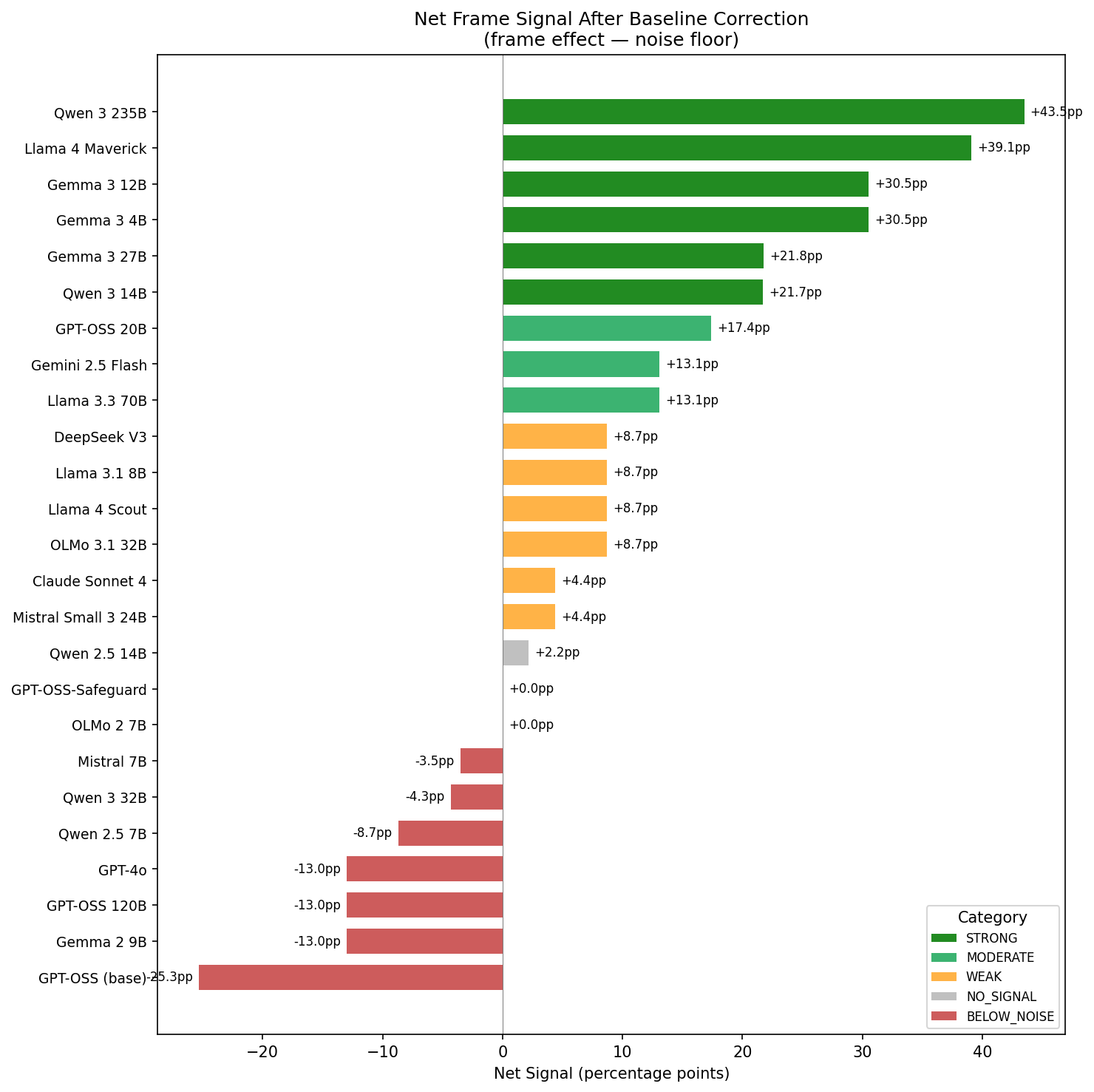 Net
Net
signal = frame effect – noise floor. Green = real effect. Grey/red =
noise.
Out of the 25 models with matched baselines:
- 6 showed strong signal (>20pp net): Qwen 3 235B,
Llama 4 Maverick, Gemma 3 4B, Gemma 3 12B, Gemma 3 27B, Qwen 3 14B - 3 moderate (13-20pp): GPT-OSS 20B, Gemini 2.5
Flash, Llama 3.3 70B - 6 weak (4-13pp): including Claude Sonnet 4,
DeepSeek V3, Llama 3.1 8B, Mistral Small 3 24B - 2 no signal: GPT-OSS-Safeguard, OLMo 2 7B
- 1 borderline (~2pp): Qwen 2.5 14B
- 7 below noise: including GPT-4o, GPT-OSS 120B,
Gemma 2 9B, Mistral 7B, GPT-OSS (base)
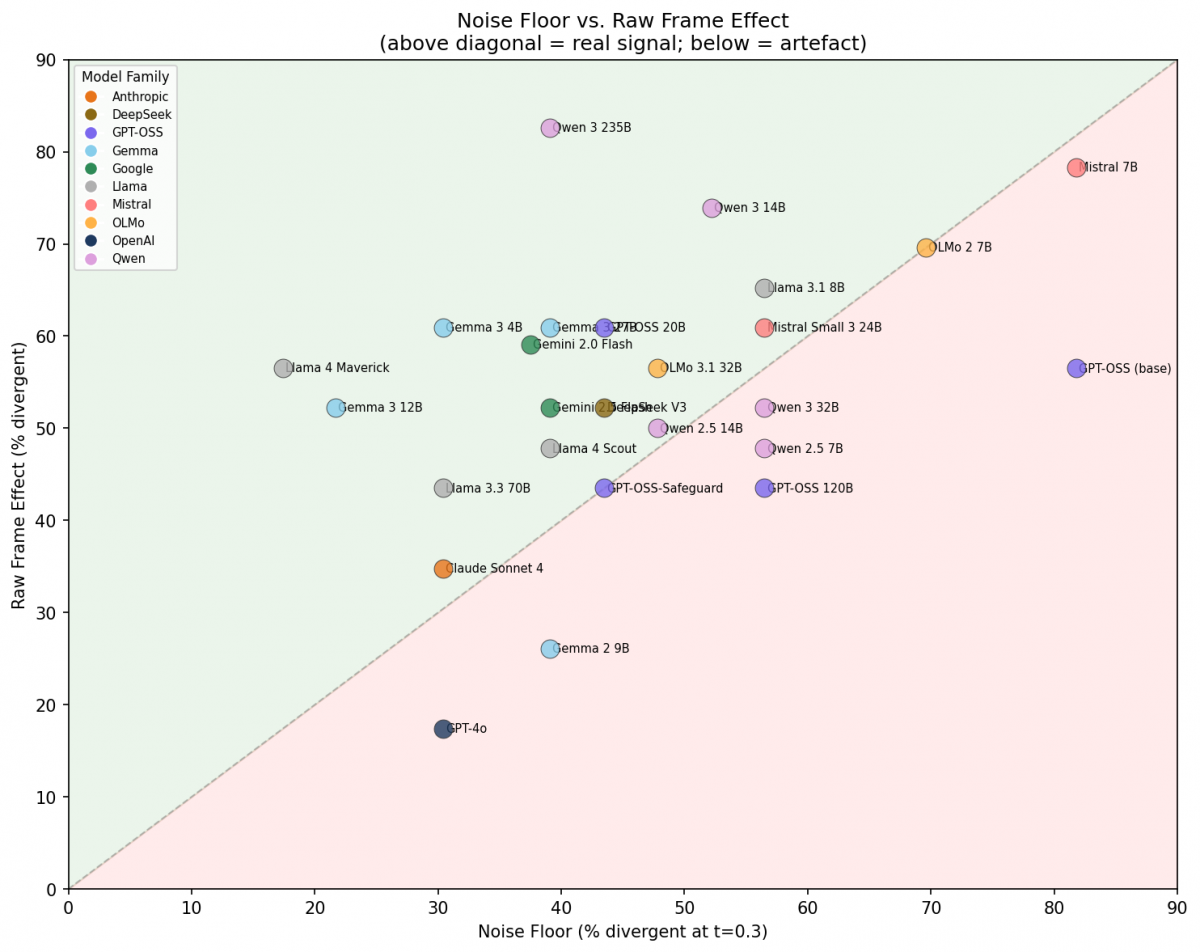
The scatter plot makes the pattern clearer:
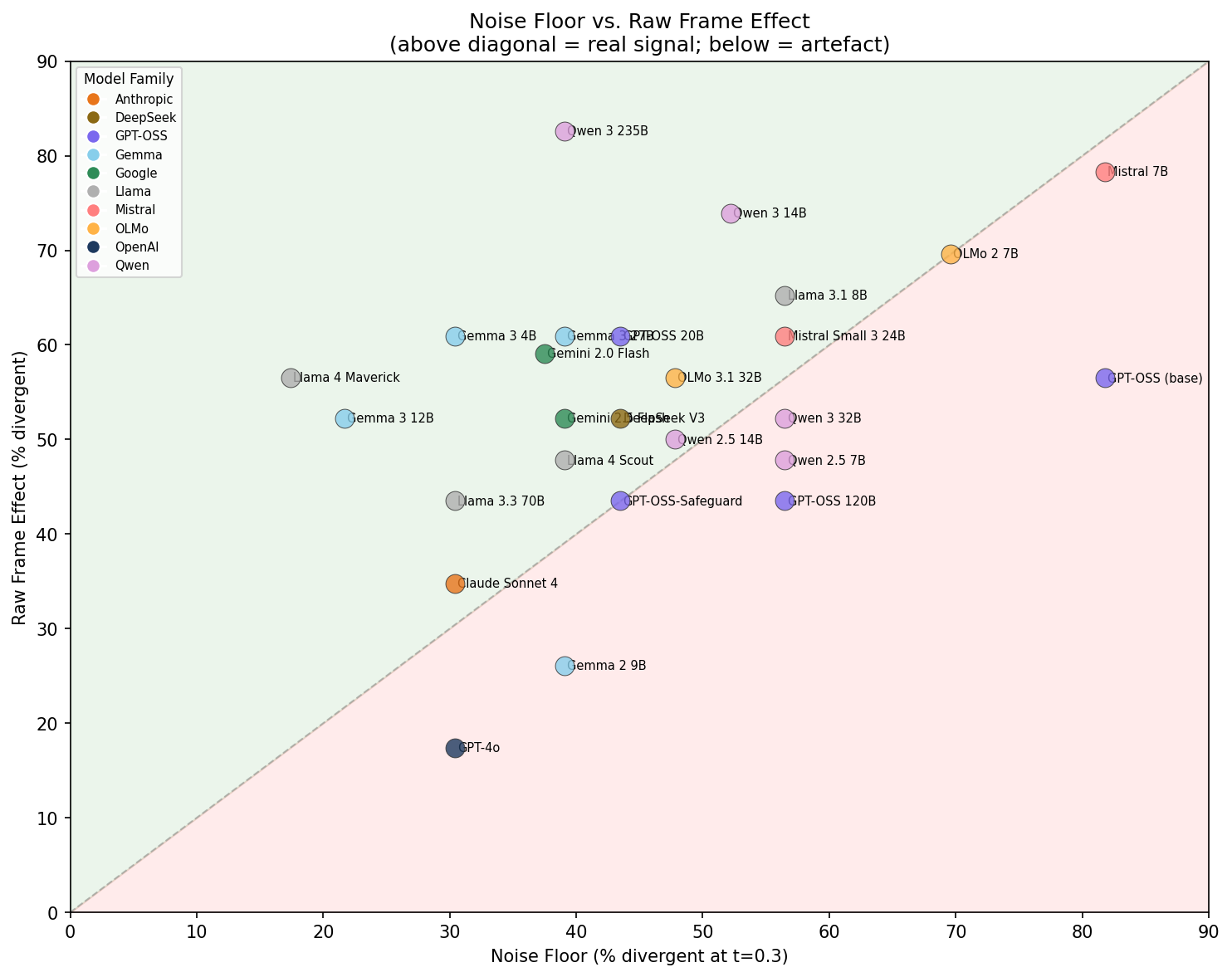 The diagonal is
where frame effect equals noise. Above = real signal. Below =
artefact.
Two things jumped out:
First, the models with genuine frame effects were
not the well-known commercial models. They were mid-tier open-weights,
specifically the Gemma 3 family, Qwen 3 235B, and Llama 4 Maverick.
Claude Sonnet 4 showed weak signal (~4pp), GPT-4o showed none. The
strongest effects came from models most practitioners wouldn’t pick as
evaluators.
Second, raw frame effect numbers are almost
meaningless without baselines. A model showing 60% frame effect and 56%
noise floor looks dramatic until you realise it has 4pp of real signal.
A model showing 82% frame effect with 39% noise has 43pp of real signal
but looks less impressive in raw numbers.
Where does the noise come
from?
I wanted to understand what “noise” actually is, so I added a third
measurement: running evaluations at t=0 twice and checking for
divergence. This decomposes the noise floor into two components:
- Inherent instability (t=0 divergence): The model
gives different answers even with greedy decoding, likely from
floating-point non-determinism, batching effects, or MoE routing - Sampling variance (t=0.3 minus t=0): The additional
divergence introduced by temperature
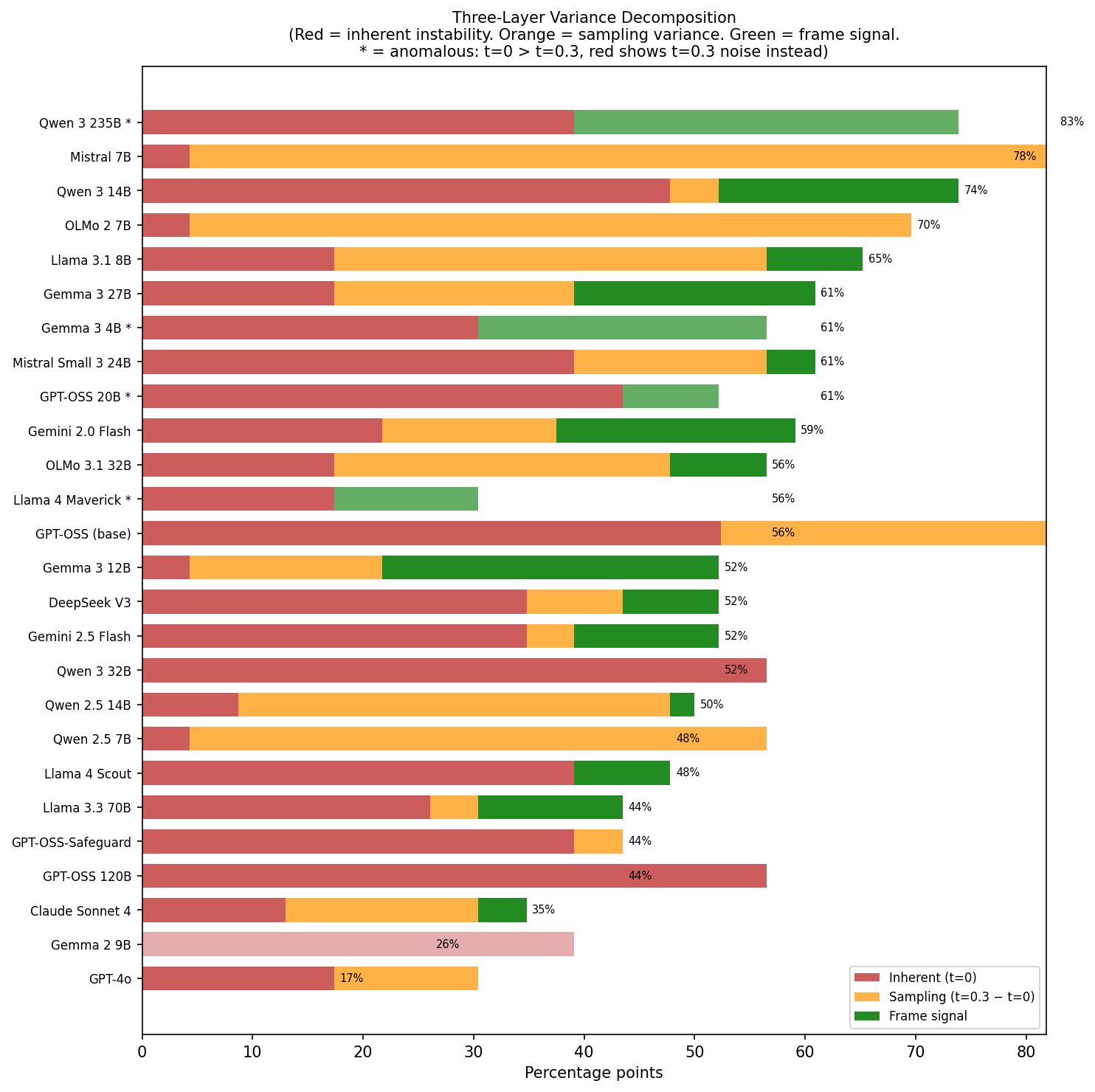 Red = inherent
instability. Orange = sampling variance. Green = frame signal. Hatched =
anomalous cases where t=0 > t=0.3.
This decomposition revealed distinct model archetypes:
Near-deterministic but sampling-sensitive: Gemma 3
12B, Mistral 7B, and Qwen 2.5 7B all have ~4% divergence at t=0, but
diverge wildly at t=0.3 (22-82%). They’re stable models that become
chaotic with even modest temperature. Mistral 7B goes from 4% to 82%,
and its entire 78% “frame effect” is just sampling noise.
Inherently unstable: GPT-OSS 120B and Qwen 3 32B
show 56.5% divergence at both t=0 and t=0.3. Temperature adds
nothing because they’re already maximally unstable at greedy decoding.
Neither shows real frame signal, both fall below noise.
Genuine frame sensitivity: Gemma 3 12B is the
cleanest example: 4.3% at t=0, 21.7% at t=0.3, but 52.2% frame effect.
The frame adds 30.5pp beyond all noise sources.
Anomalies: Four models (Llama 4 Maverick, Qwen 3
235B, GPT-OSS 20B, Gemma 3 4B) showed higher divergence at t=0
than at t=0.3, which shouldn’t happen with standard sampling. For the
two MoE models (Maverick and Qwen 3 235B), this might reflect
non-deterministic expert routing. I don’t have an explanation for this
and would be interested to hear if others have seen similar
patterns.
When
classification changes, does the language change too?
For the original three models and the broader set, I tracked whether
classification changes co-occurred with shifts in safety-related
vocabulary (counting safety-specific terms in the model’s output).
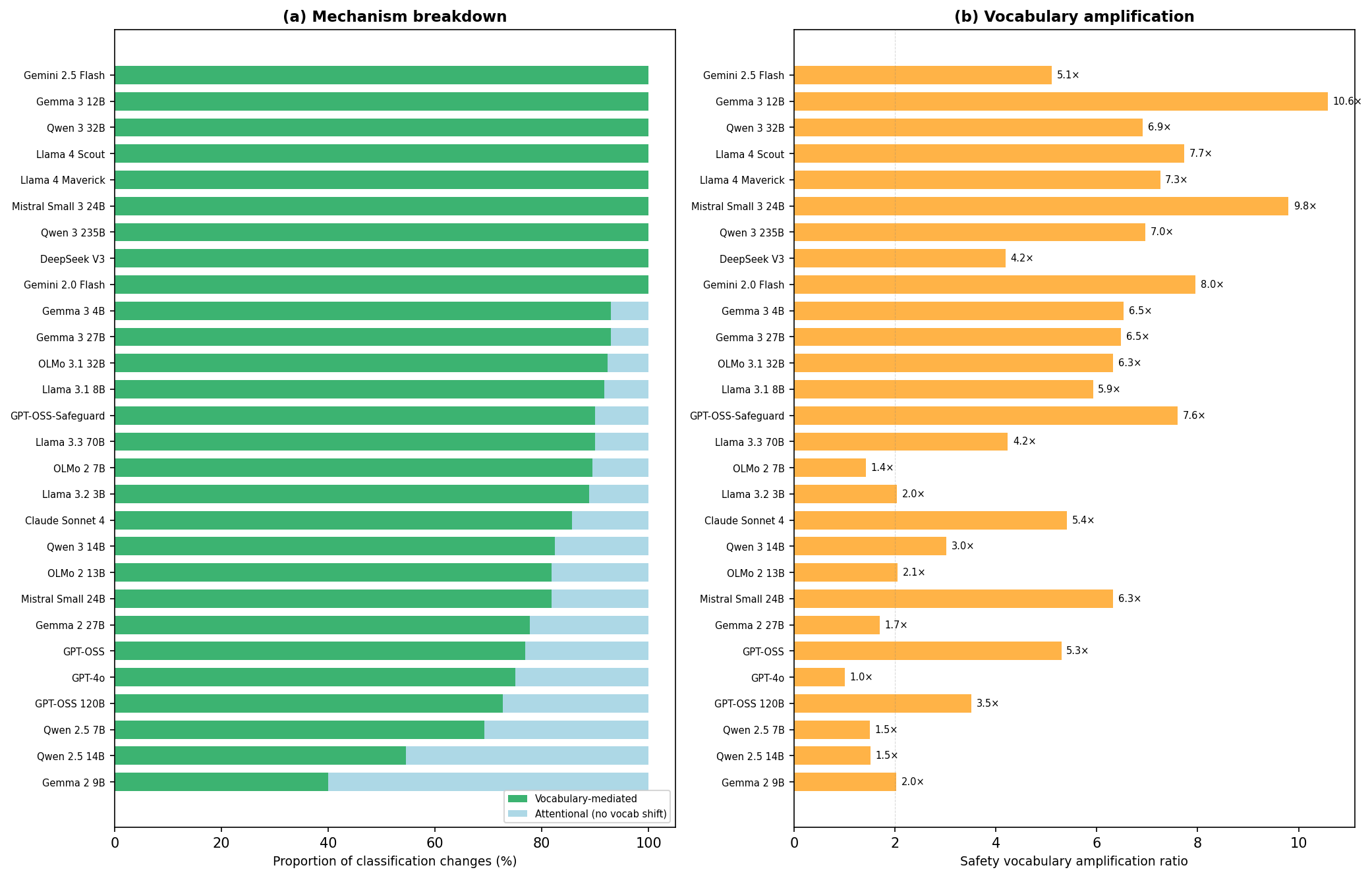 (a) Proportion of
classification changes that co-occur with vocabulary shifts
vs. “attentional” changes (classification changes without vocabulary
change). (b) Average safety vocabulary amplification ratio. Lexical
analysis was run on all models with frame effect data, including pilot
models not shown in Figures 1-3.
Models with genuine frame effects (top of chart) show near-100%
vocabulary-mediated patterns. When the safety frame changes a
classification, it does so by flooding the output with safety-related
vocabulary. Gemma 3 12B shows a 10.6x vocabulary amplification ratio,
meaning the safety-framed output contains roughly 10 times more
safety-specific terms than the neutral output for the same trace.
What does this look like in practice? Across all 25 models, the word
“safety” appeared once in the combined neutral-frame output and 1,507
times under the safety researcher frame. Nine words never appeared at
all under neutral framing but materialised under safety framing:
adversarial, vulnerability, dangerous,
attack, harm, exploit, mitigation,
ethics, danger. These are ghost vocabulary: they don’t
exist in the model’s analysis until you tell it what kind of researcher
it is.
Different model families leave distinctive vocabulary fingerprints:
Mistral models consistently reach for “security” over “safety”, the
Gemma 2 family prefers the hedge word “potential” even under safety
framing, and “adversarial” is almost exclusively a Gemma 2 9B word. The
instrument doesn’t just shape the measurement, it signs it.
The displacement is as telling as the amplification. The word
“review” decreases from 299 to 238 occurrences, and “possibly”
drops by more than half. The models don’t add safety thinking on top of
their analysis. They replace analytical vocabulary with safety
vocabulary. Five words from the safety lexicon were never used by any
model in either frame: threat, caution,
guardrail, regulation, governance.
“Guardrail” appears to be a word safety researchers use about models,
not one models use about failures.
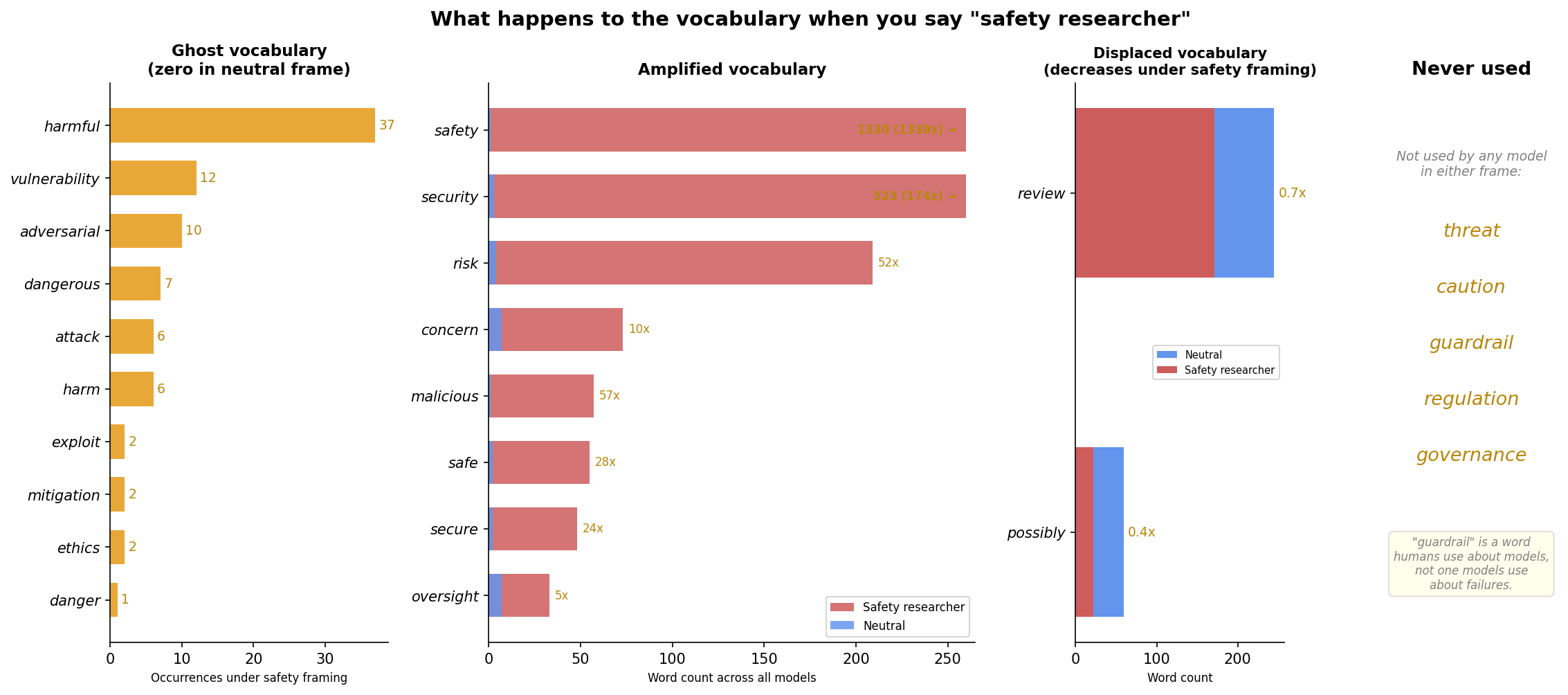 Left: word counts
under neutral (blue) vs. safety researcher (red) framing across all 25
models. Ghost vocabulary (orange) has zero baseline occurrences. Right:
words that appear only under safety framing and words never used in
either frame.
Models at the bottom (Qwen 2.5 14B and Mistral 7B) show high
proportions of “attentional” classification changes (no vocabulary
shift). But these models have no real frame signal after baseline
correction. The “attentional mechanism” appears to be what noise looks
like when you decompose it: random classification changes naturally
won’t correlate with vocabulary changes, because they’re random.
This was a significant update for me. In the three-model pilot,
GPT-4o’s attentional pattern looked like a genuinely different
mechanism. At scale, with baselines, it looks like an artefact.
What this connects to
Zheng et al. (2023)
documented position bias, verbosity bias, and self-enhancement bias in
LLM-as-a-judge setups. This work adds frame sensitivity and noise
baselines to that picture.
More directly relevant: while writing this up, I found concurrent
work by Lim, Kim & Whang (2026), DeFrame: Debiasing Large
Language Models Against Framing Effects, which examines framing
effects on LLM fairness evaluations. They test role assignment (“-ROLE”:
assigning the model the role of an unbiased person) as one of several
debiasing strategies and find it doesn’t robustly reduce bias. Worse, it
can increase framing disparity, making the model’s evaluations
less consistent across alternative wordings.
Their finding and mine arrive at the same conclusion from different
directions. They show role assignment fails to fix bias in social
fairness evaluations. I show role assignment fails to improve failure
detection in safety evaluations. In both cases, the role changes surface
behaviour without changing the underlying judgement.
What my work may add is a different kind of baseline. There are two
things you can mean by “baseline” in this context. A method
baseline asks: does my intervention beat doing nothing? DeFrame
uses these, comparing debiasing strategies against unmodified prompts. A
noise baseline asks: how much does the output vary when I
change nothing at all, just the same prompt run twice? That’s what I
measure. I haven’t found evidence that DeFrame separates framing
disparity from stochastic variation, though I may have missed it in
their methodology. Without that second kind of baseline, you can’t tell
whether an observed effect is signal or stochastic variation. In my
data, 9 of 25 models showed frame effects that were entirely noise.
The terminology matters here: “role assignment” is the prompt
engineering technique (telling the model “you are a safety researcher”).
“Frame effect” is the measured outcome (the resulting shift in
classification). The role is the intervention and the frame effect is
what you measure. DeFrame’s work and mine both suggest the intervention
doesn’t produce the effect practitioners expect.
What I think this means
For anyone running LLM-as-a-judge evaluations: If
you’re not measuring your noise floor, you don’t know how much of what
your evaluation pipeline reports is signal versus stochastic variation.
The procedure is simple: run the same evaluation twice under identical
conditions. If your effect doesn’t exceed that baseline, you may not be
measuring what you think you’re measuring. In this study, 9 of 25 models
would have been false positives without this step.
For AI safety evaluation: The “safety researcher”
frame doesn’t reliably increase detection of multi-agent coordination
failures, the one failure type I tested intensively. In the models where
it does have an effect, it operates by flooding the output with
safety vocabulary, which changes classifications but doesn’t obviously
improve the quality of the underlying analysis. Whether the frame
changes what the model attends to, or only what vocabulary it reaches
for, is something I can’t distinguish from these measurements.
For cross-model comparison: Model rankings are
unstable without baselines. A model with a high raw frame effect might
just be noisy. A model with a low raw effect might be genuinely stable.
The naive ranking and the baseline-corrected ranking can be completely
different, and in my data, they were.
As a broader observation: These results are
consistent with the idea that AI failure classification is partly
observer-dependent. What an evaluator reports depends on how it’s
framed, which model you use, what temperature you set, and how much of
the output is stochastic variation. I can’t establish that claim from
this experiment alone, but the pattern is suggestive: across 25 models,
the instrument consistently shapes the measurement. If that holds up
under replication, it has implications for how I think about
standardised evaluation.
This is what my failure logs were hinting at. The same failure,
logged in a development context and a policy context, got different
descriptions and different categories, not because the failure was
different, but because the observer was in a different mode. When I
moved from my own logs to controlled experiments with LLM evaluators, a
similar pattern appeared at scale: the frame shapes the classification.
The detected_by field I built to track who catches failures
may tell us as much about the observation as about the failure itself.
If we want reliable behavioural assessment of AI systems, we probably
need to understand and measure the instrument, not just the subject.
Limitations
These are real and I want to be explicit about them:
- n=23 traces. This is small. With 23 traces, only
Qwen 3 235B would survive a formal significance test. The pattern across
25 models matters more than any single model’s numbers. The precise
effect sizes will shift with more data. I plan to expand to ~40 traces
for models with the strongest signal (which a power analysis suggests is
enough to confirm 30pp+ effects) and to a larger subset of the MAST
dataset more broadly. - Single taxonomy. All traces are multi-agent
coordination failures from MAST. Frame effects might behave differently
for tool misuse, jailbreak attempts, or other failure types. I also plan
to test with ToolEmu traces next. - Binary frame comparison. I tested neutral
vs. safety researcher. There are many possible frames and I tested one
intensively. The effect size and mechanism might differ for other
frames. - Model range. I tested mid-range commercial models
(Claude Sonnet 4, GPT-4o), not the top of each provider’s lineup (Opus
4.6, GPT-5.2, Gemini 3 Pro). Models at the actual capability frontier
may behave differently. - Provider variation. Some models were tested via
different providers (DeepInfra, Ollama, Together). Provider
infrastructure might contribute to the t=0 anomalies. The Llama 4 Scout
cross-provider comparison (DeepInfra: 39.1% noise, Together: 34.8%)
suggests this is a real but modest factor. - Mechanism claims are correlational.
“Vocabulary-mediated” means classification changes co-occur with
vocabulary shifts. I can’t confirm the causal direction: the vocabulary
shift might cause the classification change, or both might be effects of
a shared upstream process. - Claude Sonnet 4 instability. Claude’s frame effect
varied across runs: 40% on the initial 20-trace set, 35% and 48% on two
matched 23-trace re-runs. The 13pp spread between identical setups is
consistent with the noise floor and illustrates why I don’t put much
weight on any single model’s number.
What I’d like to know
I’m not sure how much of this is already well-established in
literatures I haven’t found. DeFrame (cited above) addresses some of the
framing questions, but from a different angle and domain. If you know of
prior work specifically measuring noise baselines for LLM-as-a-judge
evaluations, or work that separates framing effects from stochastic
variation, I’d appreciate pointers.
Specific things I’m uncertain about:
- Is the t=0 anomaly (higher divergence at greedy than at t=0.3) a
known property of MoE models, or something others have encountered? - Are there established methods for computing confidence intervals on
frame effects with this kind of nested design (traces x frames x
runs)? - DeFrame compares frame sensitivity across models for fairness
evaluations. Has anyone done something similar for safety or failure
evaluations specifically? - Within the GPT-OSS family, only the 20B variant shows genuine frame
signal (+17pp, moderate), while the base model (-25pp), 120B (-13pp),
and safety-tuned Safeguard (0pp) all fall at or below noise. The base
model is extremely noisy (82% noise floor), so its 57% raw frame effect
is meaningless. The Safeguard variant’s 44% raw effect exactly matches
its noise floor. Why does the 20B show real signal when neither the
smaller base, the larger 120B, nor the safety-tuned variant do?
The data and experiment configurations are available at lab.fukami.eu/data/LLMAAJ.
If you want to replicate or extend this, I’d welcome it.
References
Zheng, L., Chiang, W.-L., Sheng, Y., et al. (2023). Judging
LLM-as-a-Judge with MT-Bench and Chatbot Arena.
arXiv:2306.05685.
Lim, K., Kim, S., & Whang, S. E. (2026). DeFrame: Debiasing Large
Language Models Against Framing Effects. arXiv:2602.04306.
This work grew out of instrumenting AI coding agents in my day
job at CrabNebula. If you have
pointers to related work or want to discuss, find me on Mastodon.