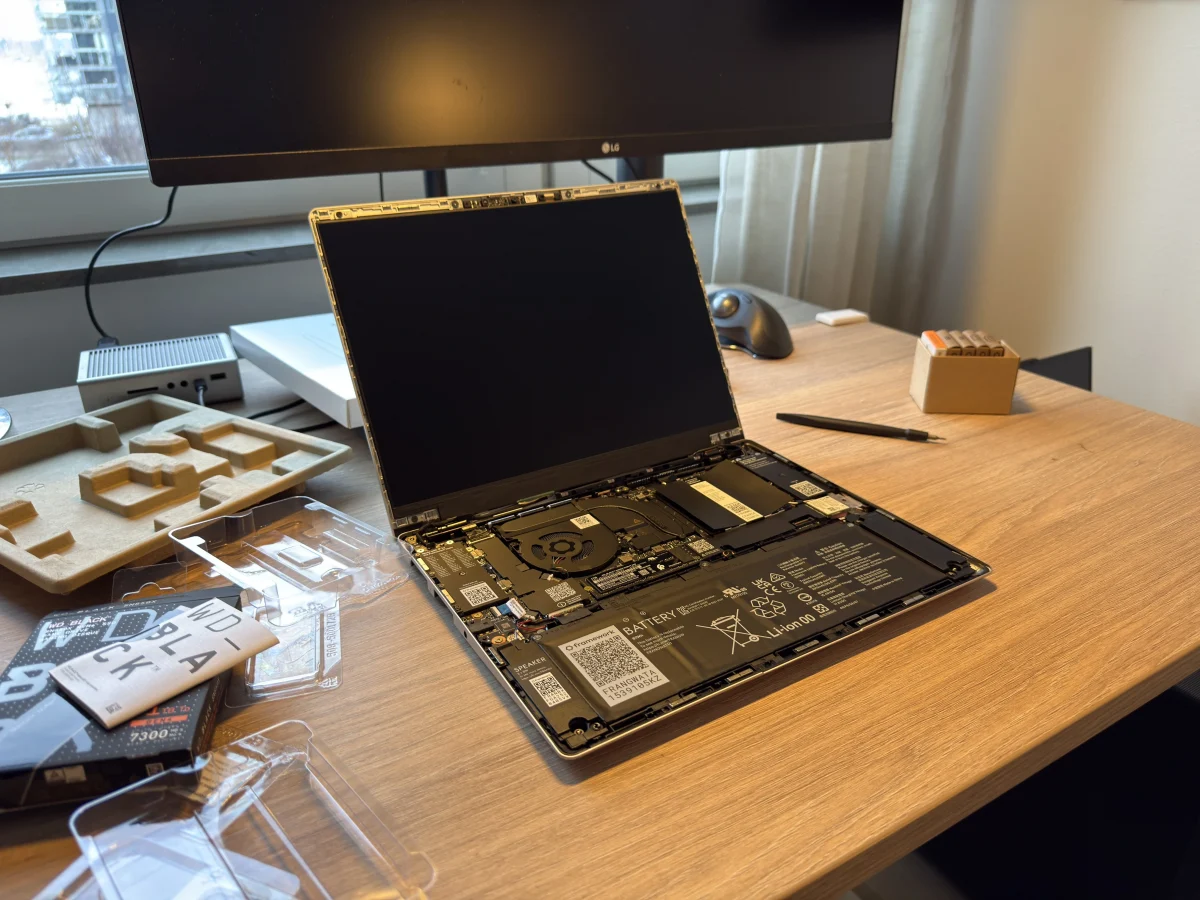
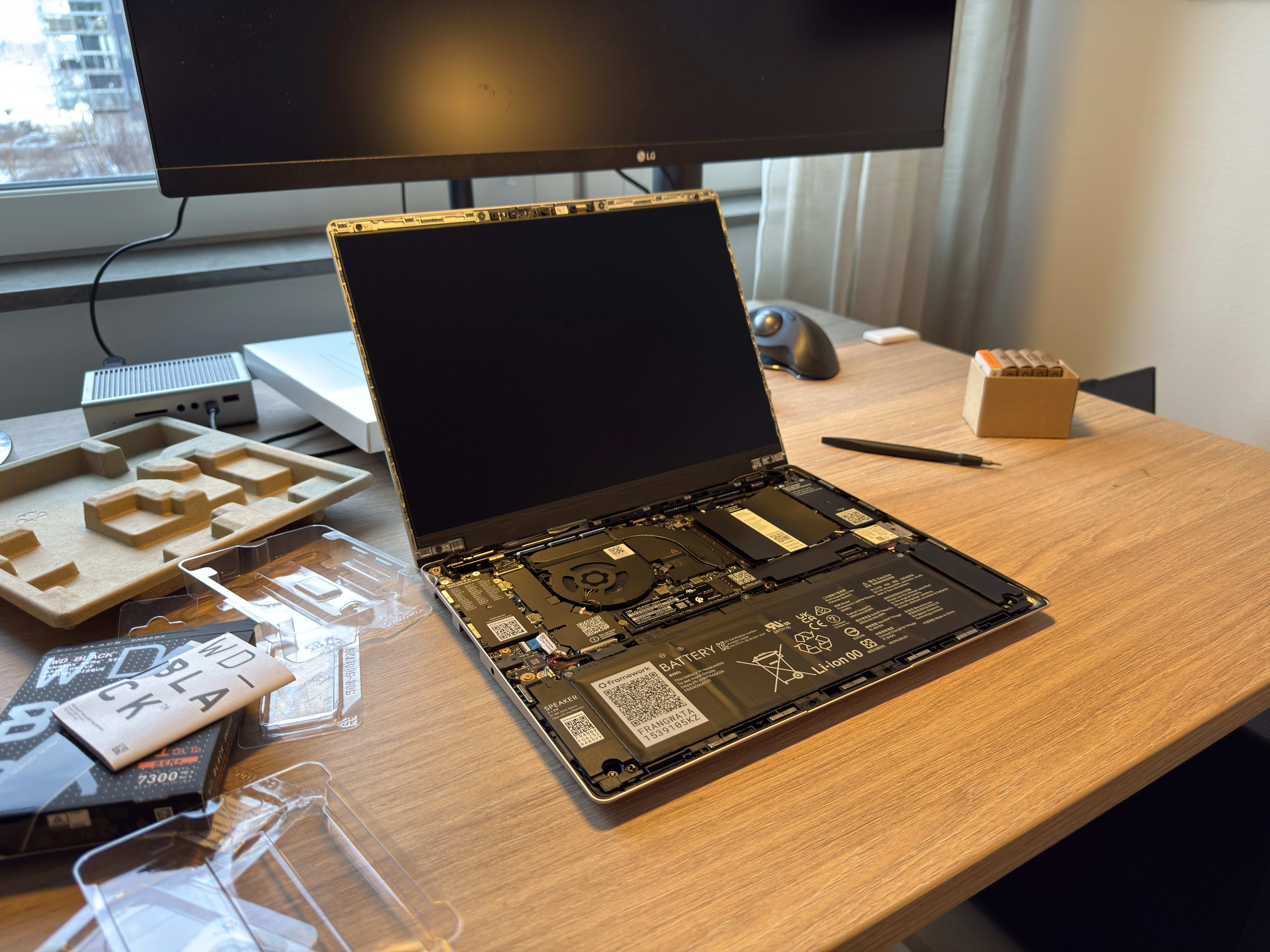
At Fosdem, I saw a lot of Framework laptops. I had been keeping an eye on the
brand for a while, and even ordered a laptop at one point, only to return it
before receiving it. This time though, I pulled the trigger and didn’t get cold
feet. Now it’s here, and I thought I’d give my initial thoughts after using it
for a few days.
Configuration
The ordering process was easy. You simply follow their wizard on their website.
You decide whether you want the AMD CPU or the Intel one, and then you specify
each part of the laptop. Very similar to ordering a Macbook. I opted for the
following specification:
- CPU: AMD Ryzen™ AI 9 HX 370
- Memory: DDR5-5600 – 32GB (2 x 16GB)
- Storage: WD_BLACK™ SN850X NVMe™ – M.2 2280 – 1TB
- Laptop Bezel: Framework Laptop 13 Bezel – Black
- Keyboard: Input Cover Kit (2nd Gen) – Blank ISO
- Power Adapter: Power Adapter – 60W – EU
- 2 USB-C Expansion Card – Aluminum
- 1 USB-A Expansion Card
- 1 HDMI (3rd Gen) Expansion Card
- 1 SD Expansion Card
- Display: 2.8K (120hz)
It doesn’t really say on their website unless you really search for it, but the
display on the latest Framework 13 does have 120hz refresh rate.
A note on the blank keyboard
Don’t get it. I thought it would look cool, and since I never look at the
keyboard while typing anyway, I thought I wouldn’t need the legends. The
problem is that I can’t remember the location of the function/media keys. This
sucks. I should’ve gone with the option with legends. Now I have to guess where
the volume buttons and screen brightness buttons are, and I often don’t,
leading to me pushing the wrong buttons and activating some other
functionality, like airplane mode…
Delivery & unboxing
Framework ships with Fedex, which I haven’t had great experience with in the
past. However, this time it worked out great. I could see exactly where the
parcel was, and it was delivered right to our apartment at the promised time.
No issues here, and nothing was damaged upon retrieval.
The packaging was really secure, which was good, but the unboxing experience
was nowhere close to the one you get when ordering a Macbook, which feels a bit
off, since they’re priced basically the same. I feel like they could improve
here, to make the initial experience of Framework stronger. Now it felt a bit
janky.
Building the laptop
Framework offers 2 different ways of buying a laptop from them. Either you go
with the pre-built option, which comes with Windows 11. Or, if you’d rather
bring your own operating system, like Linux, you can opt for the DIY option
like I did. This means that they won’t ship a prebuilt laptop to you. Instead
they will ship the parts, and you build it yourself.
This is not quite the case though. In some ways it feels like they just didn’t
put the pieces in so you can get some satisfaction by clicking the RAM and SSD
into place. I don’t get this. Why not just ship a prebuilt option without an
operating system? Building the laptop is very easy, but some of the pieces can
be a bit tricky if you’ve got big hands like me. Just be careful and follow
their guide, and you should be good.
Quality
The overall quality of the laptop feels good. It’s a mix of aluminum and
plastic, but feels solid. The only real complaint I have here is the quality of
the trackpad. It’s really bad. It’s basically unusable unless you enable
tap-to-click. I’m not sure if something’s wrong on my model, but it takes a
great deal of force to actuate the trackpad. And, it’s not even possible on the
top of the trackpad, only on the bottom third. This doesn’t feel great.
Especially coming from a Macbook, you’ll be comparing the parts of course, and
this sticks out like a sore thumb.
Installing an operating system
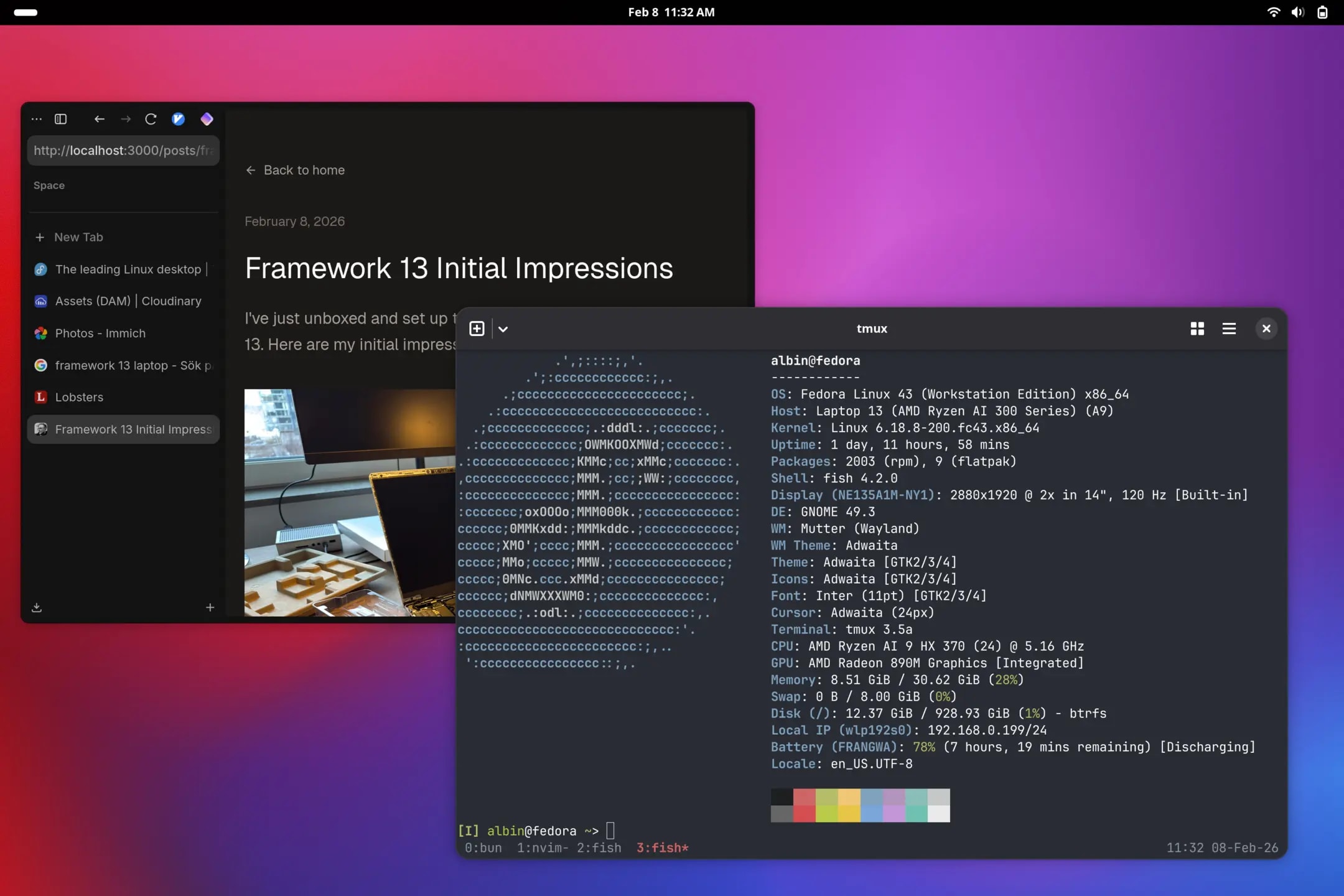
Alright, let’s get to the software part. I opted for Fedora 43, since that’s
what they seem to recommend, and it seems like they’ve collaborated quite a lot
with the Fedora team to get the software-hardware integration good.
I’ve been exploring many Linux distributions recently, and Arch has been my
favorite by far. Fedora is good, but I don’t like their package manager. Pacman
is way better. But I thought, let’s go with what they recommend, and have
official guides on. And, as expected, it went without many issues at all. I
simply downloaded a Fedora 43 Workstation (Gnome) ISO, flashed it to a USB with
Balena Etcher (from my Macbook). Then I plugged it into the Framework. Make
sure you either have a USB-C thumb drive, or order a USB-A adapter for your
Framework. Otherwise, you’ll run into issues here.
I booted the laptop. Nothing happened. Hmm… I think I’m used to Macbooks
coming pre-charged out of the box. This wasn’t the case with the Framework
though. So, I plugged in the power adapter (which I accidentally ordered 2 of),
and booted. This time it worked, and since I didn’t have Windows installed
already, it booted straight into the Fedora installation experience.
After installing Fedora, I began setting up my laptop. Starting with the
fingerprint reader. This has caused me a great deal of headache before, on
other distributions and laptops. But, after a few attempts, it registered, and
now I’m set up with fingerprint authentication, which works flawlessly.
The display
After using the laptop for a few days, I think my favorite part by far is the
display. The resolution is great and the 120hz refresh rate makes the OS feel
buttery smooth. I’m using fractional scaling at an even 200%, and using Gnome
tweaks, I set the fonts’ “Scaling Factor” to 0.8. This came from the Framework
Fedora post-installation guide. This feels more what I’m used to on macOS. It
is worth noting though that this doesn’t work in all applications, and this is
a core problem on Linux I think. Unless you stick to applications which use GTK
(I think?) this won’t take effect. This is what I don’t like with linux. If you
install 5 different apps, they might have 5 different window control icons,
font rendering and sizes. Not great. But hey.
Summary
This feels like a great laptop, and I love the fact that I’ll be able to
incrementally upgrade it in the future, when the Framework team releases new
parts. The company’s philosophy aligns with my values, and I think I’ll be
using the laptop for a long time. I can only recommend others to give it a
shot!