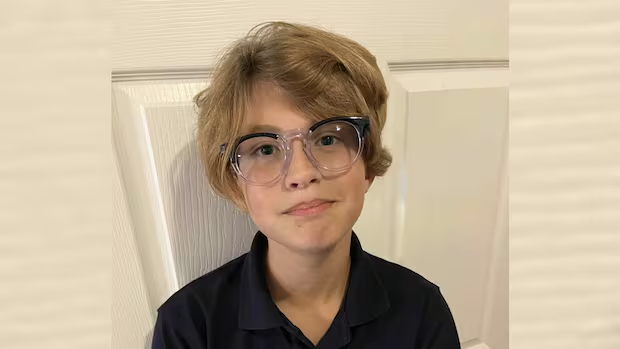
A man who lives in a Regina apartment building says the carbon monoxide detector in his unit sounded just hours before another tenant, an 11-year-old boy, died in the building.
The man said he contacted maintenance staff in the early afternoon as the alarm beeped and was told to “open my window and get a fan.”
CBC is not naming the man because he is afraid of facing repercussions for speaking out.
The man said a maintenance worker spent some time trying to figure out what was causing the detector to go off in the Metro 1827 apartment building on Dec. 19.
“He instructed me to open the windows … his theory was that someone smoking outside may have caused the detector to go off,” the man said.
Henry Losco, 11, died from carbon monoxide poisoning hours later.
His dad, Sergio Losco, says Henry was feeling sick earlier that day and went to lie down in his bed in their family’s apartment unit on the fourth floor.
He never woke up.

Henry Losco’s parents, Marina Hills and Sergio Losco, sit down with CBC News to talk about the day their son died from carbon monoxide poisoning inside their apartment at 1827 Albert Street in Regina, Sask.
Carbon monoxide, or CO, is known as a “silent killer.” It’s a gas with no smell, no taste and no colour — impossible to recognize without a detector.
The man whose CO detector went off said he regrets not pushing maintenance staff to do more. He said he believes Henry’s death could have been prevented.
He’s not alone in questioning what happened.
Now some of the building’s tenants are demanding answers and accountability.
The building’s owner declined CBC’s request for an interview through his lawyer and did not respond to CBC’s questions. The building’s maintenance man did not respond to CBC’s questions or request for an interview.
The tragedy hits hard for Marina Hills, Henry’s mom.
“I’m not the same person I was before my son died,” she said.
“Not having him a part of this world anymore, I don’t think I’m ever going to be able to accept, ever, because he was a child and children aren’t supposed to die.”
‘A preventable thing’
Heather Njaa, a health-care worker, was playing video games in her apartment suite to unwind minutes before 8 p.m. on the day Henry died and jumped into action as soon as she realized something was happening.
“I heard screaming,” Njaa said. “When you hear screams like that … you can’t not do anything.”
Njaa ran out to the hallway and saw Hills, her neighbour, four doors down, trying to revive Henry, who was ashen and stiff. She called 911 and let Hills speak with police while she took over CPR.
“I saw Marina go back in [to her apartment] and pull her husband out and all I could smell was vomit,” she said.
She kept trying to help until paramedics arrived and took over. Njaa learned days later that Henry didn’t make it.
“It’s just so horrible that that happened,” she told CBC. “It’s just something that was preventable, because when I was running throughout the entire building I heard no alarm … nothing going off.”
WATCH | Neighbour describes trying to save boy who died from carbon monoxide:
She demanded answers from the building’s management.
Emails obtained by CBC News show Njaa contacted Metro 1827’s management team on multiple occasions, asking why many of the building’s CO detectors never went off on Dec. 19 and what has been done to prevent another tragedy.
“I strongly suggest the building install monoxide detectors in every apartment,” she wrote.
The management team responded nearly three weeks after her first email, reassuring her that CO detectors are placed in “needy places” in the building.
They also added that the owner was “willing” to have a conversation with her.
On Jan. 27, she confronted Mark Frentz, owner of the Albert Street building, and recorded their conversation.
In the recording, Frentz said questions remain about what happened the night Henry died.
He said the building had two new boilers installed in the summer and they were commissioned on Dec. 18 — the day before Henry’s death.
Boilers checked day before death
“So TSASK [Technical Safety Authority of Saskatchewan] … they check to make sure the boilers are working properly, everything is fine. They signed off on it. They said everything is good,” Frentz said.
TSASK is responsible for testing and verifying that boiler systems are operating efficiently, safely and up to manufacturer specifications.
In an email to CBC News, TSASK confirmed it was at the Metro 1827 building on Dec. 18. The authority said the two boilers were properly installed and were operating “in accordance with the manufacturer’s specifications.”
It said the internal systems for both boilers were functioning properly that day.
On Jan. 30, Regina fire chief Layne Jackson said the CO leak was caused by a “critical failure in a boiler” and that a multi-agency investigation, which includes TSASK, is ongoing.

Fire chief Layne Jackson provides an update on the investigation into the fatal carbon monoxide incident that happened in Regina, Sask., on Dec. 19. An 11-year-old boy died and his dad was taken to hospital in critical condition after they were poisoned in their apartment building.
The day after the boilers were commissioned, “one of the boilers had an internal explosion,” Frentz told Njaa.
“So what that did was it blew out there. There’s a venting stack that goes out up into the roof. It blew it apart,” he said in the recording.
“So there was carbon monoxide that got into the building.”
Frentz said he was called around 8 p.m. and arrived at the building as everyone was being evacuated.
I never want to hear of a family, a mother, losing her child the way I did.–
In the recording, he told Njaa that he had asked the fire department what else he could do to ensure the building had the proper safety precautions in place.
“I’ve talked to the fire inspector since then and said, ‘Listen there, there’s code and then there’s like, what can we do to bring extra protection to people?’ And I’ve been asking him that question,” he said.
“He’s, he’s hinted at things, but I said, ‘Like, should we put a carbon monoxide detector in every room?’ He’s like, ‘Mark, it’s, it’s not needed.’”
A carbon monoxide detector was installed in Njaa’s apartment later that day.

The fire chief said on Jan. 30 that he couldn’t provide details on whether the fire department advised extra safety measures in the building after the fatal incident; he also couldn’t say whether the building had been “up to code.”
CBC News requested an interview with Frentz and also shared a detailed question list with him. He declined the interview.
Frentz’s lawyer, Ian McKay, said due to multiple ongoing investigations, he would not provide comment or additional details at this point.
“The loss of a young child is heartbreaking and his heart goes out to the loved ones of Henry Losco. [Frentz] is also wishing Henry’s father a speedy recovery,” McKay wrote.
Tenant buys her own detectors
Susan Wasylyshyn, who lives on the third floor, said she isn’t taking any chances after the tragedy. She personally bought three carbon monoxide detectors, which are now placed throughout her home.
She was so sick on the day of the leak that she was seeing stars and had gaps in her memory, she said. Her cats were also sick, and a vet later confirmed they were suffering the effects of CO poisoning.

Wasylyshyn said the CO detector that was in her suite on Dec. 19 never went off. She said building maintenance did not come to check the alarm in her unit before or after the fatal incident.
All apartment buildings in Saskatchewan are required to have CO detectors, but they don’t have to be in every unit.
The minimum requirement and location of CO alarms in apartment buildings:

A bright boy lost
Hills said she hasn’t been able to return to her unit in the building since her son died there. Sitting in her new apartment, she pulled his belongings close to her and pored over his jerseys and soccer medals.
Her boy dreamed of playing soccer in the Olympics one day.
“This is where I come to miss him,” Hills said.
Henry was a kind, empathetic person who gave his love freely. He was a bright mind and always up for a new adventure, she said.
She remembers when she asked him about the idea of moving to Saskatchewan from Newfoundland.
“He wanted another adventure and we did this. This is what we did with him,” Hills said.
She never thought this would be their last adventure together. That December night will never leave her, she said.

And it still haunts Henry’s father, too.
On the day of the CO leak, Sergio spent the day at the family’s apartment with his son. They had only lived there for 18 days.
He remembers Henry saying he felt light-headed and needed to lie down. About 10 minutes later, he went to check on his son.
Henry seemed to be asleep and his cheeks were rosy, he said.
Sergio decided to get him some Tylenol. The last thing he remembers is standing near the kitchen sink, preparing the medicine for Henry. When he regained consciousness, he was in the hospital.
Sergio remembers asking for Henry as he fell in and out of consciousness. Eventually, Hills told him their son didn’t make it.
“It just broke me,” Sergio said, wiping tears from his eyes.

Henry’s parents said they’re speaking out now so another family doesn’t have to go through the same tragedy.
“I never want to hear of a family, a mother, losing her child the way I did,” Hills said.