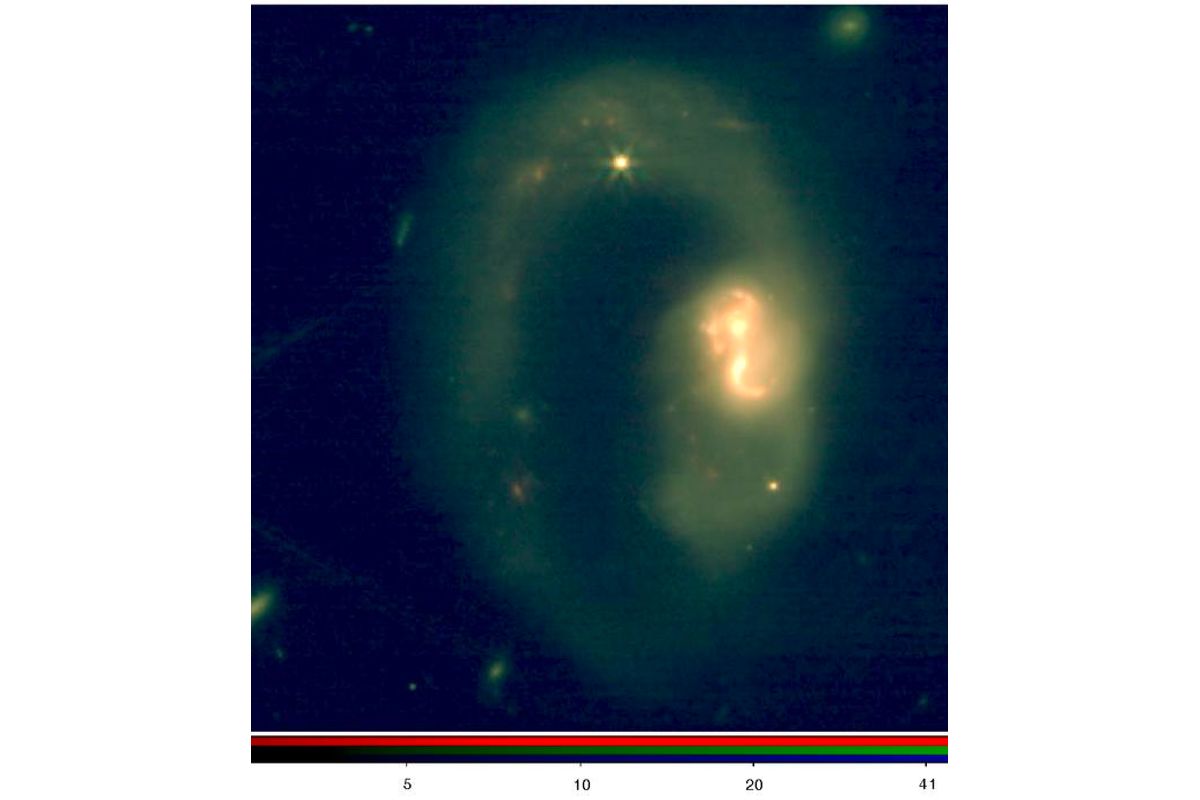
When the James Webb Space Telescope peered into the dust-shrouded core of IRAS 07251–0248, it found far more small organic molecules than models predicted. The observations revealed a dense mix of hydrocarbons — including the first confirmed detection beyond the Milky Way of the methyl radical, a highly reactive carbon-based molecule — inside a galactic nucleus long hidden behind thick gas and dust.
The study, published in Nature Astronomy, suggests that carbon in these buried galactic centers is more chemically active than expected. By analyzing infrared light, researchers were able to identify molecules floating in the gas as well as carbon locked in icy and dusty material, offering a clearer picture of how carbon is broken apart and rebuilt inside the galaxy.
“We found an unexpected chemical complexity, with abundances far higher than predicted by current theoretical models,” said lead author Ismael García Bernete in a press release. “This indicates that there must be a continuous source of carbon in these galactic nuclei fuelling this rich chemical network.”
Read More: Hidden Clues on Dark Matter Come into Sight With a New High-Resolution Map of the Sky
Detecting Organic Molecules Using Infrared Spectroscopy
To examine the galaxy’s core, researchers used Webb’s NIRSpec and MIRI instruments to collect infrared light across a range of wavelengths. Infrared spectroscopy works by splitting that light into its component colors and measuring which wavelengths are absorbed, allowing scientists to identify specific molecules based on their unique chemical fingerprints.
The team detected an array of small hydrocarbons, including benzene (C₆H₆), methane (CH₄), acetylene (C₂H₂), diacetylene (C₄H₂), and triacetylene (C₆H₂). Alongside these gases, the observations revealed substantial amounts of water ice and carbon-rich dust grains within the nucleus.
Among the most notable findings was the methyl radical. Because it is short-lived and highly reactive, it is difficult to detect. Its presence suggests that carbon in the galaxy’s core is being actively broken apart and rebuilt, rather than simply remaining trapped inside dust grains.
What stood out overall was not just the variety of molecules, but their abundance. The concentrations were higher than many models had anticipated, indicating that heat from the black hole or turbulence in the gas alone cannot fully explain what Webb observed.
Cosmic Rays as a Chemical Engine
The researchers instead point to cosmic rays, high-energy particles that travel through space, as a likely driver of the chemistry. In galactic centers, cosmic rays can collide with larger carbon-rich grains and complex molecules embedded in dust. Those impacts can break the larger materials into smaller fragments, releasing simple molecules back into the surrounding gas.
The study also found that galaxies with stronger signs of cosmic-ray activity tend to show higher levels of hydrocarbons, strengthening the case for this mechanism. Rather than simply destroying material, radiation in these regions may be continually recycling it, breaking down large carbon compounds and replenishing the gas with smaller ones.
Tracing Carbon Across Galaxies
Molecules such as methane and benzene are not biological. But they are part of the chain of reactions that can, in some environments, produce more complex compounds. Understanding how these smaller molecules form and survive near active black holes helps researchers follow how carbon shifts between gas and dust inside galaxies.
The results show that even galaxy cores buried in thick dust are not chemically quiet. Instead, carbon appears to be constantly broken apart and rebuilt by radiation and dense material surrounding the central black hole.
By looking through that dust, Webb is allowing astronomers to measure this chemistry directly for the first time, improving their understanding of how galaxies store, reshape, and redistribute carbon over time.
Read More: Hubble Discovers Dracula’s Chivito, the Largest-Known Chaotic Planet Nursery
Article Sources
Our writers at Discovermagazine.com use peer-reviewed studies and high-quality sources for our articles, and our editors review for scientific accuracy and editorial standards. Review the sources used below for this article: