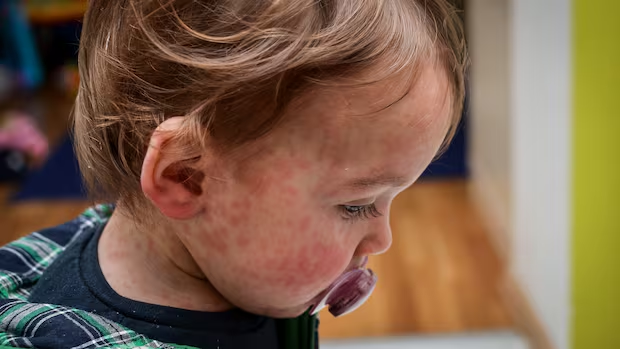
With the number of measles cases in Manitoba swelling, experts caution those who aren’t vaccinated for the disease to stay away from large public gatherings until the outbreak settles down.
The warning comes after Manitoba’s government said those who attended the AG Days indoor farm show in Brandon late last month might have been exposed to measles.
About 35,000 people attended the annual event at the southwestern Manitoba city’s Keystone Centre between Jan. 20 and 22. Those who visited hotels, restaurants and shops in the city during the three-day event were also possibly exposed to the virus, according to Manitoba public health.
“It’s absolutely terrifying,” said Dr. Philippe Lagacé-Wiens, a medical microbiologist and physician at St. Boniface Hospital.
“In a closed space, 90 per cent of people who are susceptible will catch measles if there’s a person who’s infectious and goes into that room.”

With symptoms of measles becoming physically evident sometimes weeks after getting infected, a person with the disease could spread it unknowingly.
“This chain of transmission going downstream is when you’ve got that many exposed people. It is very concerning,” he said.
In January, Manitoba reported the highest monthly count of confirmed measles cases since the outbreak began in February 2025.
As the illness continues to circulate at this extent, people are more likely to be exposed to the disease in larger groups, and those who aren’t vaccinated have a high chance of getting infected, Lagacé-Wiens said.
Measles can stay in the environment hours after an infected person has been in a space, and Lagacé-Wiens said that unlike with COVID-19, physical distancing or masks do little to protect someone from contracting it.
“The really big message is if you’re not vaccinated against measles or you have any kind of measles-like symptoms, don’t go to these festivals,” he said.
The same message should also be relayed by event and festival organizers, Lagacé-Wiens said.
Visible signs that remind people how measles can spread at large events, and the importance of staying home if presenting symptoms are an alternative, he said.
Not a time for restrictions just yet
Angela Rasmussen, a virologist and principal scientist at the Vaccine and Infectious Disease Organization in the University of Saskatchewan, said herd immunity is no longer an option to protect unvaccinated people from contracting the virus.
The only opportunity to prevent infection risks is to minimize the chance of exposure, she said. Measles is much more contagious than other illnesses in part because you have to be exposed to less of the virus to get infected.
The recommendation is that, for example, newborn babies who are not yet eligible to get vaccinated or children who have not gotten the measles shot, even if it is because they are immunocompromised, should avoid large public gatherings, Rasmussen said.
“It’s really unfortunate that parents have to make those choices, but this is what happens when the vaccination rate goes down like this.”

Manitoba’s measles outbreak has not reached the extent where restrictions or event cancellations would be needed to control the spread, according to Dr. Lagacé-Wiens.
“If we start to see situations where infants are cramming in intensive care units and stressing hospital systems … we might start to see public health pushing for reducing events,” he said.
On the heels of the COVID-19 pandemic — where widespread isolation measures and vaccine policies triggered public backlash — there’s also little appetite for restrictions around measles, and Lagacé-Wiens said that at the moment, immunization alone is still a solution to curb the number of measles cases.
But stricter measures cannot be completely ruled out in the future given the likelihood of larger virus outbreaks.
“If people don’t roll up their sleeves quite literally and get vaccinated, it’s always a possibility,” Lagacé-Wiens said

“I’m not seeing a way out of this uncontrolled measles transmission for at least a year or more at this point, unless we really have a sincere look at our vaccine rates,” he said.
Rasmussen said there has been a continuous effort from disinformation campaigns to undermine the advice of public health on vaccination, making it really hard for experts to push for measles immunization among those who have not had the shot yet.
At this stage she said health authorities have to find a strategy that’s more effective and aggressive against misinformation.
“We need to reach the people who are undecided about vaccines and figure out a way to communicate with them directly,” she said.
Following public health guidance
Brandon Mayor Jeff Fawcett said the city has been monitoring the possible measles exposure at AG days but the province has not advised of any uptick in local cases yet.
Measles has not been a significant public health issue in Brandon, Fawcett said. He credits it to high immunization rates driven in part because a large number of residents in the city lived through Canada’s measles outbreak in the 1980s.
“Our parents didn’t think twice about making sure we were taken care of by our science. It’s been well understood, and we have a lot of that generation around,” he said.
At the moment Brandon is following the lead of Manitoba health authorities, reminding people of vaccination availability and encouraging residents to monitor for symptoms.
Restrictions on gatherings would only come if public health officials recommend it, he said.
“We do have other events going on and we’re not going into an aggressive approach to it,” he said. “Life is continuing out here. People do take care of their health.”