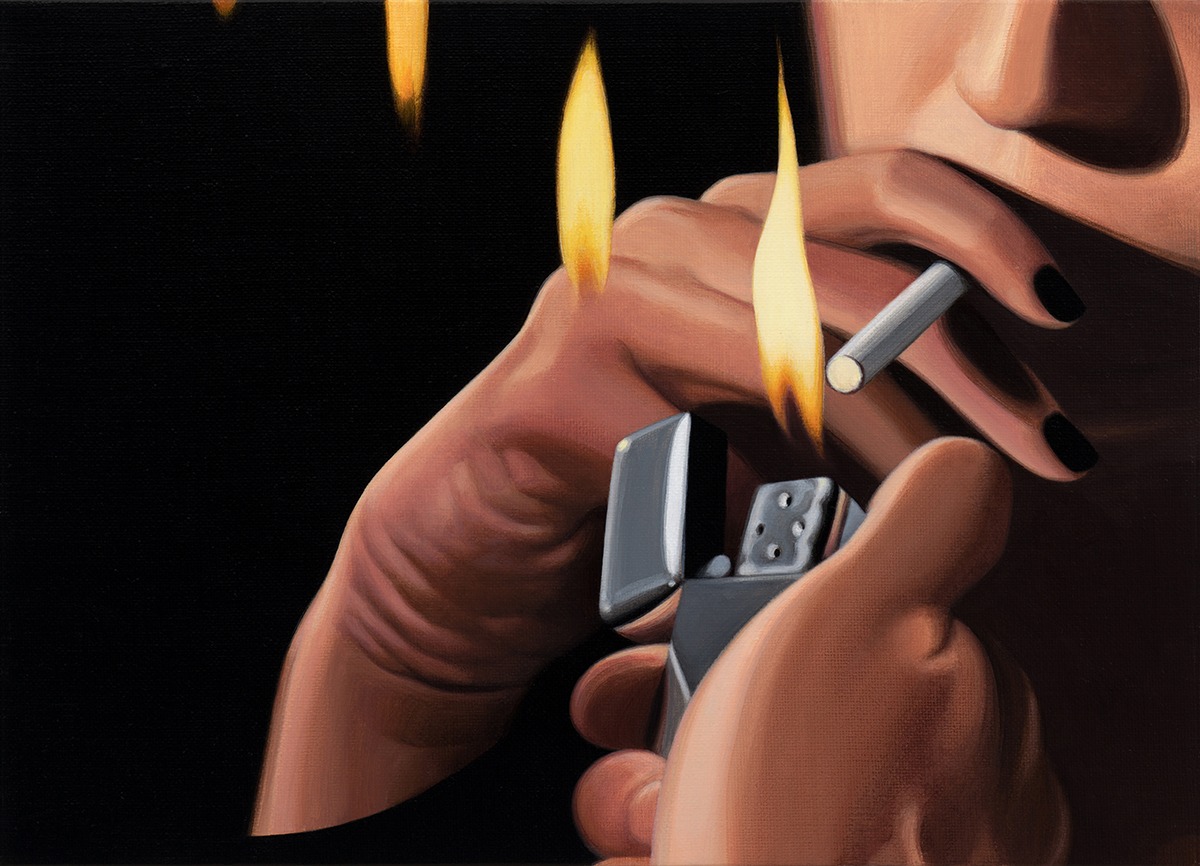
When I started smoking I was sixteen, and my life was very complicated. Large portions of each day were spent trying to disguise the fact that I had an erection. “You always get them just when you have to stand up,” people would complain, because the people I knew were also teenage boys. On weekends we would get together to make a big stink and talk about women. Once, we cycled forty minutes up a hill to buy beer. On the way down the extra momentum meant we didn’t even have to pedal. We laughed about our beer motorcycles the whole way home, and that night I had my first cigarette.
When you first have a cigarette, the initial encounter is with smoke. Smoke is hostile to the newcomer. It tickles the lungs, boxes the tonsils. It scours your insides until they feel matted and gray, like an old flannel. To really start smoking takes a certain determination. In those early days, I was sustained by an important secret only I knew: I wasn’t actually a smoker. The only reason the cigarette filter was repeatedly traveling from my hand to my lips and back again was in public fulfillment of an elaborate private boast: that even as a nonsmoker, I could still smoke everyone else under the table. This irony became increasingly etiolated and abstract, until after a few months I forgot all about it. After that cigarettes were delicious, forever.
Smoking was also easy. When I was sixteen I sent 32 pounds in an envelope to Bilbao and one month later received a “European Motorcycle Permit” under the name “Earnest Butterworth.” My parents, both former smokers, ran a fancifully liberal household. Under their regime, you weren’t allowed to smoke inside the house before you were eighteen.
When I try to remember what it was like to be that age, what I remember is a burning desire to be somebody else. I don’t just mean that I didn’t want to be me, but that I also actively wanted to be other people, who happened to be near me at the time. If I felt defined by anything, it was the absence of those instinctive ceremonies of self that the people around me were conducing quite unthinkingly. And if I didn’t have an instinct for scandal or Olympian hauteur or social grace or a gift for euphoric absurdity or a straightforward way of loving those around me or emotional percipience or a really cool skill, and was besides a 0.01st-percentile dancer with a wrong sort of face and walk, at least I could roll a cigarette quicker and better than anyone else and I always had something to do with my hands.
●
But for the one obvious catch, cigarettes seemed to me like the perfect drug. They didn’t derange or disinhibit or cause you to act in ways you would later regret. They barely even interfered with fine-motor skills. While they provided pleasure, they answered a need in a way voluntary pleasure did not. If the difference between a need and a desire is that a need can be satisfied, then the need for nicotine was unique because it could go on being satisfied all of the time: twenty, forty, even a hundred times a day. What some people want from drugs is just to do them, and no drug lets you do it over and over like cigarettes.
Though the pleasure they provide is physical, the physical properties of a cigarette are relatively unimportant. The taste, smell and texture don’t really matter, the way the taste, smell and texture of food really do. The need manifests as an ambient, all-over pang, as if every cell in your body were looking desperately for a phone charger. Schopenhauer says that money is prized above other goods because rather than satisfying a concrete need it represents in abstract the satisfaction of all human needs. Cigarettes were an almost inverse case, providing concrete satisfaction to an abstract need. They felt like they were satisfaction, satisfaction incarnate.
They were also romantic. As a teenager, a cigarette seemed to transform me into the pivot between what I was and what I desired. Here was my life; there were the horizons of sex and love and adulthood. With a cigarette between my lips I could tilt one toward the other. When I stood at the window smoking, I didn’t feel like I was looking out at the world, I felt like I was breathing it in. If I got the ritual exactly right, I could feel the old wall—the one that stood between the beauty of the world and the thing inside me that could feel it—begin to grow light and pearly. Never mind the obvious oral substitution. “Smoking is indispensable if one has nothing to kiss,” Sigmund Freud once wrote to his soon-to-be wife. When I was seventeen, a cigarette was second only to a poem in the way it could both soothe and strengthen that deep, needful feeling of having no one to kiss.
I don’t know exactly how many cigarettes I used to smoke a day, because like everyone British of my generation I rolled my own cigarettes. I didn’t ever count because counting cigarettes is for doctors. If you smoke, you use cigarettes to count other things. They are a unit: of choice, of autonomy, of freedom. While nonsmokers imagine us being led along in slow file—kneeling, shackled—behind the bitch goddess, nicotine, smokers feel they are tapping deep reserves of autonomy inaccessible to mere civilians. The more you need to smoke, the freer you feel. What’s more, you are known to others by this sign you chose. Even in the howling wind, in winter, with the rain coming down diagonally, you know that you chose to be who you are, and for people who are afraid they don’t control their own lives, there is freedom in that too.
●
Soon enough, I started to think about quitting. When I smoked, I’d wonder what would happen if I never quit. I would imagine myself flat and breathless in a bed I couldn’t leave, listening to the low clink of oxygen tanks being delivered to a nearby room. I would remember terrible things I’d heard, like the story someone told me about an emphysema diagnosis. “The bad news for you,” the doctor said, “is that it isn’t lung cancer.”
I also worried about what quitting would mean. It would be difficult, sure. But would it also be a kind of conversion, an event that would cut my life in two? What if the life I believed in so passionately now appeared merely ridiculous? If my beliefs, memories, feelings and thoughts were simply replaced, what would remain of me?
I was still young when I realized that every part of my life was punctuated with a cigarette. As I got older and started writing, I discovered that smoking a cigarette induced a passable physical impression of what it is like to have an idea. The feeling of calm, clarity and nervous activation; the changed rhythm of breath and heartbeat; the sensation of interacting physically with nonmaterial things. “I’ll just have a little idea,” I would think, skulking off to the window between paragraphs.
Every smoker keeps in the front of their mind a worse-off, more seriously addicted, probably sooner-dying smoker who they use to legitimate their own habit. For everyone I knew, I was that smoker. For me, that smoker was a friend of my mother’s I’d never met, but who was famous for setting an alarm at 3 a.m. so she could wake up for a cigarette. I never did that, but my life was constructed so that nothing would interfere with my ability to constantly dose nicotine. I started to avoid things that took place uninterruptedly indoors—long-distance travel, long movies, long museum trips—which I knew would be difficult and aggravating. I spent all three and a half purgatorial hours of Martin Scorsese’s The Irishman wondering if now would be a good time to go out for a smoke.
Smoking was always aspirational. The worse I felt, the more aspirational it became. My nails went yellow. My cuticles went yellow. I got out of breath: going upstairs, downstairs, standing, sitting. I began to snore. I began to wheeze. The dentist showed me the back of my teeth, and the color of them raised an involuntary whine of misery up out of my dentally clamped jaws. I completely lost my sense of smell. I got infections. On winter mornings I would cough over the sink, putting my finger into my mouth to break the long stretch of phlegm that was cased around my swollen uvula, bringing it stringily out of my throat like a medieval conjurer retrieving a swallowed newt. In the daytime I joked about it, and at night I lay up wondering what the hell I was going to do.
Of course, I had to stop. I should say that I never felt like a victim of big tobacco companies, or social pressure, or an overwhelming anxiety that meant I simply had to do something with my hands. I smoked because I thought it was cool, funny and doomed, and would therefore suit the cool funny doomed life I wanted. In Italy, they have a hand gesture where you make a beak with your fingers, peck at your face, then turn the beak around to peck at the person you’re talking to. The gesture means, “you did this to yourself.” Lying awake, I felt the beak of fingers pecking at my face.
●
I quit in the stupidest way possible. I didn’t taper down. I didn’t use a quitting aid. I didn’t even throw my tobacco things out. They lay where I left them on the windowsill. (At night I heard them rustling in their packets.) But this was the way it had to be done, because of the secret that only I knew: though I had stopped physically smoking, I was still a smoker. This was how a smoker would quit: stupidly, with lots of cigarettes to hand.
As physical dependency ebbed away, I began to understand that I had built around it a belief system that made smoking seem fundamental to what mattered in life. A thought I often had about quitting was that I would miss looking out the window. As though this would become impossible if I was no longer leaning with my whole torso out of it for an aggregate sixty minutes every day. Every day.
Every habit is a way of thinking about itself, and when you break the habit you lose the thought world too. When I finally quit, I understood that the lovingly detailed interior logic I’d built around my rampant cigarette addiction would be completely inaccessible to my future self. There are only two times in my life I’ve kept a diary for longer than a day. Once when I quit smoking, and once ten years before when I first experienced heartbreak at seventeen. In the earlier experience, I used to read and reread a poem by Samuel Beckett that seemed like the only other part of the universe that contained the same feelings I did. “Terrified again / of not loving / of loving and not you / of being loved and not by you.”
It was the same thought I had when I lay up worrying who I would be after quitting. I was frightened that I wouldn’t quit. I was frightened that I would quit and miss it forever. I was frightened that I would quit and eventually not miss it at all. I was afraid of the things that unimaginable person would say about the person I was then. I was deathly afraid of the voice I am speaking in now, and the power it would have over the person I had been. Partly because I am vain. But mostly because when you are young, you know two things for absolute certain. First, that you will believe the things you believe and love the people you love, forever. Second, that you won’t.
It’s been more than five hundred days since the last smoke. The physical need is gone, though the distinction between physical and psychological addiction is overdetermined in the minds of non-addicts. (Think about it this way: you need food, but it’s likely that all your problems with food are to do with wanting it.) Occasionally I’ll forget I smoked at all for an entire day. My wife is one of those perfect social smokers whose habit is all voluntary pleasure and grace. When she does, I beg her to come and stand by me, so I can breathe in the smell of smoke that’s gathered in her long black hair.
I’ve been wondering what advice I could give my younger self about smoking. There’s nothing I could say about the dangers he wouldn’t already know. I think I’d tell him about this adjacent fear he had—of turning into someone he didn’t recognize. I would say that like most people, he would surprise himself by turning into someone who felt more sympathy for his past iterations than they ever really felt for themselves. As for quitting, it’s like anything else. You just miss it every day until you don’t.
Art credit: Sujin Lee, The Fire I Need Too, 2025. Oil on linen 24.2 × 33.4 cm. Courtesy of the artist.