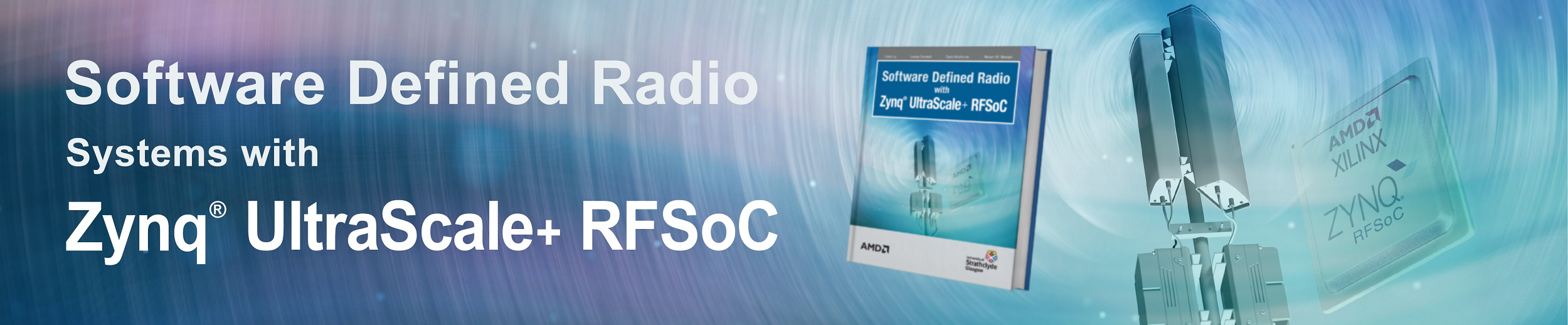
This book introduces Zynq Ultrascale+ RFSoC, a technology that brings real, single-chip, Software
Defined Radio (SDR) to the marketplace. The book is accompanied by Jupyter Notebooks that can be run on
your RFSoC-PYNQ enabled board, illustrating key concepts including sampling and quantisation, filter
design, Fourier’s theorem and FFTs, pulse shaping, QAM, frequency planning, Forward-Error-Correction,
and OFDM.
See the book website www.rfsocbook.com to download your free copy of the eBook and details on how to purchase hard copies.

RFSOC-PYNQ is an extension to PYNQ bringing support for the AMD Zynq RFSoC family of devices. RFSoC created a new class of integrated circuit architecture for the communications and instrumentation markets. RFSoC combines high-accuracy ADCs and DACs operating at Giga samples per second (GSPS), with programmable heterogeneous compute engines.
RFSoC-PYNQ provides Python APIs, libraries and drivers for the RFSoC, example overlays and designs, tutorials and other resources for RFSoC users.
RFSoC-PYNQ features
The RFSoC 4×2 is the recommended kit to get started using RFSoC-PYNQ.
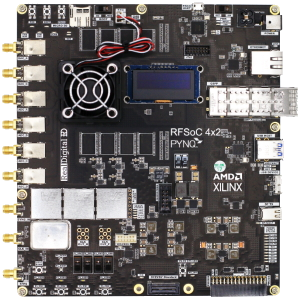
RFSoC 4×2 key features
- New Gen 3 Zynq UltraScale+ RFSoC ZU48DR
- Faster 5GSPS ADCs and 9.85GSPS DACs
- Higher resolution 14-bit ADCs
- Maximum RF input frequency increased to 6 GHz
- Two additional ADCs (four in total)
- New high-speed QSFP28 interface supporting 4x25Gbps, 2x50Gbps or 1x100Gbps Ethernet
- New OLED display for improved boot-time status
- New battery-backed real-time clock
- Upgraded open-source Overlays including Spectrum Analyzer design supporting higher RFSoC Gen 3 ADC/DAC frequencies and wider bandwidth
For more details and purchasing information see the RFSoC 4×2 Overview.
Due to global supply challenges the RFSoC 2×2 kits are discontinued.
See the PYNQ community Support forum for discussion and to post support questions related to RFSoC-PYNQ.
For other enquiries contact the AMD University Program.