
Website | Documentation | Roadmap | Discord
Valk is a programming language aimed to be fast & simple at the same time. The simplicity of Go with the performance of Rust. Valk is also the first programming language with a fully stateful garbage collector. Meaning no more mark/sweep mechanisms that cause performance problems. We aim to be a feature rich language with a large standard library.
Features: Fastest GC, Coroutines, No undefined behaviour, Package management, Generics, Traits, Closures, Fast compile times, Cross compiling, Optional manual memory mangement, Integrate c libraries, and more…
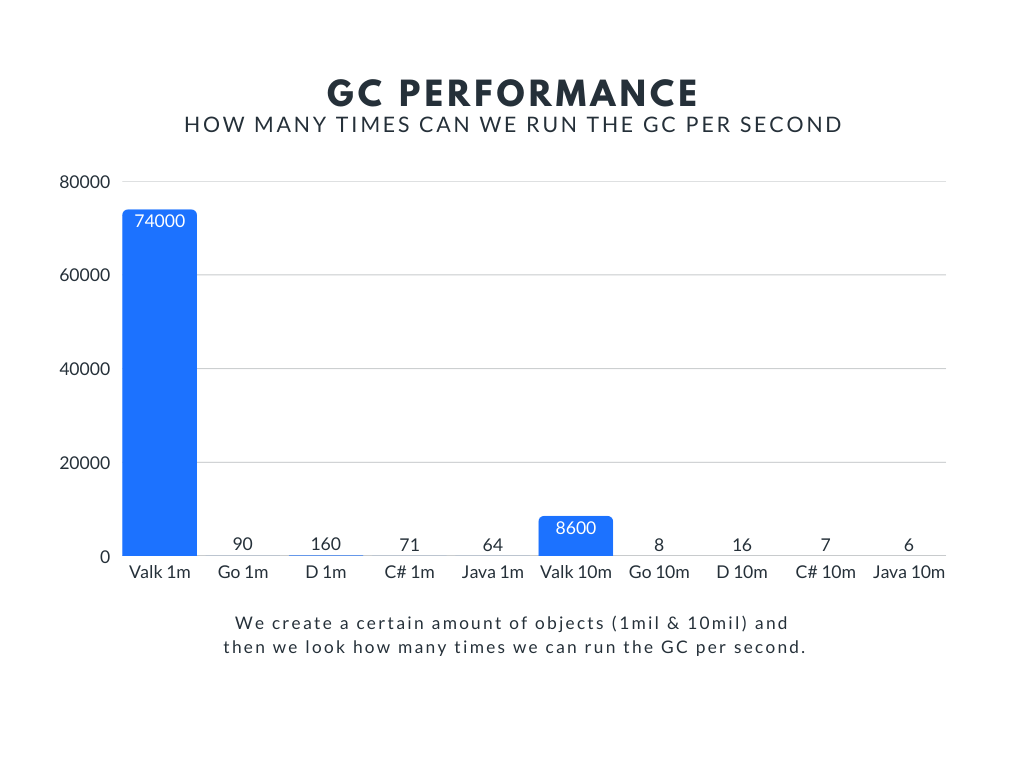
To see what a stateful GC can do, see the benchmarks
Linux / MacOS / WSL
curl -s https://valk-lang.dev/install.sh | bash
Windows (powershell)
irm https://valk-lang.dev/install.ps1 | iex
// main.valk
fn main() {
    println("Hello Valk! 🎉")
}
valk build main.valk -o ./main
./main
# Or to quickly build & run a script:
# valk main.valk
valk/vman: curl -s https://valk-lang.dev/install.sh | bash
macOS: brew install llvm@15 && brew link llvm@15
Ubuntu / Debian: sudo apt-get install llvm-15 lld
git clone https://github.com/valk-lang/valk.git
cd valk
vman use
make
# optional: make test
| OS | Linux | Macos | Windows |
|---|---|---|---|
| x64 | ✅ | ✅ | ✅ |
| arm64 | ❌ | ✅ | ❌ |
✅️ = Available & passes tests | ❌️ = Not available right now
Code: Link
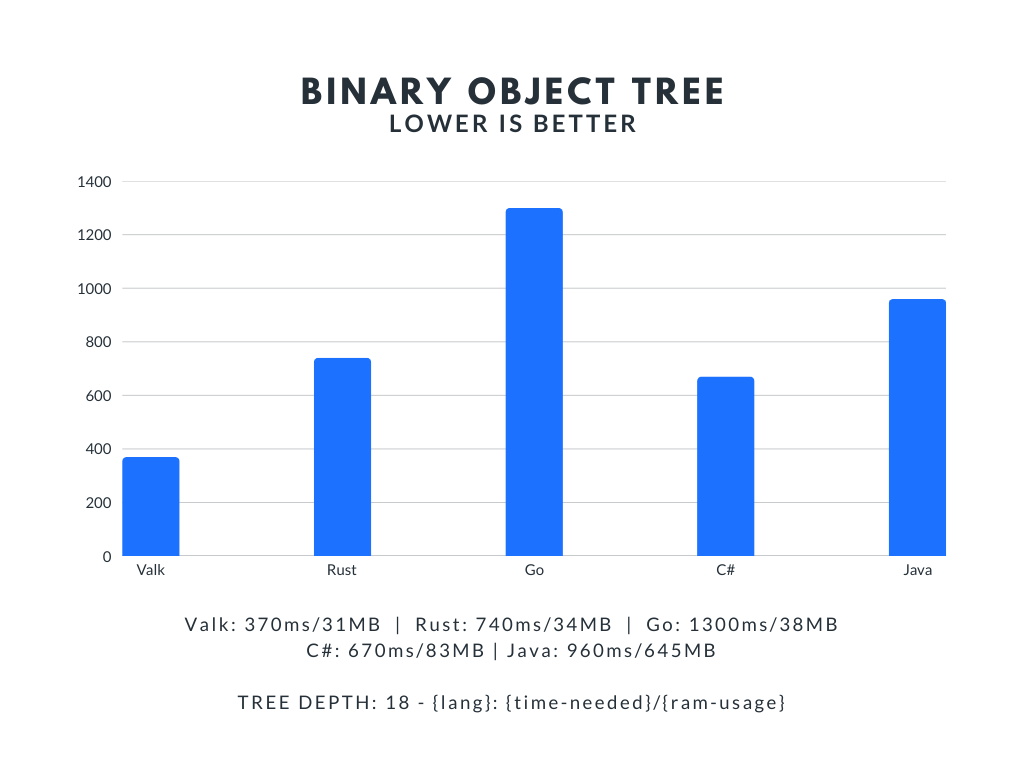
The binary object tree test revolves around creating large amount of short-/long-lived objects, iterating over them and doing some calculations.
Code: Link
Code: Link
Creating 10 million objects of size 8:
| Create short lived | Create long lived | Process memory usage | |
|---|---|---|---|
| Valk | 31ms | 128ms | 160 MB |
| Go | 115ms | 216ms | 591 MB |
Code: Link
Rust: Too much complexity. Having to deal with complex coding concepts is not great if we are already trying to solve complex problems. Also: Slow compile times and their way of doing async.
Zig: Manual memory management. It’s not something you want to do in every project. The less things you have to manage/think about, the easier it is to manage your code. There are also philosophical differences between zig and valk. E.g. No hidden allocations. Which is great, but it does come with down sides that you will need to deal with every time.
Go: Great language, but there are alot of things we dont like. Nil checking/crashes, dead locks, it’s package management, no thread local storage and more.
Note: All of these are great languages we respect. But none of them are what we want. So we created valk to do things our way.
When not to use Valk:
-
When you need very low-level control. E.g. custom assembly code / register access.
-
When your program needs to run on niche infrastructure. We currently only support: win/linux/mac for x86_64/arm64.
-
Creating .dll/.so/.a/.lib files. (We will support this in the future)
-
Co routines are semi-stackful. We run the co-routines on the main stack and if it blocks, we copy it to a temporary buffer. This way we can keep memory usage low. And yes, it’s fast.
-
Each thread manages it’s own memory. So we dont need to block other threads. You can share objects with other threads. Each time you do, the shared memory counter increases. At a certain point it will block other threads to free un-used shared objects. But we never block every X seconds like other languages do.
-
The local GC has no randomness. Every time you run a program it will use the exact same amount of memory and run at the exact same speed.
-
Co routines are single threaded. A co-routine will always run on the same thread it started on.
-
We are a self hosted language with a LLVM backend. We depend on libc for system calls. We use the native linux & macos linker. For windows we use lld-link.
The most helpful thing you can do is to create 3rd party packages.
If you want to work on the language itself, just hop on our discord and discuss with us what you want to change.
Either way, you should join our discord 😊 Everyone is welcome. The more people, the better.