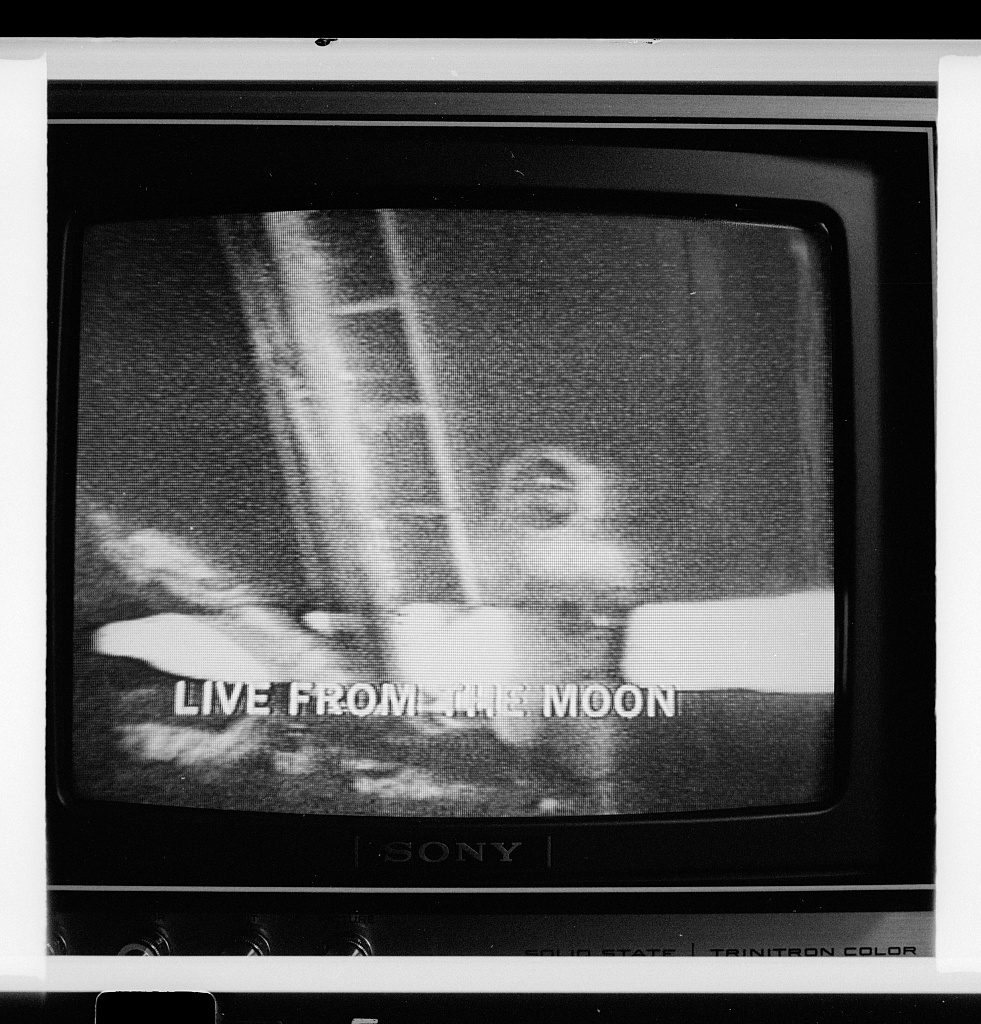
An early chapter in the history of remote sensing is that of lunar photography. The unmanned Lunar Orbiter program of 1966-1967, for example, proved that craft in space could photograph both the Earth and the moon from orbit with success. Early lunar missions established key foundational techniques, such as the creation of high resolution lenses capable of useful photography from long distances, and processes for transmitting said images back to Earth. Early images from the Apollo program were effective for land classification and geologic interpretation, but struggled to be useful for large-scale scientific applications. The later Apollo missions were charged with mapping the moon scientifically. Revised camera systems paired with imagery transformation workflows would go on to produce rectified lunar images used for topographic mapping of the moon.
The Geography & Map Division’s History of Computer Cartography and Geographic Information Sciences Archive houses the Frederick Doyle Papers, which document the transition between lunar photography and modern remote sensing. Doyle worked on classified satellite systems for Raytheon before joining the National Mapping Division of USGS in 1967, then served as the chair of the Apollo Orbital Science Photographic Team in 1969. During that time, he helped develop the improved camera systems used on Apollo missions 13-17. He would later go on to become a principle investigator for both Landsat and Skylab.

The Apollo Orbital Science Photographic Team was organized by NASA to create the next generation of photographic systems for the later Apollo missions. The goal was to improve the scientific value of lunar photographs, including the ability to create orthomaps from photographs. Apollo 15, 16, and 17 all carried the team’s revised photogrammetric mapping system, which included a panoramic camera built by Itek Optical Systems Division. Designing these photography systems was quite complex, as the team had to account for the movement of the spacecraft, distortion introduced by the camera’s lenses, variation in terrain on the lunar surface, the scanning speed of the camera, the angle of the sun at a given time (which affected the amount of light available), and extreme temperature changes (to name a few!). Apollo’s new panoramic camera produced film images with very wide angles, resulting in a distortion of scale and a curved horizon with a varying scale. The image below shows the way in which the moon’s surface would be warped in the final photograph, using 5 kilometer square grid as an example.

To make the panoramic photos useful for mapping, the images themselves needed to be corrected such that the distortions introduced by the spacecraft motion disappeared. Enter the Apollo Transforming Printer. It was able to remove the distortion introduced by the panoramic camera by reconstructing the motions of the orbital camera. Unlike today’s digital rectification processes, this was an optical remapping. The Printer utilized the original film negative, reprojected it through a lens and mirror system, and produced a print that was geometrically corrected.

The diagram below demonstrates how the panoramic photographs were rectified. The panoramic camera scanned about 54 degree on each side, but only the center 35 degrees of the panoramic photo was suitable for a correct transformation. This was taken into account when flight lines were planned to ensure the complete coverage needed for generating maps was still obtained.

The Apollo Transforming Printer is a fun example of an early processing workflow that demonstrated how imagery collected from space could be transformed to produce a useful scientific output. Below is an example of a 1:250,000 scale contoured orthomap of the area around Tsiolskovski (a lunar crater on the far side of the moon), prepared from the mapping camera photographs by DMA-TOPOCENTER.

These early scientific and cartographic frameworks originally built to understand the moon eventually impacted how we understand, analyze, and map our own planet. Many of the techniques used to process the Apollo panoramic files would be mirrored in early Earth mapping programs, such as Skylab.