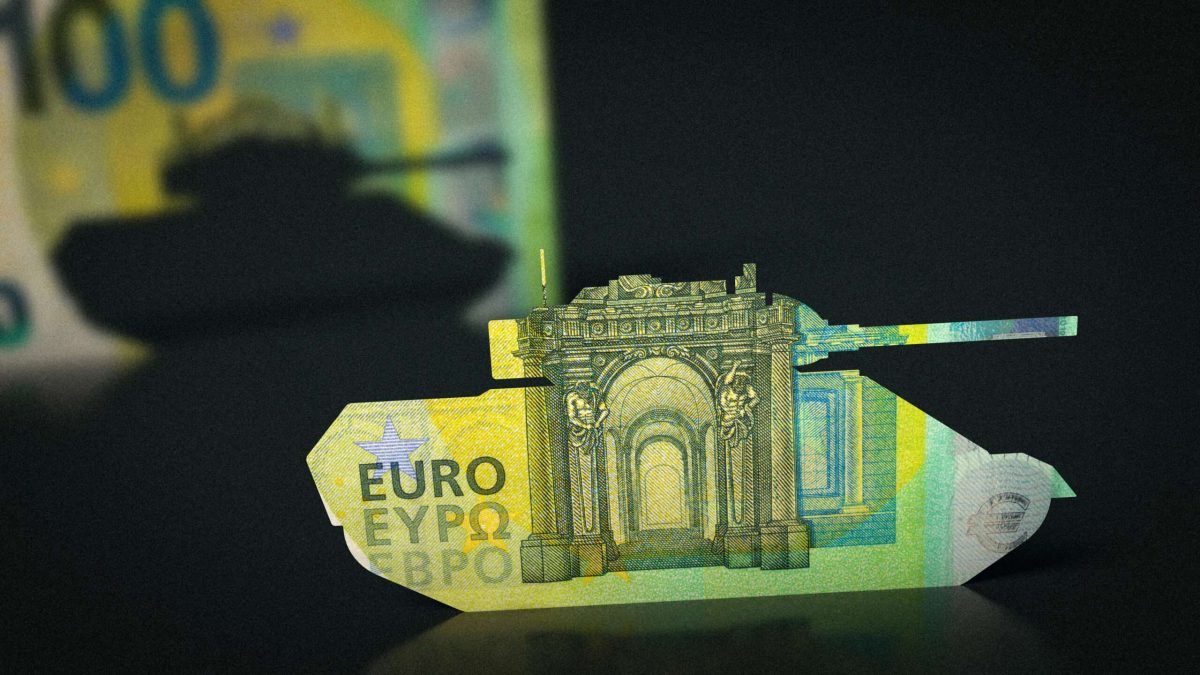
There are downsides to insulting and threatening friends and acting like a Mafia don slapping around his goons. You risk turning them against you, for one thing. But if those friends have been freeloading off you for years, well, there are some upsides, too. We’re seeing that as President Donald Trump’s rough treatment of our European allies has driven them to huffily make steps to actually defend themselves rather than continue to rely on the American defense umbrella.
You are reading The Rattler from J.D. Tuccille and Reason. Get more of J.D.’s commentary on government overreach and threats to everyday liberty.
For years, Trump has pointed out that the prosperous nations of Western Europe have long free-loaded off of American military might to maintain their security—especially against Russia’s threat from the East. He claims that, during his first term, he told NATO leaders if they didn’t meet the alliance target of 2 percent of GDP on military spending per member, they’d be on their own. According to him:
One of the presidents of a big country stood up, said, “Well, sir, if we don’t pay and we’re attacked by Russia, will you protect us?” I said, “You didn’t pay. You’re delinquent?” He said, “Yes, let’s say that happened.”
“No, I would not protect you. In fact, I would encourage them to do whatever the hell they want. You got to pay. You got to pay your bills.”
Those were rough words for supposed allies. They didn’t stand alone. Since then, Trump has also threatened to acquire Greenland over the protests of Europeans, Denmark (which governs the island territory), and Greenlanders themselves. That’s on top of his trade war antics which imperil the commerce that most effectively binds people together in peaceful relations. Such bullying has an impact.
“European governments and corporations are racing to reduce their exposure to U.S. technology, military hardware and energy resources as transatlantic relations sour,” Politico‘s Nicholas Vinocur and Zoya Sheftalovich wrote last week. “At a weekend retreat in Zagreb, Croatia, conservative European leaders including [German Chancellor Friedrich] Merz said it was time for the bloc to beef up its homegrown mutual-defense clause, which binds EU countries to an agreement to defend any EU country that comes under attack.”
“Military spending across the European Union is ramping up in what observers have noted is a significant and ‘extraordinary’ pivot from the comparatively placid postwar decades,” Northeastern University’s Tanner Stening observed last summer. “As part of the ReArm Europe plan, EU member states hope to mobilize up to 800 billion euros. In June, NATO leaders agreed to increase defense spending up to 5% of each country’s gross domestic product by 2035.”
Frankly, it’s about time. In December 2023, The Wall Street Journal reported that the U.K.—which is relatively well-armed for Europe—”has only around 150 deployable tanks and perhaps a dozen serviceable long-range artillery pieces” while “France, the next biggest spender, has fewer than 90 heavy artillery pieces, equivalent to what Russia loses roughly every month on the Ukraine battlefield.” In worse shape was Germany, which “has enough ammunition for two days of battle.”
To put this in context, the U.K., France, and Germany view Russia as their main security threat, yet all three countries are far more prosperous than Russia. Germany’s economy alone is more than double that of the Russian Federation in GDP terms. There’s no excuse for these countries’ relative helplessness.
But even before the Journal report and Trump’s latest insults to Europe, our allies were—however grudgingly—taking steps to take on more of the load. In 2019, according to the NATO Secretary General’s Annual Report, the U.S. share of the NATO alliance’s collective GDP was 52 percent, but it made 70 percent of all NATO defense expenditures. By the latest report, for 2024, the U.S. share of NATO GDP was 53 percent, but its share of defense expenditures had declined to 64 percent. That’s still a disproportionate burden for Americans, but an improvement over what went before.
“It goes without saying that this ramp-up is huge for Europe. It’s always been a struggle reaching that 2% mark, and then to watch at the most recent NATO summit every nation with the exception of Spain promise 5% — it’s just astounding,” noted Northeastern political science professor Mai’a Cross.
That said, there’s still a problem built into those NATO numbers. Between 2019 and 2024, Americans’ share of NATO defense expenditures fell. But our share of total GDP rose by one percent even as Finland and Sweden joined the alliance. The U.S. economy is fast outstripping the economies of our allies.
“In the period 2008-2023, EU GDP grew by 13.5% (from $16.37 trillion to $18.59 trillion) while U.S. GDP rose by 87% (from $14.77 to $27.72 trillion),” according to Tuft University’s EconoFact. “Accounting for population, EU GDP per capita as a percentage of U.S. GDP per capita fell from 76.5% in 2008 to 50% in 2023.”
Even America’s hat, also a NATO member, suffers by comparison. “The productivity gap with the U.S. stands at about $20,000 per person a year, putting Canadians’ wages roughly 8% below their U.S. counterparts,” the Royal Bank of Canada cautioned in 2024. “Anyone who invested $1,000 in Canada’s main stock index in 2000 would have $4,400 today; the same investment in the U.S. S&P 500 index would be worth $6000—a more than 35% difference.”
Across the board, the main problem is that most of these countries have hobbled themselves with taxes and red tape. Utrecht University’s Ricardo Martins wrote last September that “the EU increasingly embraces its role as a ‘regulatory superpower,’ exporting rules where it struggles to compete in innovation and economic dynamism.” Many European officials recognize the challenge but struggle to get the state—or various states—out of the way. That means NATO nations other than the U.S. will continue to have problems assuming a larger share of the mutual defense burden.
But with the U.S. increasingly turning away from Europe, America’s sometime allies on that continent have no choice but to take on more responsibility for defending themselves. It appears that, spurred by a brusque and hostile U.S. president, they’re doing just that by spending more on their militaries. Their efforts would be even more effective if they accepted as much responsibility for creating the freedom that lets innovation and prosperity thrive and build the economic resources they need to be truly capable of self-defense.