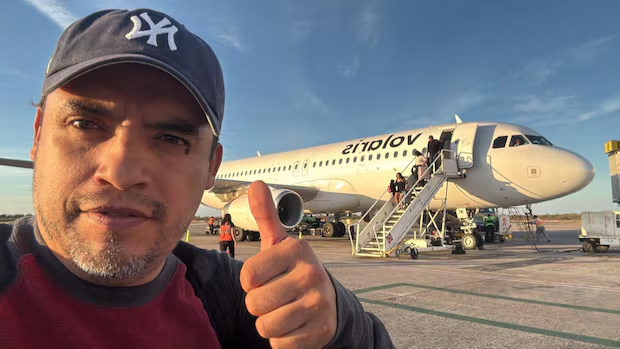
Jaime Castañeda said he identified the body of his 43-year-old geologist brother on Sunday by viewing photographs presented to him by officials at the federal attorney general’s local headquarters in the coastal Mexican city of Mazatlán, in the northwestern state of Sinaloa.
José Manuel Castañeda Hernández was working for Vancouver-based mining company Vizsla Silver Corp. when he was kidnapped on Jan. 23, along with nine other employees, from Concordia, a municipality that sits about 50 kilometres east of Mazatlán.
“In truth, this has been very painful to be here, in a place where we don’t want to be,” said Jaime Castañeda, in a telephone interview with CBC News.
José Manuel Castañeda Hernández, originally from the state of Guerrero, was a husband and a father to two children, a 14-year-old son and a 10-year-old daughter.
“It’s so hard to see … how they suffer,” said Jaime Castañeda. “There’s no justice with what’s happening.”
The identities of two other kidnapped Vizsla Silver Corp. workers, from the state of Zacatecas, were also confirmed by a family member and a federal politician on Sunday.
All three men were found dead late last week by federal authorities near a rural village called El Verde, about 15 kilometres north of Concordia.
Their bodies were discovered in what local media have widely described as a mass grave.
The kidnapping and discovery of multiple bodies in the mountainous area around Concordia unfolded against the backdrop of a sudden surge in violence driven by the 18-month civil war between factions of the Sinaloa Cartel — one of the most powerful organized crime groups in the world.
One of the factions, called Los Chapitos, remains loyal to the sons of now-jailed Joaquín (El Chapo) Guzmán. They are fighting a faction known as La Mayiza that is loyal to the son of Ismael (El Mayo) Zambada, who once co-led the Sinaloa Cartel with El Chapo.
Mexico’s Security and Civilian Protection Secretary Omar Harfuch has said it’s suspected that a cell linked to Los Chapitos was behind the kidnapping of the mining company’s employees.

The Attorney General’s Office confirmed in a statement Friday that authorities found bodies and human remains at the El Verde site, without specifying a number or using the term mass grave. The statement said that one of the bodies had the “characteristics” of one of the missing Vizsla Silver workers.
“We are devastated by this outcome and the tragic loss of life. Our deepest condolences are with our colleagues’ families, friends and co-workers, and the entire community of Concordia,” said Vizsla Silver in an emailed statement to CBC News.
“As we grieve, our focus remains on the safe recovery of those who remain missing and on supporting all affected families and our people at this incredibly difficult time.”
Jaime Castañeda said that he met at least seven other families at the federal attorney general’s local headquarters who were there to identify bodies taken from the site.
The families of two Vizsla Silver employees from the state of Zacatecas were among those asked to identify bodies in Mazatlán, said Zacatecas state Attorney General Cristian Paul Camacho.
“We are in communication with both families … and one of the families just told us that they are already in the process of carrying out the corresponding identification procedures,” said Camacho, in a telephone interview with CBC News.

Ignacio Aurelio Salazar Flores, 40, from Zacatecas, was one of the employees whose body had been identified, his wife Dayanara Nataly Esparza confirmed Sunday.
Esparza told CBC News in a text message that it was “the toughest day” of her life, adding she was too distraught to speak.
The identity of the second worker from Zacatecas, José Ángel Hernández Vélez, 37, was confirmed in a social media post by Sen. Geovanna Bañuelos, who is from the same state and a member of the government-aligned Labour Party.
Canadian mining firm Capstone Copper also posted a notice of condolences for Hernández Vélez.

Kidnappings may be a message: analyst
David Mora, a senior analyst with the International Crisis Group, travelled to the Concordia area in the middle of January, days before the kidnapping, to gather testimonies from families who had been displaced by violence and were returning home.
Mora said he was told that Los Chapitos had been driven out of the region and that La Mayiza faction had told the families it was safe to return.
“Assuming, as the government says, that the group behind the kidnapping is Los Chapitos, I would say then that it’s a show of strength, to send the message that they’re not out of the picture in that part of Sinaloa,” said Mora.
Targeting workers connected to a foreign company, like Vizsla Silver, may have been part of their calculations, he said.
“These people have connections to a Canadian company and this area is very strategic because of the minerals and also the logging industry,” he said. “It raises the political angle of this specific attack.”

There have been 2,776 cases of intentional homicides and 3,290 people have been reported missing since the war between the factions exploded in 2024, according to statistics compiled by the Noroeste news organization in Sinaloa.
Now José Manuel Castañeda Hernández has moved columns on this grim graph of statistics.
“He loved mining, he loved being out in the camps, doing the exploration,” said Jaime Castañeda. “And this profession, it came down the generations, because our father was also a miner.”
Castañeda said he last saw his brother on Jan. 7 after he dropped him off at the bus station in the city of Cuernavaca, located just south of Mexico City. His brother needed to take the bus to the capital so he could catch a flight to Mazatlán and return to work.
“He was younger than me and I would watch over him when he was a child. It’s like he was my son — I raised him,” he said.
“I’m left with a memory of a good person who always helped people. He always told the truth. Always, always, always. His whole life, he was like that. Noble.”