
Listen to this article
Estimated 4 minutes
The audio version of this article is generated by AI-based technology. Mispronunciations can occur. We are working with our partners to continually review and improve the results.
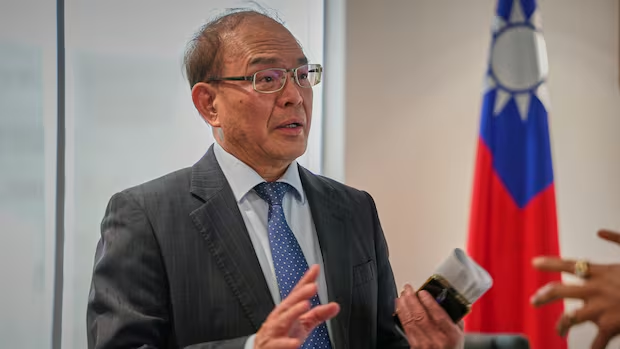
Taiwan’s representative in Canada says he is concerned the Liberal government may be deliberately delaying the signing of a trade agreement with Taipei to preserve its relationship with China.
Harry Tseng, the head of the Taipei’s Economic and Cultural Office in Canada, told Radio-Canada that the negotiating teams from Ottawa and Taipei have initialed every page of the trade co-operation framework agreement and it has been ready for final signatures since April.
There are “no negotiations left. Not only [is it] initialed — we have three versions of the text ready: English, French and Mandarin,” said Tseng. “That tells you how close we are to the final signature. This is a result of very long-term synergy and it is there, readily available.”
He said the initialed pages are a sign that the document is complete.
“You need to honour that,” he said.
Taiwan — a de facto autonomous island that China considers to be one of its provinces — is Canada’s sixth-largest trading partner in Asia.
Among the areas of collaboration defined in the framework agreement are online commerce, energy, net-zero transition and supply chain resilience — particularly for semiconductors. Last June, a similar agreement was concluded between the United Kingdom and Taiwan.
Tseng says Canada has left Taiwan with the impression, intentionally or not, that it wants to improve its relations with China at the expense of Canada’s relationship with Taiwan. He said he sees a contradiction between Prime Minister Mark Carney’s speech in Davos, Switzerland, which called for trade diversification and was critical of superpowers, and his reluctance to sign an agreement with Taiwan.
“We are trading with every country. We are trading with China as well. Why on earth can China stop any countries from trading with Taiwan?” Tseng said.
Carney says he’s ‘never afraid’
Carney dismissed Tseng’s concerns Wednesday, insisting his government is capable of conducting trade with both Taiwan and China.
“I’m never, never afraid. We have trade relations with Taiwan. But we’re focusing on strengthening our trade relations with China. We’re making a lot of progress. For families in the automotive and clean energy sectors, it’s been a great success,” Carney said.
In an email, Global Affairs Canada confirmed to Radio-Canada that a trade co-operation framework agreement had indeed been concluded with Taiwan in March 2025, and that a review of the next steps is underway.
Since coming to power, Carney has adopted a pragmatic approach toward China, visiting Beijing last month to conclude a “new strategic partnership,” which includes the removal of several tariffs.

After a decade of tense relations, Canada and China struck a trade deal on EVs and canola Friday. But while Prime Minister Mark Carney said the partnership ‘reflects the world as it is today,’ concerned human rights activist Sherap Therchin — who has been sanctioned by China — says the two countries’ definition of human rights are quite different.
A few days before that visit, the government asked two Liberal MPs to cut short their parliamentary trip to Taiwan. MPs Marie-France Lalonde and Helena Jaczek said that they wanted to avoid any confusion with Canada’s foreign policy.
Bloc Québécois MP Simon-Pierre Savard-Tremblay, who himself visited Taiwan on a parliamentary visit in 2022, said recalling those MPs and delaying the signing of the trade agreement were both likely done to appease China.
“I see no other reason,” Savard-Tremblay, the Bloc’s international trade critic, said.
“We keep saying we need to diversify, that we need reliable partners. In the case we’re currently discussing, Taiwan is a democracy. It’s a market economy.”
He said Quebec industries such as green tech and artificial intelligence have much to gain from deepening ties with Taiwan.
The Canadian government’s Indo-Pacific strategy, launched in 2022, also aims to continue developing economic and people-to-people ties with Taiwan while supporting its resilience.
Beijing refuses to have official diplomatic relations with any country that openly recognizes Taiwan as a separate state.
As part of its “One China” policy, Canada maintains unofficial but significant relations with Taiwan in economic, cultural and people-to-people exchanges, Global Affairs Canada spokesperson Samantha Lafleur said in an email.