
Follow Winter Olympic SportsPersonalize Your Feed
Brian Orser knows Canada’s odds of bringing home a singles figure skating medal from the Milano-Cortina Winter Olympics are slim.
The 1987 world champion — and decorated coach — isn’t alarmed, because he believes better results are coming.
“When we’re in what looks like a lull, it’s because something is brewing and something is simmering,” Orser said. “Then all of a sudden it just comes to a boil, and everybody’s happy.
“We just have to be patient.”
For much of the past half-century, Canadian singles skaters have played a starring role on the world stage, bringing home an impressive array of medals.
As a child, Orser watched in awe from his living room in Penetanguishene, Ont., when the revolutionary Toller Cranston won an Olympic bronze in 1976, blazing a trail for other Canadians to follow.
Orser carried that torch with two Olympic silver medals and a world title in the 1980s, inspiring fellow world champions Kurt Browning and Elvis Stojko — between them winners of six crowns in eight years in the 1990s — who in turn paved the way for Jeffrey Buttle and Patrick Chan.
“Like any sport and really in any nation, there’s cycles, and we had a cycle of reigning men’s champions for quite a long time,” Orser said last month at the Canadian championships in Gatineau, Que., where he coached multiple skaters. “At some point, that theory will maybe go on hold for a little bit.”
While Canada hasn’t dominated to the same extent on the women’s side, the country still produced Olympic medallists Elizabeth Manley (1988), Joannie Rochette (2010) and Kaetlyn Osmond (2018) in the past 40 years.
Strong lineage
Canada’s strong lineage makes the current drought hard to miss. No Canadian has won a singles medal at the Olympics or world championships since Osmond in 2018 — and no man since Chan in 2014.
Orser says he doesn’t have an explanation for the highs and lows of Canadian figure skating.
“You could make yourself crazy trying to figure out why it happens,” he said. “It’s not a matter of coaching, it’s not a matter of the talent pool, sometimes it’s just timing.”
Browning also weighed in on the singles situation, believing part of the answer lies in how much the sport has changed globally. He noted that Japan — now a powerhouse country — barely challenged for the men’s podium in his era.
The four-time world champion also suggested people grow accustomed to success and rarely question it.
The 2018 Olympic gold-medal team that included Chan, Osmond and ice dancers Tessa Virtue and Scott Moir, he said, “was a unique collection of skaters” — not the norm.
“When you get in your car for the 100th time and drive to work and get there again, you don’t question it. When you have a fender bender or an accident, you question it and question it,” Browning said in a phone interview. “That’s what we’re doing if we don’t have the success that we’ve had in the past.
“We just haven’t had the same success in this last eight years but what a tough act to follow for anybody.”
Gogolev, Schizas are Canada’s only singles entries
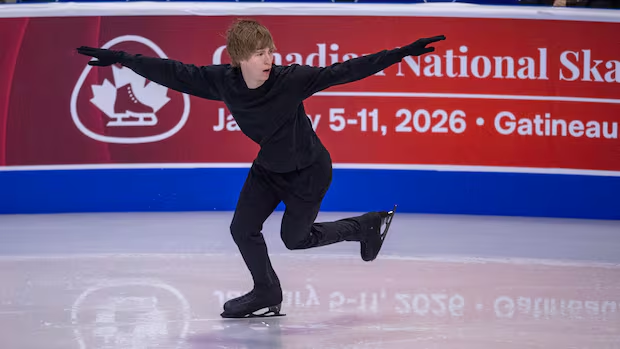
Stephen Gogolev and Madeline Schizas are Canada’s only singles entries in Milan, rather than the maximum of three men and three women.
They were both crowned national champions in January and have enjoyed strong seasons, but reaching an individual Olympic podium for either is a major long shot.
Where Canada’s singles skaters could have a chance is the team event, which begins Friday at Milano Ice Skating Arena.
Schizas, a 22-year-old from Oakville, Ont., thrived under pressure in the 2022 Games, placing second in both the short program and free skate as Canada’s team finished fourth.
“That’s where my opportunity at a medal is,” said Schizas, who finished a career-best 11th in singles at last year’s world championships in Boston.
“We’re obviously going to need good performances all around, but especially in the singles disciplines in the short program.”

Gogolev was on a path to becoming the next standard-bearer in Canadian singles, landing his first triple axel at 10 years old and winning the Junior Grand Prix Final days before his 14th birthday — when Orser was his coach — but a major growth spurt and back problems sidelined the teenager.
Now 21, the Toronto native is healthy, and his results this season have been impressive, posting scores that could challenge for a top-10 placement. At nationals this January, his stellar performance punched his ticket to the Olympics.
Ten countries will compete in the team event, with the top five after the short programs advancing to the final. The United States and Japan are expected to battle for gold and silver, but Canada — with Russia absent — could fight with Italy and Georgia for bronze.
“If both Maddie Schizas and Stephen Gogolev go to the team event with the skates that they had at nationals, you’ve got to feel really good about their chances to help Canada podium,” said Browning, who will feature on the CBC’s Olympic broadcast. “I don’t really think that there’s a lot of wiggle room for that bronze medal.”
Looking beyond Milan, Orser remains confident that Canada’s singles cycle will come back around. He points to Skate Canada’s developmental Next Gen program, and to “hotshot” junior Lia Cho.
The 13-year-old Cho, from Calgary, broke her own Canadian junior record at nationals in January with 199.60 points — a score that would have won the silver medal in the senior event.
“She’s just a natural super talent, and they surface every once in a while,” Orser said. “A talent like that surfaces in Korea, surfaces in Japan, surfaces in Russia, surfaces in the United States, and we have one in Canada.
“I don’t have a crystal ball, so we don’t know how she’s going to be in five years from now, but I think she’ll be pretty darn good.”