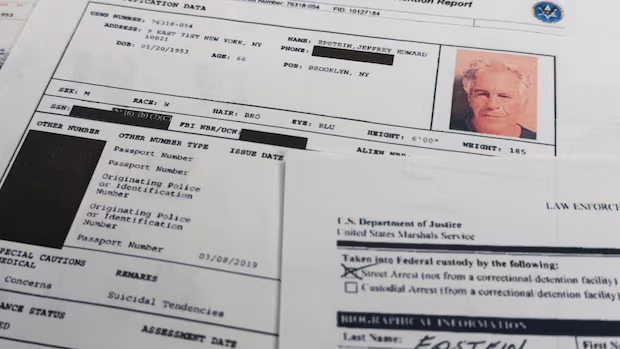
Only Jefferey Epstein and his longtime confidant and girlfriend Ghislaine Maxwell have ever been prosecuted in the U.S. in connection with the sexual abuse of underage girls. However, the recent release of millions of documents related to the Epstein files has raised questions about why no one else has been charged.
Some legal observers say any allegations of criminality in these documents, including allegations of sexual abuse at the hands of individuals other than Epstein, aren’t necessarily enough to spark a prosecution or prove a crime occurred.
“The issue is that the Epstein files, they’re hearsay. They’re not admissible in court,” Neama Rahmani, a former U.S. federal prosecutor, told CBC News in a phone interview.
Rahmani says that unless prosecutors have access to witnesses willing to testify against someone else, there’s no case.
“Cases aren’t built on documents,” he said. “They’re based on witness testimony.”
According to the rules of evidence, a witness declaration or affidavit is not considered admissible in court, Rahmani said, and that includes the affidavits in the Epstein files.
A sworn statement by itself is not enough for a criminal prosecution, Rahmani said, unless that accuser is willing to testify.
‘This isn’t some anonymous tip’
On the social media platform Bluesky, Democratic Congressman James McGovern cited a document that includes “sworn testimony, under penalty of perjury” from someone who said she witnessed Epstein and Trump, before he was president, sexually abuse underage girls.
The individual, who uses the pseudonym “Tiffany Doe” in the files, also said in the document that she and someone referred to as “the Plaintiff” were threatened with death by Epstein and Trump if they exposed the abuse.
“This isn’t some anonymous tip,” McGovern said in his Bluesky post.
But Rahmani says that in that particular case, prosecutors would want to have the actual alleged victims. The Confrontation Clause of the U.S. Constitution gives any accused criminal defendant the right to cross examine their accuser, he said.
“It’s possible to move forward with a prosecution, but in that case, without the [alleged] victims themselves corroborating the testimony, that’s going to be a very, very difficult case to prove.”

The U.S. Justice Department is releasing three million more pages from Epstein files today, including more than 2,000 videos and 180,000 images. Deputy U.S. Attorney General Todd Blanche signalled that today’s drop represents the full release of Epstein files, as required by law. The released documents include extensive redactions; Blanche said information about victims was removed before they were released.
DOJ released more than 3 million pages
Epstein served jail time in Florida in 2008 and 2009 after pleading guilty to soliciting prostitution from someone under the age of 18. He died by suicide in a New York Jail in August 2019, a month after being indicted on federal sex trafficking charges.
In 2021, a federal jury in New York convicted Maxwell of sex trafficking for her role in recruiting some of his underage victims. She is currently serving a 20-year prison sentence.
Last Friday, Deputy Attorney General Todd Blanche said the department was releasing more than three million pages of documents along with more than 2,000 videos and 180,000 images from the Epstein files.
Department officials had said over the summer that a review of Epstein-related records did not establish a basis for new criminal investigations, The Associated Press reported.
Blanche has said that position remains unchanged.
“There’s a lot of correspondence. There’s a lot of emails. There’s a lot of photographs. There’s a lot of horrible photographs that appear to be taken by Mr. Epstein or people around him,” Blanche said Sunday on CNN’s State of the Union. “But that doesn’t allow us necessarily to prosecute somebody.”
The files also contain a number of unsubstantiated allegations of abuse against U.S. President Donald Trump.
Blanche said Sunday that there were a “ton of people” named in the files besides Trump and that the FBI had fielded “hundreds of calls” about prominent individuals where the allegations were “quickly determined to not be credible.”

The U.S. Department of Justice released another batch of files from its investigation into Jeffrey Epstein last week. Former president Bill Clinton and his wife, Hillary Clinton, have agreed to testify before Congress to avoid contempt charges.
What did Epstein’s associates know?
Epstein’s links to powerful individuals around the world, many of whom are mentioned in the files, has also raised questions about what, if any, knowledge the wealthy financier’s associates had about his crimes.
Barbara McQuade, a former U.S. attorney for the Eastern District of Michigan, says it’s difficult to know why none of them have been charged without knowing all of the facts.
“But just because people associated with Jeffrey Epstein [doesn’t] mean they committed a crime,” she said in an email to CBC News.
For example, child sex trafficking requires interstate travel with a child for a commercial sex act, she says, and simply talking about travelling to Epstein’s island or engaging in offensive conversations about women is not enough to establish evidence of a crime.
“Some of this conduct is what prosecutors refer to as awful but lawful.”
In a separate interview with PBS News, McQuade said it would not surprise her if the Justice Department simply did not have sufficient evidence to prove some of these cases.
Ethical responsibility vs. criminal culpability
Cheryl Bader, a former assistant U.S. attorney, said it’s clear that people who associated with Epstein either knew or should have known that he was taking advantage of young women.
“But having an ethical responsibility to speak up is different than being criminally culpable,” said Bader, who is currently a clinical associate law professor at Fordham University School of Law.
The prosecution has to establish more than just somebody knows another person is committing a crime and decides not to intervene to stop it, she said.

Jess Michaels and Liz Stein are among a group of Jeffrey Epstein survivors who have come together to heal and demand accountability. They spoke with CBC Radio’s The Current about how their stories often get lost in the politics surrounding the case.
“You may know your neighbour is committing tax fraud, but it’s not a crime, unless you’re assisting them in doing it,” she said.
It would be different if the prosecution could prove that a defendant aided or abetted criminal activity and provided them with the means to do it or some substantial support, she said.
“But just knowing and associating with someone as a criminal is not enough.”