The line appears in the last verse of the final song on Bad Bunny’s Grammy Award-winning album Debí Tomar Mas Fotos. Like the whole record, the rhyme is intentional and well-weighted and aimed at an audience that doesn’t need it explained.
“A mi me quieren como a Tito,” raps Bad Bunny, whose government name is Benito Martinez. “Y soy serio como Cotto.”
Listeners back home in Puerto Rico understand it the way Canadians would a stanza about legendary hockey players, but I’ll spell it out for the rest of you.
“Tito,” is Felix “Tito” Trinidad, the Hall of Fame boxer from Puerto Rico – a three-division world champ whose 12th-round knockout over Fernando Vargas remains one of the most thrilling title fights of the 21st century. And “Cotto” refers to Miguel Cotto, Puerto Rican world champ who was known for a sinister left hook and a stoic demeanour.
He’s also the Mario Lemieux to Tito’s Wayne Gretzky, arriving half a generation after an all-time great and then joining him as a national icon.

Martinez spends his 17-track opus peeling back layers of his personality, and that boxing-centric parting shot reveals one more. Yes, he’s a hit maker and a patriot, a custodian and defender of his island’s history and culture, but he’s also a sports fan.
In a different era, those details might mark him as the ideal Super Bowl halftime performer. He does huge numbers online, where he’s been Spotify’s most-streamed artist four of the last six years, and in real life, where the first 12 shows of his current world tour have reportedly averaged $14.2 million US in ticket sales. He performs in Spanish, an asset as the NFL seeks to expand internationally, but he also speaks the language of sport.
NFL shot-callers understand, which explains why Bad Bunny is taking the stage this Sunday at Super Bowl 60 in Santa Clara, Calif.
Then there’s the sizable and loud portion of the NFL’s constituency who might know that Bad Bunny, like anyone else born in Puerto Rico, is a U.S. citizen, but think he’s too foreign to perform at America’s marquee sports event. That group includes retired running back Eric Dickerson, the anonymous current NFLers who skewered Bad Bunny in The Athletic, and Mike Johnson, the Speaker of The House.
I’d call the group opposing Bad Bunny diverse, but “diversity” is a dirty word these days. And given that Bad Bunny is an American with broad and deep appeal outside the NFL’s bubble, I’d say the people lining up against him are missing the point, but I suspect they get it.

Whether it’s Americans telling a fellow citizen that he’s not American enough to perform at the Super Bowl, or ICE agents prepping for a trip to the Winter Olympics, double standards abound, and it’s not an accident or oversight. On the contrary, this month’s overlap between sports, pop culture, and politics highlights the profound hypocrisy animating campaigns against immigration, immigrants and diversity.
Politicians didn’t object in 2003, when Shania Twain of Windsor, Ont., headlined the Super Bowl halftime show, and right-leaning hot take artists stayed silent in 2020, when Shakira, the Colombian pop star, got the gig and Bad Bunny made a guest appearance.
The following year, Abel “The Weeknd” Tesfaye performed at Super Bowl halftime without objection from culture warriors. In today’s environment his presence looks like a colossal missed opportunity. Black and Canadian and first-generation? That’s three grounds for grievance, yet The Weeknd came and went with no political blowback.
But something about Bad Bunny in 2026 has a lot of right wingers triggered and scrambling for answers.
So, respect to Talking Points U.S.A., because they weren’t satisfied with idle complaints. They organized an alternate halftime show, with Kid Rock atop the bill, that will stream online. If you dream of an America with no Spanish speakers, or hope to relive whatever year Kid Rock had his last hit, you have an option.
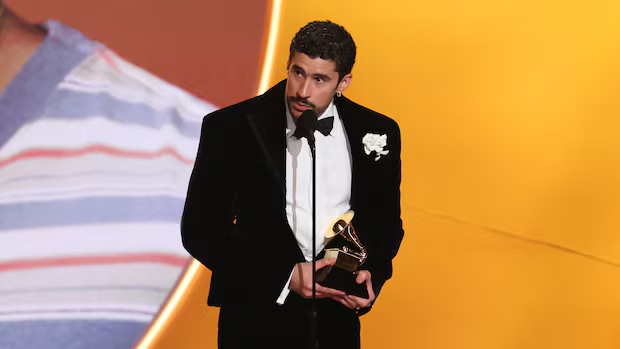
I’ll stick with Bad Bunny, who made it plain when accepting the Grammy for best Musica Urbana Album.

Puerto Rican musician Bad Bunny was a big winner at this year’s Grammy Awards and used the opportunity to speak out against U.S. President Donald Trump’s immigration policies.
“Before I say ‘Thanks to God,’ I’m gonna say ‘ICE out,’” he said. “We’re not savage, we’re not animals, we’re not aliens. We’re humans and we are Americans.”
The audience on-site greeted Bad Bunny with a standing ovation, but opposition percolated immediately in the exact corners of the internet where you’d expect to find it.
“F*** BAD BUNNY,” tweeted John Rocker, former MLB relief pitcher and current, recurrent, Bad Bunny critic. “THIS LOSER CANT EVEN FINISH A SENTENCE IN ENGLISH!!”
Here’s where the anti-Bad Bunny crowd actually does miss the point, because it doesn’t actually matter if you speak Spanish. Bad Bunny glides gracefully between musical genres on this album, but he doesn’t code switch. If you can’t decipher the local vernacular you’ll miss half of what he’s saying, even if you aced Spanish in high school. It’s like learning English on Duolingo then listening to Supercat.
That Grammy speech came in his second language, but sent a clear message about a grave threat to civil liberties everywhere.
Uninvited guests
ICE deputizes recruits like cops, outfits them like soldiers, then tasks them with rounding up immigrants and citizens alike, on the premise that Real Americans don’t want them around. But ICE is also set to send agents to the Winter Olympics in Italy, uninvited guests with no clear role in a foreign country, showing up even though the host nation has told them to stay home.
It’s a glaring double standard. If you’re an immigrant, or a U.S. citizen whose first language is Spanish, we don’t want you in our cities or our Super Bowl. But if you’re another country it doesn’t matter if you want us; we’re coming to the Olympics anyway.
You know who understands that kind of hypocrisy?
Kid Rock, who volunteered to counterprogram against Bad Bunny to appease people who couldn’t stomach seeing a Puerto Rican perform on a massive stage at the intersection of sports and pop culture.
I can’t speak for the rest of you, but I remember when I first saw Kid Rock: December 19, 1998, on HBO, mic in hand, rapping as he accompanied Angel Manfredy to the ring for his title fight against Floyd Mayweather. Manfredy is a native of Gary, Indiana, 20 minutes southeast of Chicago, but you get one guess where his folks are from.
Same place that gave us Tito and Cotto, and Carlos Delgado and Roberto Clemente, and I could keep going but you get the point. Same place that Bad Bunny says he’ll never leave.
You can’t build a wall around it, and you can’t freeze him out. There’s not enough ice on the planet for that.
When he takes the stage on Sunday all you can do is change the channel.
And that’s fine.
He wasn’t performing for you anyway.