
Follow Winter Olympic SportsPersonalize Your Feed
Calgarians waking up Friday morning may feel a nagging suspicion in the back of their minds that there was somewhere they were supposed to be.
Some might remember being sold on a grand spectacle that would have started this week, directing the world’s attention squarely at Calgary and inviting the globe’s greatest athletes to town.
But if Calgarians go looking for that spectacle, they’ll find it about 8,000 kilometres away in Milan, Italy.
In 2018, Calgary looked like the favourite on a short list of potential hosts for the 2026 Winter Olympics, boasting the pedigree of previously hosting the 1988 Games. The city’s bid resulted in months of debate over whether Calgary could afford the Olympics, all leading to a plebiscite in November in which 56 per cent of voters called for the bid to be abandoned.

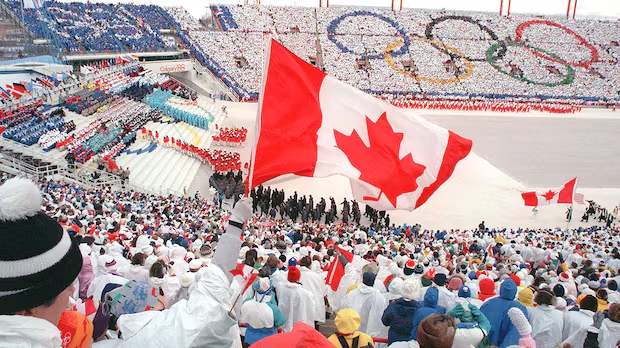
The 1988 Olympic legacy looms large in Calgary’s history, putting the city on a large global sports stage.
It’s also one of three times the world’s biggest sports event was held in Canada in less than 35 years, along with Montreal in 1976 and Vancouver in 2010.
But it’s looking increasingly likely Canada could go just as many years without hosting the Olympics.
And as many of the last remnants of the 1988 Games fade, it’s unclear whether Calgary is still an Olympics city, and if the public would support its return.
‘Dealt a pair of twos’
Mary Moran calls not pushing the date back for Calgary’s Olympic plebiscite the greatest regret of her life.
The vote arrived when Alberta’s economy was still recovering from the oil industry’s recent downturn, amid discussion of unemployment and empty downtown office towers.
Moran, who was the Calgary Olympic Bid Corporation’s CEO, says it was hard for voters to wrap their heads around how Calgary could invest in a sports mega-project, especially when a funding agreement between every level of government was still being finalized weeks before the plebiscite.
“We were dealt a pair of twos in a high-stakes game,” says Moran.
“I just think we were left on our back foot defending situations that we didn’t know the numbers to.”

The bid’s supporters argued Calgary could use the event to bring in new investment and update aging infrastructure.
The plan for 2026 had a $5.1-billion price tag, paying for a long-awaited multi-sport fieldhouse and a mid-sized arena, as well as renovations to the Saddledome, McMahon Stadium, the Olympic Oval speed skating track, and the sliding track and ski hill at WinSport. The bid also planned to convert temporary athlete accommodations into affordable housing after the Games to address the city’s housing crisis.
Events would be split between Calgary and mountain communities like Canmore, Kananaskis or Whistler, B.C. Canmore’s municipal government supported the plan, offering to contribute funding as well.

Reflecting on the plan, former city councillor Evan Woolley now sees it as a missed opportunity.
“The Olympic bid was new money that would have not otherwise flowed to Calgary,” said Woolley.
“When I look at the city today, what investments would we be wandering around looking at right now as the Olympics opening ceremonies could have been happening? When we look at those investments, that’s just not happening.”

Woolley, who chaired the city’s Olympic assessment committee, was one of the bid’s biggest supporters.
But he says when the provincial and federal governments didn’t offer as much funding as the city had hoped, he saw that Calgary couldn’t afford to carry the financial risk of the Games and recommended pulling the plug.
Support in Calgary collapsed throughout 2018, Woolley says, after the public sensed less excitement for the bid and a slow process to commit money to it, which left voters with questions about the event’s viability.

Calgarians came out in the hundreds of thousands to vote in a plebiscite asking whether they wanted their city to continue pursuing a bid for the 2026 Winter Olympics. While the vote was a non-binding plebiscite, citizens voted against the city’s plan to host the Games, paving the way for Calgary’s city council to officially halt the bidding process.
“We’re having a national conversation about this now, which is our ability as a nation and as a city to deliver infrastructure expeditiously and with speed to meet the challenges of today. And [in 2018] we dragged and dragged and dragged,” says Woolley.
‘Disaster from the start’
While Woolley says public support dropped, Mark Tewksbury says he didn’t see much momentum to begin with.
“I thought it was a bit of a disaster from the start,” says Tewksbury.
Tewksbury, a Calgary-born gold-medal-winning swimmer at the 1992 Olympics, advocated for what the Games could do to boost the city’s sports infrastructure.

But he argues the bid lacked a clear vision. Instead of an Olympic push beginning with a buzz of excitement, it revolved too much around discussions about money.
“A project of this magnitude starts with a vision, it starts with something that’s really exciting that compels people,” says Tewksbury.
“Without that raison d’être to start, without [saying] ‘here’s why we need this, here’s our north star, here’s why, as Calgarians, this is so important,’ I feel like it was a little bit doomed to fail.”

Erin Waite, an organizer with No Calgary Olympics in 2018, argues what drove voters to oppose the bid was opportunity cost. Calgarians were worried the mega-project would mean foregoing funding for other areas, she says, and she felt the bid didn’t articulate how the Olympics would improve the city for everyday Calgarians long-term.
“The tendency with hosting the Olympics is the identified needs in the city are not the things that get built,” says Waite.
“It’s a massive cost for a very actually small group of people who benefit, and that’s not a great equation from my point of view.”
Global votes against Olympic bids
Hosting the Olympics in 2026 is a far cry from what was required of Calgary in 1988, and a large part of what drove Calgary’s “No Olympics” movement, and similar advocacy in other cities, is the large bill that’s often left for hosts to cover.
Every Olympics has come in over budget since 1960, a 2024 Oxford study shows, and in more than half of those Games with available data, the cost was more than double the projected budget.
It’s often escalating security costs that hosts have had to contend with in the past 25 years. After the 2024 Paris Olympics, Reuters reported that France’s top auditors found event organizers failed to properly forecast a large security bill.
Calgary’s bid proposed spending $495 million on security, but the projection was criticized as too low given recent Olympics, like Vancouver, routinely spent at least $1 billion on security.
Moran argues comparisons to Vancouver were unfounded because it’s a port city that had to consider vulnerabilities that Calgary didn’t.
But the risk of that cost rising in Calgary was one of Waite’s greatest concerns.
“Likely, the government of Canada would step in and help. But on paper, the City of Calgary was solely liable, and you can’t ignore that,” says Waite.
Concerns about cost overruns places Calgary’s plebiscite as part of a larger movement where cities have become more skeptical of supporting Olympic bids, says Jules Boykoff, a former professional soccer player who has written extensively about the Olympics’ impact on host cities.

Cities all over the world have voted to reject Olympic bids, including Vienna and Boston. In the Massachusetts capital, an anti-Olympic campaign was so persistent in its efforts to dampen public support to host the 2024 Olympics that organizers eventually quashed their bid.
As the Games have become more expensive, Boykoff says public opinion can often be divided about whether the Olympics are worthwhile.
“The Olympics are an enormously popular event so long as they’re not happening in your community. Once they’re happening in your community, people start paying much more careful attention,” he says.
There’s a dearth of public polling about hosting the Olympics that would help guide cities to know when and why people want the event in their backyard, Boykoff says. He argues any city considering a bid should have a robust democratic conversation, just like Calgary did.
“I think that a city that hosted the Olympics before and that had a rich history of the Olympics, saying ‘no’ to the Games speaks volumes,” says Boykoff.
“It says that the Olympic project has really changed quite a bit.”
Declining sports infrastructure
While the benefits to GDP and the employment gains associated with hosting the Olympics are often called into question, supporters of the Calgary 2026 bid pointed to the opportunity to attract money to rebuild the city’s aging sports infrastructure.

Many of those facilities are still in need of support. WinSport at Canada Olympic Park decommissioned its ski jump towers and suspended operations on its sliding track in 2019. Even the Olympic Oval, while still in use, is near the end of its life, says former Olympian Catriona Le May Doan.
“The oval is on the brink of disaster,” says Le May Doan, a speed skater who won Olympic gold in 1998 and 2002.

Le May Doan adds that even much of the city’s basic sports facilities are in need of upgrades, that elite sport venues are also needed for recreational use in a growing city, and that a fieldhouse remains one of the city’s top unfunded sport needs and has remained one for decades.
“There’s so many layers to what we’ve lost, and we’re playing catch-up,” says Le May Doan.
20:38Is Calgary still an Olympic city?
Can’t you feel it? Or has the spirit aged out of Calgary, more than 36 years after the Olympic Winter Games hit the city? The bricks that line downtown’s Olympic Plaza are the latest physical symbol of Calgary’s Olympic legacy that may be going away – so we ask if the city still has a place on the podium.
Calgary’s sports infrastructure gap is a window into a national problem of aging sports facilities, says Tewksbury, which has led to less depth in Canada’s young, emerging Olympic talent who can compete for medals.
“If you don’t invest in that, it hits a point where there’s nothing in the pipeline, infrastructure starts to deteriorate, and unfortunately that’s kind of the state of the Canadian sports system,” says Tewksbury.
Will Calgary be an Olympic city again?
Calgary 2026 wasn’t Canada’s last serious attempt at hosting the Games. Following Calgary’s plebiscite, a bid to bring the 2030 Games back to British Columbia was shut down when the provincial government said it wouldn’t support the project due to cost concerns.
After Milan, the next four Olympics are scheduled for Los Angeles, the French Alps, Brisbane in Australia and Salt Lake City, Utah.
A crowded list of candidates are vying to host the Olympics in 2036, and Switzerland looks to be in the driver’s seat for 2038.
So, Canada will face an uphill battle if it wants to host the Games again before the 2040s.
Calgary Eyeopener9:51Unconventional Panel – Hypothetical 2026 Olympics
What would a Calgary 2026 Olympic Winter Games have looked like? Our Unconventional Panel dreams it up.
Le May Doan says the International Olympic Committee was frustrated Canada turned down the 2026 and 2030 Games with different levels of government disagreeing on the bids. She says a successful bid would need a champion similar to how former B.C. premier Gordon Campbell pushed for Vancouver 2010.
Calgary Mayor Jeromy Farkas opposed the 2026 bid, and he still argues locals made the right decision to vote against it because there wasn’t enough of a return on investment in the bid’s business case.
But he didn’t rule out a future bid.
“We think about Alberta’s and Calgary’s Olympic legacy, the fact that we need to renew our Olympic Oval, other training facilities — there’s a strong business case for reinvesting and doubling down on our Olympic legacy,” he said on Tuesday.

Eight years ago, Waite argued Calgary could organize around a vision for its future that didn’t need the Olympics. Today, she doesn’t see a clear vision for the city, but she hopes it can focus on growing sustainably to prepare for hitting two million residents.
“A lot of those things that make a great city are boring things. They aren’t necessarily a 10-day international event,” says Waite.