
Listen to this article
Estimated 5 minutes
The audio version of this article is generated by AI-based technology. Mispronunciations can occur. We are working with our partners to continually review and improve the results.
Over the past five months, Premier Wab Kinew has made a series of hints and promises about major projects capable of transforming Manitoba’s middling economy into something far more powerful.
While it’s too soon to say the math ain’t mathing, it would be helpful if the premier would show his work.
In September, Kinew promised to wean Manitoba off federal transfer payments by 2040, effectively ending our status as a have-not province. How precisely this would happen, the premier did not say.
In October, he told a Toronto podcast audience Manitoba’s planning three energy projects that could generate $30 billion in new economic activity — a value equal to more than a third of the province’s existing gross domestic product.
What these projects are, the premier did not say. But he did say they would happen soon enough to end Manitoba’s have-not status “not, like, 40 years in the future” but instead “within the next five, 10 years type of thing.”
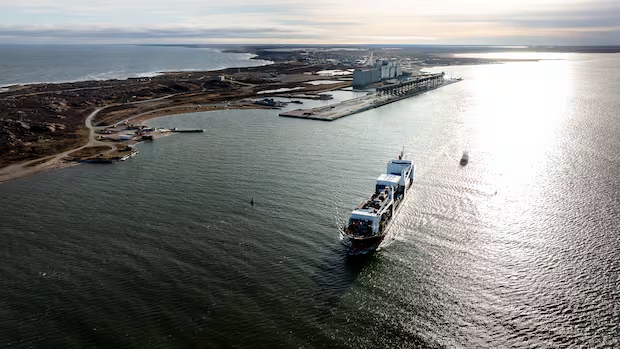
In November, Kinew insisted Mark Carney’s major projects office has signed off on a Port of Churchill expansion even though it was left off the list of the first “nation-building projects” announced by the prime minister.
Then in January, Kinew claimed a major energy company was interested in investing in the Churchill megaproject, which could include a port expansion of some sort, an upgraded Hudson Bay Railway, an all-weather road to Churchill, icebreakers in Hudson Bay, and an “energy corridor” that could involve the transport of oil and gas through Arctic waters.
Who that energy company is, Kinew did not say.
On one hand, there’s nothing unusual or untoward about a premier playing the role of provincial cheerleader. If the federal government is going to spend billions of dollars on new infrastructure projects, Manitobans can and should expect Kinew to try to grab a slice of that pie.
What voters in this province should not expect, however, is any quick fixes for Manitoba’s economic malaise.
A structural deficit
The gap between provincial spending and revenue has been so large and so sustained throughout this NDP government’s time in office, University of Winnipeg economics professor Philippe Cyrenne said it’s fair to call it a structural deficit.
And this gap exists in spite of some of the largest transfer payments to any Canadian province, both in actual dollars ($5 billion is coming from Ottawa in 2026-27) and per capita ($3,347 in federal transfers for every Manitoban).
Manitoba’s NDP government finished its first fiscal year — which it shared with Heather Stefanson’s PC government — with a $2-billion deficit.
It followed 2023-24 up with a $1.2-billion deficit at the end of 2024-25 and is on track to complete the current fiscal year with a $1.6-billion deficit.
There is no simple way to turn this ship around, even if more ships start coming and going from Churchill.
It would take five to 10 years before a major project on the scale of a Port of Churchill expansion would start generating more tax revenue for the province, Cyrenne said.
“These projects are notoriously hard to get going, in terms of the approvals and environmental reviews,” the economist said in an interview late last week.
“Things takes so much longer and in many cases they end up being way more expensive than people had anticipated.”
There is no pricetag for the Port of Churchill expansion right now. The scope of the project has to be determined first.
Cyrenne said exports the Port of Churchill could increase provincial revenues over the long term, however. So could Manitoba Hydro exports to Saskatchewan and Alberta, he said.
That would require the provincial Crown corporation to increase its generating capacity, fix its existing, aging infrastructure and build new transmission lines.
The good news is Hydro is a known entity with tangible assets — not a whisper of a hint of a promise of something new and wonderful.
Program cuts unlikely
The only other option for Manitoba to close the gap between its revenue and expenses is to radically slash program spending.
This is an unlikely course of action for the Kinew government.
Cyrenne noted most governments respond to their base — and the NDP’s base supports the idea of government spending on healthcare and social services.
“Even if their deficits are in the billion-dollar range or a billion and a half, I’m not sure where the breaking point would be for the NDP’s base, if there is one. Whether they would lose elections based on that, I’m not sure,” the economist said.
“Governments really are only as frugal as the electorate demands, in some sense.”
Indeed, deficits only seem to anger voters when they run the risk of crippling the political entity in question, the way financial crises led to mass protests in places as diverse as Iceland in 2008, Greece in 2010 and Sri Lanka in 2022.
This means it’s likely safe for Kinew to talk big about the economy in the long term while revenue growth inches along right now. But there may come a time when voters tire of hints and promises and begin to take more of an interest in the provincial balance sheets.