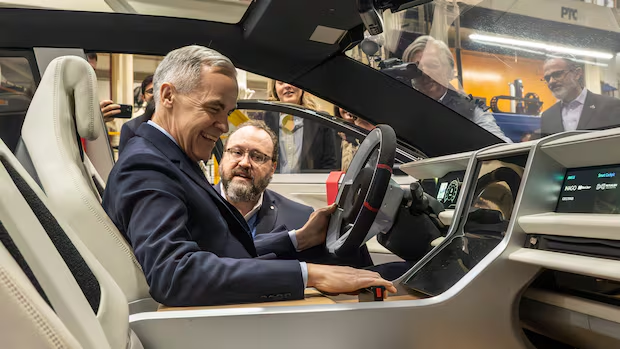
Prime Minister Mark Carney is repealing Canada’s electric vehicle mandate that required all new car sales to be electric in a decade, scrapping another Trudeau-era environmental policy.
Instead, Carney is taking his own approach by introducing stronger greenhouse gas emission standards for vehicle models 2027-32 to encourage automakers to produce more zero-emission vehicles.
“Canada will set a new, more ambitious sovereign path to reduce automobile emissions,” Carney said at a news conference at an auto parts manufacturer in the Greater Toronto Area.
“We’re tightening by twofold our GHG emissions standards and we’re giving the industry the flexibility how they achieve that, whether through plug-in hybrids, EVs, more efficient ICE [internal-combustion engine] vehicles.”
The government unveiled its new national automotive strategy aimed at protecting Canada’s auto sector and jobs in the face U.S. President Donald Trump’s desire to move vehicle production south. Ottawa is also trying to jump-start the country’s battery-powered vehicle industry.

Prime Minister Mark Carney announced a suite of investments on Thursday as part of a new strategy for Canada’s auto industry, including measures to ‘make electric vehicles more affordable and reliable for Canadians.’
Carney expects his new emissions system will lead to 75 per cent of new cars sold in Canada being electric by 2035 — an ambitious goal, but still less than the previous mandate that Carney is ditching.
Government officials said they haven’t precisely calculated how much carbon pollution the new system will eliminate. But Carney said it was modelled based on “grams per mile.”
“So it’s a 57 per cent reduction in the emissions as this ramps up for the vehicles in the country,” Carney said.
New incentives to buy EVs
Carney announced the Liberal government is also launching a new $2.3-billion program to offer consumers and businesses purchase or lease incentives of up to $5,000 for EVs and up to $2,500 for plug-in hybrids.
Plug-in vehicles must be under $50,000 to qualify and be made by countries Canada has free trade agreements with, which would exclude any vehicles made in China. The price cap will not apply to Canadian-made vehicles.
But the maximum $5,000 and $2,500 rebates will only be available for 2026. Starting next year, both rebates decrease steadily until the program is slated to end after 2030.
In the past, Canada offered a popular rebate of up to $5,000 to consumers to help bring down the cost of plug-in vehicles, but the program ran out of money more than a year ago due to high demand.
More charging stations
The government also plans to find partnerships to build more EV charging stations across Canada.
“Wherever you live in Canada, charging your vehicle should be as simple as filling your gas tank,” Carney said.
Carney said the $1.5-billion fund is needed because “too many Canadians worry about being able to reliably get charging on journeys, especially in our rural and northern communities.”
The government is also preparing to release a new electricity strategy in the coming weeks, Carney said, to double Canada’s grid capacity and make electricity more reliable and affordable.
Tariff relief for automakers
To try and keep automakers in Canada from moving south, Ottawa plans on giving Canadian automakers more relief from U.S. tariffs.
The prime minister said if the U.S. “insists on auto tariffs” during the CUSMA review, the government is looking at rewarding companies that sell vehicles in Canada.
“We will explore strengthening Canada’s automotive remission framework through a tradeable credit system that would reward companies that produce and invest in Canada,” Carney said.
“In short, companies that manufacture and invest here would earn credits, while companies seeking to sell vehicles in Canada without paying tariffs would be required to purchase those credits.”
Another $3 billion from the Strategic Response Fund and up to $100 million from the Regional Tariff Response initiative will go toward helping the auto sector diversify to other markets outside of the U.S. and grow.
The EV mandate would be the latest environmental policy from the Trudeau era that Carney is dropping. He cut the consumer carbon tax on his first day in office, and he has since weakened a commitment to implement an oil and gas emissions cap and abandoned Trudeau’s promise to plant two billion trees.

After announcing his government would scrap Canada’s electric vehicle mandate on Thursday, Prime Minister Mark Carney was asked whether he still considers himself to be a leader on climate change. Carney said his government is looking to put in place a new electricity strategy and tighten greenhouse gas emissions standards — but is giving industry ‘flexibility’ on how they achieve that.
Asked if he considers himself a leader on climate change, Carney said “absolutely.”
“I consider Canada a leader on climate change and on focusing on climate change results and solutions,” he said.
Carney outlined a list of his environmental plans, including what he called a “huge range” of direct support and tax incentives to the clean energy production chain. Carney called it the “most competitive investment regime by a mile for the auto sector.”
Green Party Leader Elizabeth May welcomed the reintroduction of the rebate, but said the suggestion that Canada is a climate leader is “an absolute joke.”
“What about the rest of the program? We’ve got Swiss cheese and you’ve just added more holes,” she said, pointing to the repealing of the sales mandate and other Trudeau-era climate policies that Carney has walked back.

On Thursday, when asked what he thinks of Prime Minister Mark Carney calling himself an environmental leader, NDP interim Leader Don Davies said ‘I think the facts completely belie that.’ Carney said he still considers Canada a climate leader after announcing his government would scrap the EV mandate that morning.
Like May, interim NDP interim Leader Don Davies welcomed the revived rebate and news of the auto strategy but said Carney claiming to be a climate leader doesn’t match his record.
“I think the facts completely belie that,” Davies told reporters on Parliament Hill.
Davies said the Liberals’ auto strategy will need to focus on ramping up Canadian production of affordable EVs.
Conservative industry critic Raquel Dancho panned Thursday’s announcement as “insulting” to Canadian autoworkers, arguing that it will only help American companies. In a statement, she said the Liberals should help workers by delivering on their promise of getting a trade deal done with the U.S.
“This announcement is proof that the Liberals are more concerned with their ideological crusade than getting a deal on trade and supporting Canadian workers,” Dancho’s statement said.
Ontario premier welcomes move
Ontario Premier Doug Ford swiftly issued a statement saying he welcomes and supports the federal government’s new auto strategy.
“Ontario has been urging the federal government to end its electric vehicle mandate because it made our auto sector less competitive, undermining investment and threatening jobs at a time when the sector is under attack by President Trump,” Ford said.
The auto sector is a major employer in Ontario.
“This is a pivotal moment for Canada. Our economy and sovereignty are under attack. It will take a united, strong Team Canada to fight back to defend our workers, businesses and communities,” Ford’s statement said.
The federal government’s new strategy comes as electric vehicle sales sag.
Monthly sales data published by Statistics Canada shows a clear drop in sales of new EVs at the beginning of 2025 and never recovered from its heights in previous years. This drop coincided with the government’s decision to pause its widely used EV rebate program.
The lack of government incentives, along with economic uncertainty related to tariffs and a drop in interest in EV giant Tesla all weighed down sales, according to a StatsCan analysis.