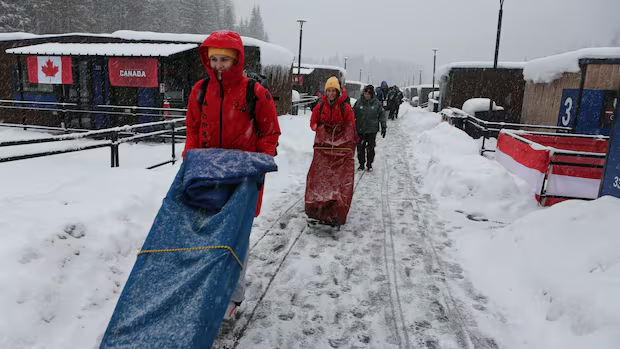
Travelling between venues at the 2026 Milano-Cortina Winter Olympic Games should be listed as its own endurance sport.
Spectators, athletes and organizers will have to rely on a multi-layered transport network that connects the very widely spread venues for these Games, which range from a bustling, stylish metropolis to mountain towns with endless views.
It would take a single journey of about 850 kilometres to visit the eight Olympic hubs hosting the ceremonies and 16 disciplines featured at this year’s Winter Games: Milan, Livigno, Bormio, Tesero, Antholz-Anterselva, Predazzo, Cortina d’Ampezzo and Verona (of Romeo and Juliet fame).
Together, they cover an area of about 22,000 square kilometres, with half of them in the Dolomites, northern Italy’s famous mountain range of jagged limestone peaks and deep valleys, where many communities have limited vehicle access and train schedules can be difficult to untangle.
Milan is the main centre for ice sports, while Cortina will showcase many alpine and sliding disciplines. But if freestyle skiing is your thing, you’ll need to head to Livigno in the Alps. Looking for biathlon? Antholz-Anterselva, a 3½-hour drive to the east, is the venue.
It’s a logistical puzzle for everyone involved and one that is relatively new for the International Olympic Committee (IOC), after its 2020 agenda outlined a strategy for host cities to use existing infrastructure as much as possible and create long-term use plans for new builds.
IOC president Kirsty Coventry acknowledged at a news conference Wednesday that the model may end up putting more responsibility on national Olympic committees to spread resources across the many venues and far-flung locations.
“It’s possible and I’m doing it,” Coventry said of travelling between the venues in northern Italy, adding that, “it will be a long two weeks because of the travel time, but what’s really cool is you’re going to get to see world-class venues in the most iconic, beautiful places.”

The simplest way to get between the six hubs is by rail. Cars are not generally permitted near the competition sites. In Cortina d’Ampezzo, for example, spectators driving in will have to use designated park-and-ride lots.
Dedicated shuttle buses will run from major transport hubs, like train stations and park-and-ride areas, directly to Olympic venues.
Milan’s metro, tram and bus network have extended their hours to serve the city’s Olympic venues. Metro stops providing access to the main arenas are paired with special shuttles for last-kilometre connections, if required.
No emotional centre
Coventry said the IOC has put in place several ways to measure the impact of the spread of these Games and whether it really is more sustainable than other solutions.
Many Olympic Games have been held over much smaller areas but at greater cost due to the requirement of new infrastructure: consider Sochi 2014 — considered the most expensive Olympics in history — or even the 1988 Games in Calgary, which spurred the construction of the Saddledome and the Olympic Oval.
As per the IOC’s 2020 agenda, Paris 2024 relied on existing and temporary venues for the majority of events to reduce environmental footprint and cost.
But doing so for this year’s Milano-Cortina Games has meant they’ve become the most geographically dispersed of any Winter Olympics in history.
The framework is meant to allow more areas in northern Italy to benefit from the investments and tourism that come with such big events.
But many feel it also deprives the Games of an emotional centre, with spectators having to make hard choices about which events to attend and athletes having difficulty cheering on teammates in far-flung disciplines.
For example, Canadian athletes, their family and friends can usually converge at Canada House in the host city. This year, the Canadian Olympic Committee (COC) will instead be hosting a rotating Olympic house celebration series between Cortina, Livigno and Milan on separate days, COC chief executive officer Dave Shoemaker told The Canadian Press last month.

“I totally support having a more sustainable Games, but it’s also going to make it more challenging to feel like a united team out there,” Canadian freestyle skier Brendan Mackay told the news service.
“I’m still excited to watch the other events that are up in Livigno. Then, hopefully, I will be able to make it into Milan for closing ceremonies, too. That would be really cool to get to go walk with athletes I didn’t get to see compete live.”

The Milano-Cortina Winter Games are the most spread-out Winter Olympics ever, and that poses some unique challenges for moving both athletes and fans around. But because of costs and climate change, this kind of geography may become more common.
Friday’s opening ceremony will give an example of how organizers have tried to unite the venues.
While Milan’s San Siro stadium will host the headliners, including Mariah Carey and Andrea Bocelli, there will also be simultaneous ceremonies in Predazzo, Livigno and Cortina d’Ampezzo so that all competitors can participate in the traditional parade of nations.
And, for the first time in Olympic history, two cauldrons will be simultaneously lit by the Olympic flame: one in Milan, one in Cortina.
Multiple Olympic villages
With these Olympics being so widely spread, organizers also had to find housing for athletes in several different locations. In Milan and Cortina, and also in Antholz-Anterselva near the Austrian border, Bormio and Livigno near the Swiss border, and Val di Fiemme in Trentino province.
In smaller hubs, athletes are being housed in hotels and other existing facilities.
As part of the IOC’s sustainability drive, Milan’s Olympic Village will become housing for 1,700 students after the Games, while the 400 mobile homes for athletes in Cortina will be distributed to tourist destinations throughout Italy.

As Olympic athletes descend on Milan, CBC News chief correspondent Adrienne Arsenault goes on a tour of the accommodation in the athlete’s village to see how the Canadians are settling in.