The Donald Trump administration on Thursday finalized its overhaul of the U.S. government’s civil service system, according to a government statement, which would give the president the power to hire and fire an estimated 50,000 career federal employees.
The overhaul, released by the Office of Personnel Management (OPM), fulfils a presidential campaign promise for Trump to strip job protections from federal workers that his team deems to be “influencing” government policy.
The move represents the biggest change to the rules governing the civil service in more than a century. Trump planned what was originally called the “Schedule F” overhaul late in his first administration, but his 2020 election loss prevented him from following through on the initiative.
Trump will have the power to select which government positions will lose their job protections, according to the OPM statement.
The new policy will be scrutinized by a federal judge. Federal worker unions and their allies sued in January to stop the policy before it was fully developed. Federal judges paused the litigation while the Trump administration finalized the changes.
A court challenge will resume in the coming days, said Skye Perryman of Democracy Forward, one of the groups behind the lawsuit.
“We will return to court to stop this unlawful rule and will use every legal tool available to hold this administration accountable,” she said in a statement.
Front Burner30:56What’s behind Trump’s latest Canada threats?
‘If you’re a lawyer … DM me’
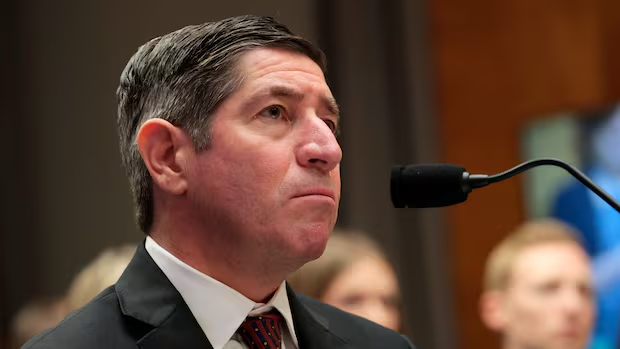
OPM director Scott Kupor said Thursday that the shift “ensures taxpayer dollars support a workforce that delivers efficient, responsive and high-quality services.”
Budget data points to little, if any, cost savings. The government has spent close to $244 billion US on federal salaries since Trump returned to the White House, three per cent more than it did during the same period under Trump’s Democratic predecessor Joe Biden, according to a recent Reuters analysis from Treasury Department data.
Kapoor said the final rule “explicitly prohibits political patronage, loyalty tests or political discrimination.”
WATCH | The latest episode of Two Blocks From the White House:
But Democrats in Congress and some departing employees suing the government have challenged those claims. For example, the Justice Department moved to fire career lawyers and FBI agents who had previously worked on investigations involving Trump, even though those duties were assigned.
The departures have caused backlogs and staff shortages, The Associated Press reported last month after interviewing more than half a dozen fired employees from the Justice Department.
Senior leaders have solicited job applications, some of those employees said. Last week, Chad Mizelle, acting general counsel for the Department of Homeland Security and a former Department of Justice chief of staff under Trump, raised eyebrows with an open call recruiting message on social media platform X.
“If you are a lawyer, are interested in being an [assistant United States attorney] and support President Trump and anti-crime agenda, DM me,” Mizelle posted.
Joyce Vance, a former federal prosecutor, said on the same platform: “Send me a DM if you want to be a federal prosecutor is not how government hiring works.”
Lowest level in a decade
The OPM estimated federal job losses of 317,000 during fiscal 2025. As a result, the U.S. federal workforce fell to its lowest level in at least a decade, according to government data published last month, a result of Trump’s campaign to shrink the government.
The progressive think-thank Center on Budget and Policy Priorities in a release last month said that based on Department of Labour data, the federal civilian workforce at the end of 2025 had fallen to the smallest share of the overall employed U.S. workforce on record, with data going back to the 1930s.
Trump said last month at the White House that his administration had “cut millions of people from the federal payroll.”
I don’t feel badly because now they’re getting private sector jobs and they’re getting some times twice as much money, three times as much money,– U.S. President Donald Trump
“I don’t feel badly because now they’re getting private sector jobs and they’re getting sometimes twice as much money, three times as much money,” he said.
Trump added that those laid off were “getting factory jobs,” even as data from his own administration has pointed to a downturn in manufacturing jobs.
The U.S. government employs 2.1 million workers, according to OPM statistics. The federal government has long been seen as a stable employer, with staff commonly spending decades working inside U.S. agencies.
Trump and his team sought to change that at the start of his second term, as he argued that the federal government was bloated and inefficient.

Ahead of his re-election in 2024, the Heritage Foundation led a host of conservative groups in contributing ideas to a hoped-for second Trump administration, with its Project 2025 plan promising to “dismantle the administrative state.”
Data from the Organization for Economic Co-operation and Development (OECD) contradicts the claim of a bloated public service, at least in terms of numbers on a per capita basis. The U.S. recently had a share of public sector employment that was four percentage points lower than the OECD average, at slightly more than 14 per cent.
As well, comparative data indicates that the U.S. has far more political appointees both in number and percentage, than nearly all Western governments.
Trump tapped billionaire CEO Elon Musk to help spearhead downsizing effort, even as his several business ventures appeared to put him in a conflict of interest position. Young staff on Musk’s Department of Government Efficiency have been accused of improperly accessing the private data of Americans.
Cuts hit nearly every major federal agency last year, according to OPM statisitcs. Several lost more than a quarter of their staff, including the departments of Education, Agriculture and Housing and Urban Development. The Department of Homeland Security is an exception, with the headcount barely fluctuating since Trump took office.

Federal worker unions and their allies sued over the terminations that resulted. Many of the lawsuits are still pending in court.
Musk, who clashed with Trump months after taking on the assignment, told a podcast in December the DOGE efforts were “a little bit successful.”
DOGE no longer exists as a centralized entity, Kupor told Reuters in November.
The OPM statement Thursday also said the Trump administration is changing how long-standing legal protections that prohibit U.S. government agencies from retaliating against whistleblowers will be enforced.
Federal agencies will be in charge of setting up job protections for their own employees that accuse them of wrongdoing, such as violating the law or wasting money. That would be a change from the past, when an independent office known as the Office of the Special Counsel handled whistleblower disclosures from most civilian federal workers.