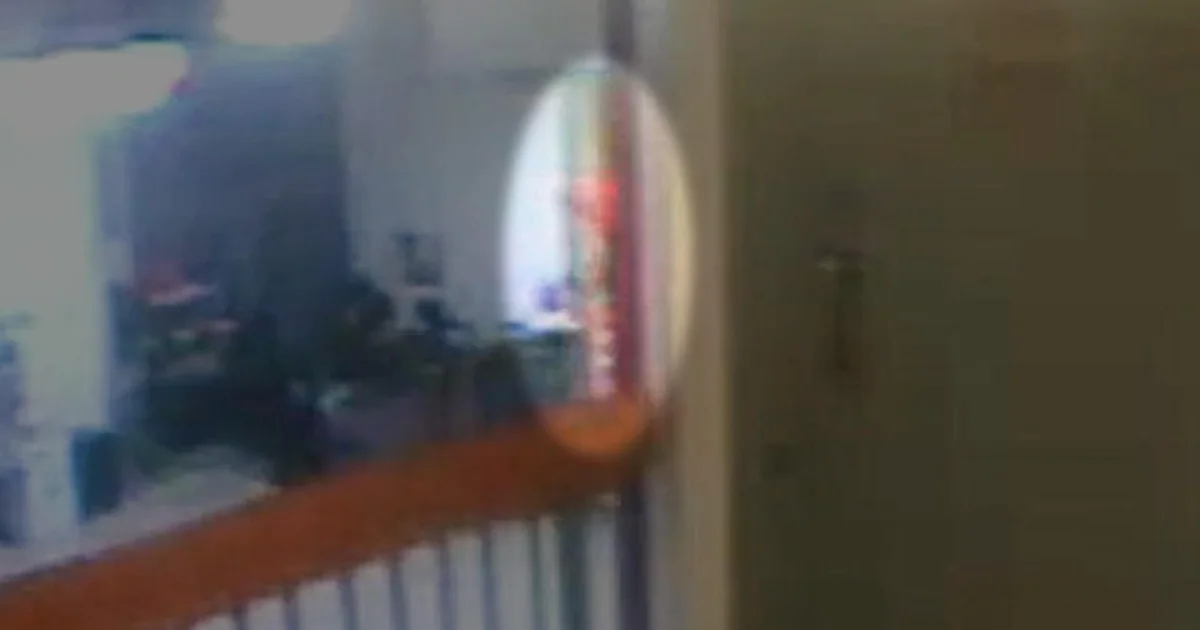
Newly released Department of Justice documents show that investigators reviewing surveillance footage from the night of Jeffrey Epstein’s death observed an orange-colored shape moving up a staircase toward the isolated, locked tier where his cell was located at approximately 10:39 p.m. on Aug. 9, 2019.
That entry in an observation log of the video from the Metropolitan Correctional Center appears to suggest something previously unreported by authorities: “A flash of orange looks to be going up the L Tier stairs — could possibly be an inmate escorted up to that Tier.”
It also appears, according to an FBI memorandum, that reviews by investigators led to disparate conclusions by the FBI and those examining the same video from the Department of Justice’s Office of Inspector General.
The FBI log describes the fuzzy image as “possibly an inmate.”
Document released by Department of Justice 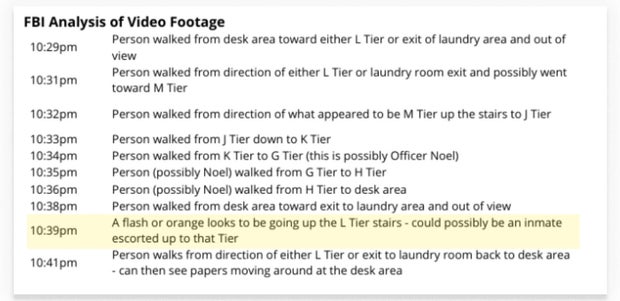
The inspector general logs it as an officer carrying orange “linen or bedding,” noting it in their final report as “an unidentified [corrections officer].”
Document released by Department of Justice 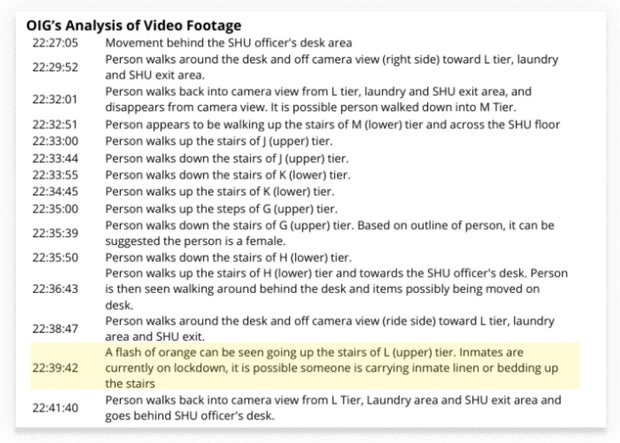
The final report by the Inspector General stated: “At approximately 10:39 p.m., an unidentified CO appeared to walk up the L Tier stairway, and then reappeared within view of the camera at 10:41 p.m.”
Official reports state that Epstein died by suicide some time before 6:30 a.m., when his body was discovered by a corrections officer delivering his breakfast. No official time of death was ever determined. In recent months, there have been questions about the work of investigators probing the circumstances of his death.
In an in-depth analysis of surveillance video from the jail, CBS News previously reported on the figure on the stairs and consulted independent video analysts who said the movement was more consistent with an inmate — or someone wearing an orange prison uniform — than a corrections officer.
The new records raise more questions about activity near Epstein’s tier late that evening. Official reviews of Epstein’s death make no mention of the figure in orange, and later pronouncements from authorities including the attorney general at the time, Bill Barr, were that no one entered Epstein’s housing tier the night of his death. Last summer in an interview on “Fox & Friends,” then-deputy FBI director Dan Bongino said, “There’s video clear as day, he’s the only person in there and the only person coming out. You can see it.”
Prison employees interviewed by CBS News said escorting an inmate at that hour would have been highly unusual. The identification of the individual could have been crucial to reconstructing the events, given that the sighting occurred within the estimated window of Epstein’s possible time of death.
The staircase leading to his cell tier was captured by the only camera known to have been recording that night, positioned in a way that partially obscured the approach to Epstein’s tier. Government investigators relied heavily on that footage in reconstructing the timeline of events. But because of the camera angle, it was not possible to rule out whether someone could have climbed the stairs and entered the tier without being clearly visible. CBS News’ analysis of that video found additional contradictions between what the video showed and official statements.
U.S. Bureau of Prisons 
Inside the SHU
Thousands of pages released last week as part of a broader Justice Department disclosure of Epstein-related files, totaling more than 3 million documents, provide additional detail about the hours between the evening of Aug. 9, when Epstein was last seen alive on camera, and the discovery of his body the following morning.
Records and interviews describe a largely quiet night inside the Special Housing Unit, or SHU, where Epstein was being held. Several inmates told investigators they were using drugs inside their cells, including marijuana and K2, a synthetic substance that multiple witnesses said was common on the tier.
Among those interviewed were the two corrections officers assigned to the unit that night, Tova Noel and Ghitto Bonhomme, a materials handler who had not previously been publicly identified. Documents show Bonhomme was interviewed twice in September 2019 in sessions conducted in lieu of a grand jury subpoena.
According to Noel’s account, Bonhomme had been working multiple consecutive shifts and slept while on duty for a period between approximately 10 p.m. and midnight.
Investigators also questioned Noel about an unexplained change in the recorded number of inmates in the SHU, which appeared to drop from 73 to 72 sometime between 10 p.m. and 3 a.m. Noel said she was “probably” mistaken about the discrepancy and told investigators she had no memory of a count changing.
Neither officer was specifically asked about the orange-colored figure noted in the video observation log. Bonhomme told investigators he did not remember the period between 10 p.m. and midnight and said he had no recollection of anyone walking up the stairs toward Epstein’s tier at around 10:30 p.m. He added that a jail employee entering a tier alone would have violated policy.
A separate internal presentation included in the document release described a corrections officer, believed by investigators to be Noel, carrying linen or inmate clothing up to the tier. The 2023 inspector general report did not identify Noel as the figure seen in the footage. In her interview, Noel told investigators distributing linen was not part of her duties. “I never gave out linen. Ever,” she said. “Because that’s done on the shift prior.”
An early morning discovery
Bonhomme ended his shift at midnight and was replaced by another corrections officer named Michael Thomas, who would discover Epstein’s body hours later. Noel continued on for a second consecutive 8-hour shift.
Thomas and Noel failed to complete inmate counts at 3 a.m., and 5 a.m. as well as mandatory 30-minute wellness checks of Epstein. Investigators speculated the officers may have fallen asleep.
Thomas and Noel were later charged with falsifying records certifying the inmate counts had been completed. Federal prosecutors eventually dropped the charges in exchange for cooperation agreements that included interviews. A transcript of Thomas’ interview, conducted two years after Epstein’s death and released in the recent document disclosure, shows significant gaps in his recollection of the morning Epstein was found.
Thomas told investigators he discovered Epstein in his cell shortly after 6:30 a.m. on Aug.10 and that he “ripped” Epstein down from the hanging position.
Investigators asked what happened to the noose.
“I don’t recall taking the noose off. I really don’t,” he replied. “I don’t recall taking the thing from around his neck.”
Noel, who remained standing at the cell entrance, told investigators she saw Thomas lower Epstein to the floor but did not see a noose around his neck.
The noose Epstein allegedly used has never been definitively identified. According to the inspector general’s report, a noose collected at the scene was later determined not to be the ligature used in Epstein’s death.
Thomas also described Epstein as shirtless when he found him. Evidence records indicate a shirt believed to have been cut from Epstein’s body was later returned from the hospital in a bag of personal belongings.
Released by Department of Justice 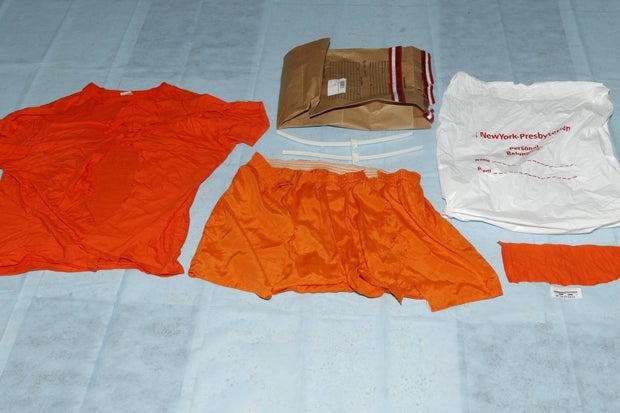
The new documents also show that New York City’s Office of the Chief Medical Examiner reviewed the jail surveillance footage six days after Epstein’s death as part of its investigation and concluded the video was too blurry to identify any individuals. Hours later, the office publicly ruled Epstein’s death a suicide. The medical examiner did not provide an estimate of how long Epstein may have been dead before his body was discovered. CBS News had previously reported on the office’s unorthodox handling of the crime scene.
Dr. Michael Baden, a forensic pathologist retained by Epstein’s brother, previously told CBS News Epstein had likely been dead for several hours before he was found but because the body had been moved, determining the time of death was impossible.
Bonhomme declined to comment when contacted by CBS News. Noel’s attorney told CBS News, “Ms. Noel will not be making any statements [or] attempts to clarify any aspect of this situation.” Previous attempts to reach Michael Thomas on the phone, through his attorney and at his home, have been unsuccessful.