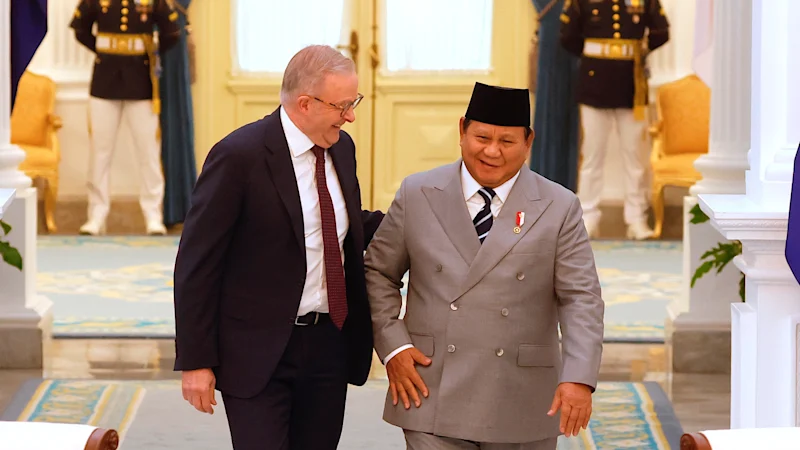

Australia will develop joint military training infrastructure in Indonesia in a potentially provocative initiative flowing from the goodwill of a “watershed” defence agreement inked on Friday by Prime Minister Anthony Albanese and Indonesia’s President Prabowo Subianto.
The purpose of the “joint” infrastructure is to allow the facilities in Indonesia to be used by the country’s military forces and its partners, including Australia. Indonesia is staunchly non-aligned with any major global power bloc and does not permit the presence of foreign bases on its soil.
Responding to a question about whether the facilities could pave the way for a permanent or semi-permanent Australian troop presence on Indonesia, Albanese said it was “a matter for Indonesia to consider down the track”.
“What we are doing, though, is reaching out and offering our support where it’s helpful for it to be given,” he said at a press conference in Jakarta.
He added that there was nothing new about Indonesia and Australia swapping personnel and committing to exchanges, citing President Prabowo’s time at Duntroon in Australia before rising through the ranks of the Indonesian military.
As part of the knowledge sharing and people-to-people relationship building, Australia and Indonesia will additionally begin an exchange program for junior military leaders, and Australia will invite a senior military figure to embed in the Australian Defence Force.
Albanese announced these initiatives immediately after signing the Treaty on Common Security – or the Treaty of Jakarta, as he called it on Friday. The agreement, which he called historic, comes amid increasing volatility and uncertainty in the Indo-Pacific stemming from the policy approaches of US President Donald Trump and his power rivalry with China.
“No country is more important to Australia or to the prosperity, security and stability of the Indo-Pacific than Indonesia,” Albanese said, with Prabowo at the lectern next to him.
Most significantly, the treaty committed both countries to “consult each other in the case of adverse challenges to either party … and, if appropriate, consider measures which might be taken either individually or jointly”.
What this could mean in practice remained intentionally ambiguous, but the treaty was not a mutual defence pact like the Pukpuk Treaty signed with Papua New Guinea last year.
Another article of the deal has committed Australia and Indonesia to consult at leader and ministerial levels on “a regular basis”, which is also ambiguous and aligns with articles already existing in the Lombok Treaty of 2006.
One Indonesian figure, not authorised to speak publicly, did not believe the agreement would add much to the Lombok Treaty and the Defence Cooperation Agreement of 2024, but believed Australia was keen to use the word “treaty” to make it more eye-catching.
Albanese flew into Jakarta on Thursday night, his fifth visit as prime minister to the world’s third-largest democracy and second since Prabowo took office in October 2024.
The lavish welcoming ceremony did not all go to plan. Some of 120 horses leading the prime minister’s vehicle inside to the Merdeka Palace grounds got skittish and bolted, dropping at least two Indonesian military men riders to the pavement. Red faces, but no one appeared to be seriously injured.
Indonesia is the world’s largest Muslim-majority democracy. The archipelagic northern bulwark of 280 million people is predicted to be a top-five global economy within the next 15 years.
Get a note directly from our foreign correspondents on what’s making headlines around the world. Sign up for our weekly What in the World newsletter.
