
Listen to this article
Estimated 4 minutes
The audio version of this article is generated by AI-based technology. Mispronunciations can occur. We are working with our partners to continually review and improve the results.
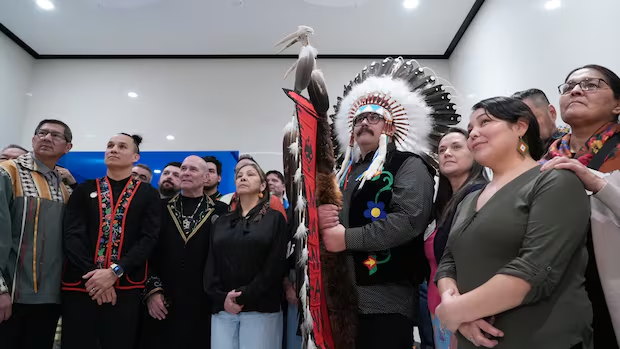
Sipi Flamand, Chief of the Atikamekw Council of Manawan, was denied access to public consultations into Quebec’s proposed constitution at the National Assembly on Thursday, because he was carrying an eagle staff — a sacred object from his community.
The First Nations leader was told the staff went against the regulations of the National Assembly on decorum and he would have to leave it behind to enter the room for consultations.
“We came to the National Assembly in the spirit of nation-to-nation relations and they treat us as subhuman,” said Flamand, adding the refusal to let him in the room with the eagle staff demonstrated ignorance.
“It’s a sacred object. It’s an object made by elders to represent our territory,” he said.
Other chiefs remained outside the room with him, in a show of solidarity. Representatives from 32 First Nations travelled to the National Assembly on Thursday to take part into consultations into Bill 1 — the Quebec government’s draft constitution.
For Assembly of First Nations Quebec-Labrador Chief Francis Verreault-Paul, the move was representative of the ‘colonial nature’ of the Coalition Avenir Québec’s (CAQ) Quebec constitution.
“There are chiefs who are outside and who will remain outside because we can’t leave this sacred staff on its own,” Verreault-Paul told the committee. “This could have been a historic occasion to change things together.”
Verreault-Paul pointed out that question period at the National Assembly always begins with the sergeant-at-arms carrying the ceremonial mace, which represents the authority of the King and the Speaker of the National Assembly.
He does not see why the eagle staff should be treated differently.

Verreault-Paul said that chiefs across the province registered for the consultations into the bill — they never received a formal invitation from the province to participate.
“Accepting this bill would mean abandoning our rights, our traditional culture, and consenting to our assimilation,” Lucien Wabanonik, Chief of the Lac-Simon Anishinaabe Nation, told the committee.
Bill 1 only makes mention of First Nations once and only in the preamble. Verreault-Paul said Indigenous leaders were not consulted on the wording of that section either.
“[The bill] says there is only one people in Quebec and it’s Quebecers,” he said.
Indigenous leaders from across the province are calling for the bill to be withdrawn in its entirety.
“Erasure and invisibility are the very characteristics of colonialism,” said Verreault-Paul.
He likened the Quebec government’s approach to the proposed constitution to when the government took the AFNQL to Supreme Court, to challenge Canada’s Indigenous welfare law, because the government felt it threatened provincial jurisdiction.
“It’s a paternalistic approach, again,” said Verreault-Paul.
In a heated exchange at the National Assembly Thursday, Justice Minister Simon Jolin-Barrette, who tabled Bill 1, accused Verreault-Paul of misinterpreting the bill and misquoting him.
He said he heard the First Nations leaders’ concerns when they met in Montreal in November.
“On the aspect of colonialism, I formally reject this. It’s your opinion and I reject that accusation,” Jolin-Barrette said at the consultations.
He added there is nothing in the Quebec constitution that would infringe on Indigenous rights and that the province has the right to draft its own constitution.
Should the Quebec government refuse to withdraw the bill, Mohawk Council of Kahnawà:ke Grand Chief Cody Diabo says it should at the very least be made clearer in the bill that the rights of First Nations will be respected.
“We do not approve Quebec trying to legislate over us,” he said.