
Welcome to our weekly newsletter where we highlight environmental trends and solutions that are moving us to a more sustainable world.
Hi, it’s Bridget. After attending an event where kids shared how they felt about climate change, I talked to some of them about their hopes and concerns for the future.
This week:
- Many kids feel hopeless about climate change. Here’s what helps
- The Big Picture: Unlocking Canada’s lithium brines
- Alberta’s ‘Gas City’ votes to fund huge solar project
Many kids feel hopeless about climate change. Here’s what helps

Despite being concerned about the high use of fossil fuels and non-renewable resources, 14-year-old Midu Nguyen remains hopeful that the world will take action on climate change.
To her, it’s all about perspective. She takes the same approach to it as she does to tests at school.
“If you have a test and you don’t want to study for it because you think you’re already going to fail it, then you will fail,” she said in an interview with CBC News.
“If you change that mindset and think, I will be able to change this, then I think you can really do that.”
But Nguyen is not a typical kid.
A 2023 study published in The Journal of Climate Change and Health found that at least 56 per cent of Canadian youth respondents feel afraid, sad, anxious and powerless when it comes to climate change. And 78 per cent reported that climate change impacts their overall mental health.
One way to shift that mindset is to talk about it.
Catherine Malboeuf-Hurtubise, a professor at Université Laval and a Canada research chair in art-based and existential interventions in youth mental health, says kids need to be included in conversations about climate, as they will be the ones suffering the most consequences of climate change.
“I think we underestimate their ability to understand, feel and make sense of what’s happening,” she said.
Malboeuf-Hurtubise believes collective action is the solution and told CBC News that kids need to understand that it’s OK to not have a solution, but that gathering and talking about climate change is a way out of despair.
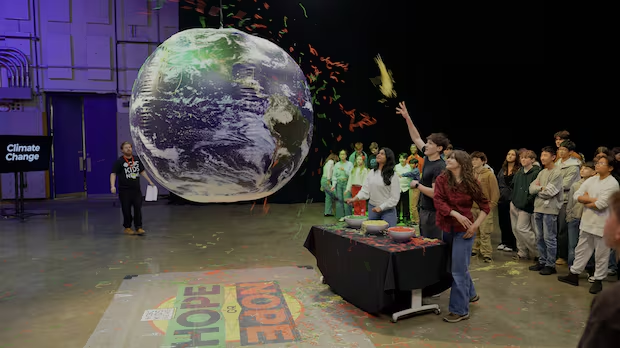
Nguyen was one of 100 kids from schools across southern B.C. that gathered at CBC Vancouver to take part in Hope or Nope, a CBC Kids News event where they could share their feelings about climate, the cost of living and AI.

They started by logging their views, and were then given the opportunity to talk to their peers and have their questions answered by a climate expert.
At the beginning, only nine kids were hopeful.
Let kids feel despair and hopelessness
Thirteen-year-old Aubrey Woodhouse voted nope.
“I want to have hope, but at the same time I feel like it’s pretty unrealistic considering the amount of irreversible damage we’ve already caused in such a short amount of time,” she told CBC News.
“It’ll take a lot of work and a lot of resources that people aren’t willing to give, because of greed and hunger for power and money.”
Woodhouse says she hopes her generation can fix climate change to the best of its ability, but sees it as unlikely. She doesn’t feel that people take her seriously, because she’s “just a kid.” She believes young people will be left to deal with the consequences of climate change.
These feelings of hopelessness are familiar to Malboeuf-Hurtubise.
When she started doing research on eco-anxiety in children a few years ago, she developed clinical interventions around the theme of hope that she implemented in schools. But the kids didn’t want to talk about hope.
Malboeuf-Hurtubise soon realized they wanted to talk about despair and hopelessness, and needed a place to voice and explore those emotions.
“Generally speaking, from our research, none of them want to give up or stop acting to preserve the environment. But they have doubts as to where this is going and whether their future will be OK.”
She says this is all the more reason to involve them in conversations.
Through her work, Malboeuf-Hurtubise has learned the importance of validating children’s feelings — as opposed to just telling them not to worry or that things will all work out — because that’s not what kids, or many adults, are seeing and feeling.
Thirteen-year-old Avani Ray says she hears negative stuff from her mom about how quickly we can reverse the effects of climate change, but Avani wants to stay a part of the conversation.
“We’re going to grow up and it’s going to be our responsibility.”
Don’t forget about hope

Climate scientist Simon Donner has watched his students at the University of British Columbia go from curious or disinterested to scared about their futures.
He stresses the importance of hope using genuine stories and explanations.
“I think the climate scientists and activists of my generation have done a great disservice to the next generation because we have scared the crap out of them, and because we have only told them one half of the story, and we haven’t told them how solutions to climate change will make the future better.”
He told CBC News that people can see through false hope, so his approach is to be frank.
“Don’t use a bunch of pre-prepared lines or anything. Just be genuine and they’ll respond to that.”
He told the kids that one of the most important things they could do is talk about climate change with parents and friends. The more they talk about it, the more that can cascade into action and change opinions.
After hearing from Donner, Poppy Weiler, 13, changed her vote from nope to unsure, because the scientist helped her see things differently.
“I was questioning, but I wasn’t like, ‘Oh, I’m going to change my opinion completely,'” said Weiler, who still worries about things like how the beauty industry impacts the environment.
While Nguyen recognizes that corporations have a big impact on climate action, that’s actually the reason she remains hopeful.
“In the future, we will be the ones leading those corporations,” she said.
“And if our generation starts learning, caring and pushing for change now, we can reshape how those systems work from the inside.”
Watch Hope or Nope on CBC Gem.
— Bridget Stringer-Holden

Old issues of What on Earth? are here. The CBC News climate page is here.
Check out our podcast and radio show. In our newest episode: We hear you — plastic is “upsetting, confusing, enraging.” But Judith Enck says there’s hope. The Beyond Plastics founder says people and policy makers are finally clueing in to the toxins in these products. We hear about efforts to hammer out an international treaty to curb plastics production and pollution. And, there’s been a key Canadian court ruling on banning single-use plastics.
What On Earth29:59If you hate plastic, here’s what you can do about it
What On Earth drops new podcast episodes every Wednesday and Saturday. You can find them on your favourite podcast app or on demand at CBC Listen. The radio show airs Sundays at 11 a.m., 11:30 a.m. in Newfoundland and Labrador.
Check the CBC News Climate Dashboard for live updates on record-breaking weather and current conditions across the country. Set your location to find out how today’s temperatures compare to historical trends.

Reader feedback
In last week’s Big Picture on EVs with solar panels, we wrote that while some Nissan, Hyundai and Toyota models offered the panels, they didn’t add much to the vehicles’ range. Myra Froc took issue with that description: “You are behind the times on whether we could soon be driving solar-powered vehicles. We drive a 2024 PHEV Toyota Prius XSE Premium with a solar-powered 185-watt solar roof option. It gives us an average of 7 miles [11 kilometres] more range on a sunny day. Its regular range on electricity is 65 km and in ideal conditions will get up to 76 km. On gasoline alone it averages 4.8 L to 5 L per 100 km. But we don’t need to fill up the tank very often. At home, we can get a full charge from our solar panel installation.”
Rob Dunbar asked: “Why are hydrogen-powered vehicles not being discussed as an option? Friends of mine have one in Vancouver and love it. Less batteries means using less rare earth minerals and zero pollution. Filling stations could easily transform a pump or two for refuelling and the stations are already there. No waiting for your batteries to charge … just sayin’. We’re missing out on a good option.”
Actually, just last week, Korean automaker Hyundai said it was exploring a “potential collaboration” with the Canadian hydrogen energy sector. Hyundai’s NEXO and Toyota’s Mirai are the only hydrogen car models available in Canada. MIT’s Climate Portal has a handy explainer on why EVs have beaten hydrogen so far (cost, lack of infrastructure and the fact that most hydrogen is made from natural gas are all factors).
Write us at whatonearth@cbc.ca (and send photos there too!)
The Big Picture: Unlocking Canada’s lithium brines
Could a technological leap unleash Canada’s lithium resources while being gentler on the environment? I looked into a relatively new process called direct lithium extraction (DLE), which has so far been mostly in the pilot testing phase.
Last year, a couple of mining startups in Alberta said they were able to successfully extract battery-grade lithium using the technology in demonstrations. The lithium is found in salty brines under the ground, which the companies accessed through old oil and gas wells.
Lithium in those brines is in very low concentrations, making it tricky to extract. Currently, lithium brine extraction mostly happens in South America, where the brine is pumped onto giant surface pools and then left to evaporate over months or even years, leaving the lithium behind.
But that’s only possible in warm, dry climates, and not in Canada.
DLE, instead, relies on chemical solvents to directly extract the lithium from the brine. It takes far less time, and research suggests it uses far less land and wastes far less water than other forms of lithium extraction.
It’s coming at a good time for the essential battery metal. Global demand for lithium is estimated to rise eightfold from now until 2040, and it’s part of the federal government’s strategy to produce critical minerals domestically, meaning the burgeoning industry could get support from Ottawa.
All good news for building out Canada’s clean energy industry — if companies can show DLE can work at scale.
— Inayat Singh
Hot and bothered: Provocative ideas from around the web
- Astronomers at the European Southern Observatory (ESO) in Chile are breathing a sigh of relief after a massive green hydrogen and green ammonia project slated to be built near one of their large telescopes has been cancelled, at least for that location. The problem was that the light from such a facility would pollute the sky in the area, which is one of the few true dark-sky sites in the world. ESO said they are supportive of the project but would like to see it at a distance that wouldn’t affect their scientific studies.
Alberta’s ‘Gas City’ votes to fund huge solar project

A southeastern Alberta city known for its gas wells has decided to move ahead with building a large urban solar project — on the condition there’s a buyer for the energy it produces.
Elected officials in Medicine Hat, Alta., voted unanimously on Monday to fund a $131.5-million solar farm that they hope will attract new business, provide carbon levy savings and extend the lifespan of gas-fired turbines.
“You’ve got potential for getting the ball rolling on new investment in the city, which I think we’d all agree is something that we need,” Mayor Linnsie Clark said.
The City of Medicine Hat will start by constructing a 75-megawatt first phase of the Saamis Solar Park project, leaving the door open to further expansion later.
Once fully built to produce 325 megawatts, Saamis Solar Park could at times meet Medicine Hat’s entire electricity demand and provide a new energy source as its gas fields deplete and power profit revenue remains volatile.
However, shovels will not break ground until after the city signs a deal with a business that wants to purchase the renewable energy.
The city will also need approval from Alberta’s energy regulator to scale back an original project planned by private sector firm DP Energy.
Last year, Medicine Hat approved spending $7 million to acquire DP Energy’s plan to build panels on 650 hectares of former industrial land inside city limits.
But the city is also hoping to offset up to 30 per cent of the total cost through federal grants that would require Alberta government approval.
If it’s able to check off the pre-conditions and launch construction, staff say Saamis Solar Park will be operational by 2028.
A big change
The decision to invest in solar is a landmark decision for the municipality known as “the Gas City.”
Medicine Hat’s grandfathered municipal power company and century-old gas interests have historically paid for civic projects and kept tax rates low thanks to the so-called “Medicine Hat advantage.”
Unlike the rest of Alberta, Medicine Hat produces and sells all of the power in its local franchise area while setting its own rates for local sales. Home power prices are currently linked to the Alberta wholesale power price.
It also sells excess power to the grid at open market prices. Such exports helped bring in a $134-million profit in 2023, but only $12 million last year as prices collapsed.
The city also pays about $12 million per year in TIER (Technology Innovation and Emissions Reduction Regulation — Alberta’s industrial carbon pricing) fees on gas-fired power. Officials estimate the first phase of Saamis would earn $7 million annually in credits.
Dozens of residents turned out to Monday’s meeting with signs opposing the Saamis solar farm, with some loudly voicing their objection.
Some in attendance at the meeting were members of the Medicine Hat United Ratepayers Association, a group formed in 2023 to protest record power prices and later objected to Saamis at regulatory hearings.
Wesley Pratt, the association’s acting chair, said he wasn’t convinced by staff and council that Saamis wouldn’t cause an increase in utility costs.
“I have no confidence that they won’t go up, because this is a city-owned endeavour,” Pratt said after council’s approval.
“At the end of the day, we support the city. If the city loses money, the taxpayers and the residents have to pick up the slack.”
‘A business perspective’
But energy staff were clear in a council presentation: Saamis Solar Park won’t impact property taxes or utility bills.
Instead, staff and council insisted the project was about making a profit for the city as opposed to an ideological stance on renewables.
“We’re not pursuing it because it’s green. In fact, we’re looking at this from a business perspective,” Pancoast told council.
As the cost of solar technology dropped drastically over the past 15 years, it’s become a more viable option, according to the city’s analysis.
“What we’re seeking to achieve with a project like Saamis Solar is favourable in economics, full stop,” Pancoast said.
Gordon Howell, an Edmonton-based engineer specializing in solar electric systems, said the city was smart to home in on the solar project’s business case in a city so proud of its gas production.
“Medicine Hat has this opportunity to develop their solar resource,” said Howell. “Their solar resource is far, far greater than their gas resource.”
— Eli Ridder
Thanks for reading. If you have questions, criticisms or story tips, please send them to whatonearth@cbc.ca.
What on Earth? comes straight to your inbox every Thursday.
Editors: Emily Chung and Hannah Hoag | Logo design: Sködt McNalty