Opinion

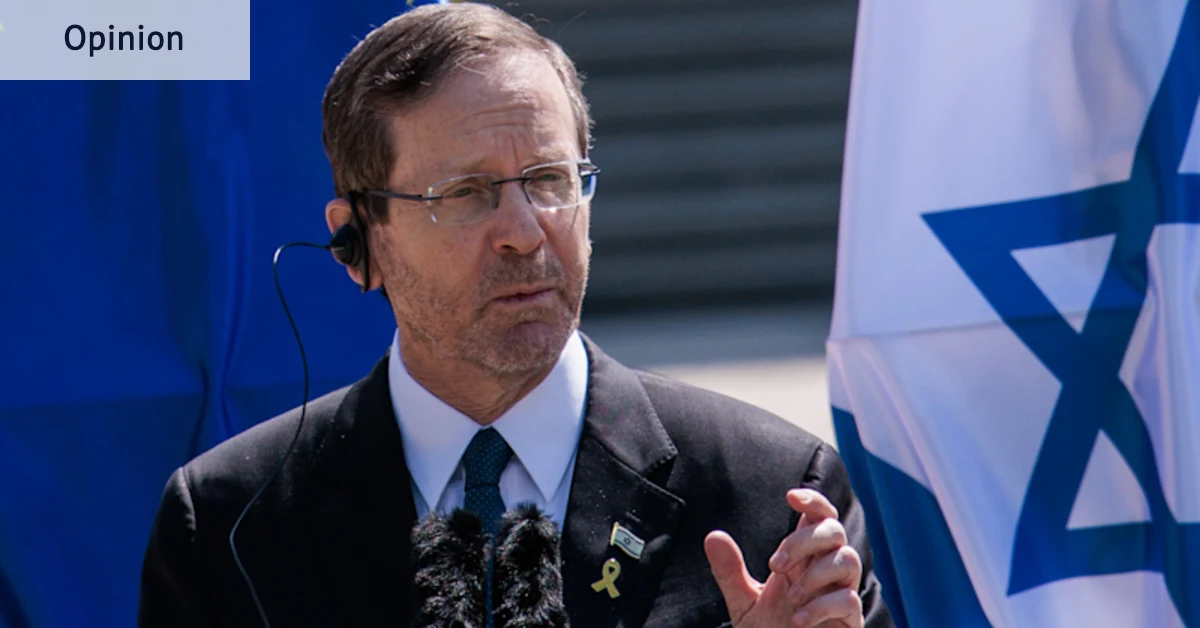
Isaac Herzog is the President of Israel, the homeland of millions of Jews. He will arrive in Australia in the next few days for a five-day visit. In the words of Prime Minister Anthony Albanese, Herzog’s principal purpose will be, “to engage with members of the Jewish community who are grieving the loss of 15 innocent lives” – those murdered in Bondi on December 14 last year in the worst-ever terrorist attack on Australian soil.
The Jewish community deserves that engagement. They are entitled to draw from it all the comfort the visit can offer. As a proxy representative of some 100,000 deeply traumatised Jewish Australians, and millions who grieve with them, and as the holder of an office that is constitutionally above party politics, Herzog is entitled – even though some have said it is inappropriate for him to visit now – to much more than the basic respect, which in any event civilised society must give to all.
Australia is also entitled to hope that the president’s visit will result in the intrusion of a small gleam of light upon a dark landscape. Although there are many exceptions, most Palestinians and Israelis are entrapped in deep mutual antagonism. Each community nurses grievances, grounded in injustice, against the other. Each perceives the other to be the first, or at least the principal, source of their victimhood. Grievance feeds on grievance, with a mutual absence of objectivity becoming one of the burgeoning barriers to reconciliation.
In these circumstances, Australia should ask that the president’s visit take a small step towards reconciliation. One step would be to begin a search for objectivity, without which peace between Palestinians and Israelis is impossible. That search might begin on May 11, 1949, when the United Nations admitted Israel as a member. It did so while at the same time noting that Israel “unreservedly accepts the obligations of the UN Charter”. These include compliance with the decisions of the International Court of Justice (ICJ).
Israel has flouted its Charter obligations. Two examples are among many that prove the point. First, on December 23, 2016 the Security Council – with the United States declining to exercise its right of veto – adopted Resolution 2334 by which it reaffirmed “that the establishment by Israel of settlements in the Palestinian territory occupied since [the six-day war of] 1967, including East Jerusalem, has no legal validity and constitutes a fragrant violation under international law and a major obstacle to the achievement of the two-State solution and a just, lasting and comprehensive peace”. The Council also reiterated “its demand that Israel immediately and completely cease all settlement activities”.
The second example concerns two authoritative pronouncements of the ICJ. In the first of these, delivered on January 26, 2024 as in interim decision but with binding legal consequences, the court found – with only two dissentients – that a plausible case of genocide in Gaza had been made out by South Africa in a proceeding brought by that country against Israel. The court’s final decision is some time away. Secondly, on July 19, 2024, the 15 judges of that court handed down their advice in a proceeding entitled Legal Consequences arising from the Policies and Practices of Israel in the Occupied Palestinian Territory, including East Jerusalem.
It is of relevance to Australians that one of those 15 judges is Hilary Charlesworth, a Laureate Professor of the Melbourne University Law School and a Distinguished Professor at the Australian National University. She has an impeccable reputation. And, in this instance, she was consistently in agreement with the great majority of her colleagues. By 11 votes to four the court was “of the opinion that the State of Israel’s continued presence in the Occupied Palestinian Territory is unlawful” and that Israel is therefore under an obligation to end that presence “as rapidly as possible”. By 12 votes to three it held that all states (which of course includes Australia) “are under an obligation not to recognise as legal the situation arising from Israel’s presence in the Occupied Palestinian Territory and not to render aid or assistance in maintaining the situation created by” that presence. And by 12 votes to three the court was of the opinion that international organisations, including the UN, are under an obligation not to recognise as legal the situation arising from Israel’s presence in Palestine, and that the UN and especially the General Assembly should consider the action required to bring Israel’s unlawful presence to an end as rapidly as possible.
The government of Israel has inexcusably denied the authority not only of the Security Council but also of the ICJ. Yet these are two ultimate sources of international law. Israel has not withdrawn from territory acquired by war. It has not accepted that there must be a two-state solution to the Palestinian question. On the contrary, it has encouraged Israeli settlements in the occupied West Bank and allowed the settlers to inflict harm, amounting to massive injustice to the displaced Palestinian residents. It has also, at an unimaginable price in human suffering amounting to “a plausible case of genocide in Gaza”, reduced the Gaza Strip to rubble, unfit for human habitation, a ghastly wilderness accompanied – at the cost of well over 60,000 Palestinian lives – by the destruction of everything upon which civilised life depends. No Palestinian could fail to be traumatised by it to the point of utter despair.
Australian Jews are not responsible, and must not be blamed, for the actions of Israeli governments. Nothing excuses antisemitism. The point here is that Israel’s legal standing among the nations of the world is something which, as the head of the State of Israel, President Herzog might usefully bear in mind.
David Harper is a former Court of Appeal judge.
The Opinion newsletter is a weekly wrap of views that will challenge, champion and inform your own. Sign up here.
 David Harper is a former judge of the Court of Appeal of the Supreme Court of Victoria, a former Chair of the Australian Red Cross (Victoria) International Humanitarian Law Committee and a member, with Ken Lay AO as Chair, of a Victorian Government Panel which reported on Terrorism and Violent Extremism Prevention and Response Powers.