AI can’t replace all software, and SaaS companies aren’t all going out of business this year, but that’s not the point. Software stocks are getting taken out to the woodshed because the software pie is shrinking. After years of consistent, steady growth, SaaS companies’ future prospects and revenues have become unpredictable.
“The draconian view is that software will be the next print media or department stores, in terms of their prospects,” Jeffrey Favuzza from Jefferies Financial Group.
This week was just the asteroid impact or the super volcano erupting. What comes next is the winter and multiyear contraction. Life will go on for the SaaS companies that adapt or are built for this new climate. However, this is the end for many software incumbents that long-term investors and private equity saw as stable investments.
“I don’t think it’s realistic to think that the hundreds of players that are making aggressive bets in this area are all going to be the winners,” Jeff Blazek, Neuberger Berman’s Chief Investment Officer.
“It’s probably going to be a streamlined, small handful of companies that will be able to claim the superior returns, which may bode poorly for the other players.”
No one has really broken down the impacts of AI on SaaS companies in a comprehensive way, so you can hear the analysts hemming and hawing with their predictions. This week, software technology companies are being sold off indiscriminately. But as Blazek puts it, some companies will claim the superior returns. What should we be looking for?
My frameworks emphasize intent and outcomes for AI products and platforms because those are the most valuable touchpoints to own. Just as you want to serve an ad as close to the point of intent to buy or the actual purchase as possible, you also want to position your app or AI interface in the same place. Taking the high ground of intent and outcome is a crucial AI monetization paradigm.
I learned this while trying to build an agentic version of myself for my clients. When they need me, they most often schedule a meeting with me or send an email to start the process. The point of intent to book time with me flows through their email and calendar management app, typically either Outlook or Gmail.
If I want to replace myself with an agent, I need to make that an option in their Outlook and Gmail workflows. Since I don’t own either one, that integration is challenging. I would be relegated to a supporting role in a marketplace while Google or Microsoft gets the bigger opportunity.
I could also target the outcome. My clients are in a meeting, and they want to loop the AI agent version of me in. That happens in Zoom or Teams. Again, since I don’t own either one, that integration is challenging, and the opportunity size is limited.
Salesforce has figured out that Slack is its platform’s most common origin for intents. That’s why it has integrated significant AI and agentic functionality into Slack.
SAP has created Joule to be its single pane of glass and starting point for all intents.
Moltbot/OpenClaw is integrated into the most common chat apps to capture intents from a natural starting point.
You can see some obvious winners emerging just by following how agents must be integrated to become part of people’s workflows. Intent gateways like WhatsApp, iMessage, Slack, Discord, and Telegram are natural AI and agentic portals. They’ll likely be fine.
The apps that handle the transformation from intent to outcome are in significantly greater danger of replacement. In the new paradigm, I explain my intent and guide the agent to deliver my outcome. That moves all the supporting apps the agent uses as tools into the background. That also pushes them further down the value chain, reducing their perceived value.
When you use Tableau daily, you feel its value. When you interact with information and reporting through Slack, you forget Tableau’s value.
You can also see why ChatGPT, Gemini, and Claude are so valuable. They are the place where a growing number of people begin their workflows and bring their intents. If I can chat with team members through ChatGPT, Claude, or Gemini, do I still need Slack?
Well, yes. Significant amounts of the data required to do work (either human or agentic) live in Salesforce’s Data Cloud or Data 360. Salesforce controls the data and owns an intent gateway. That’s a recipe for surviving AI’s disruption.
Microsoft has Outlook and several ways to control the enterprise’s data. That’s another potential moat. In reality, many SaaS companies have defensible moats, but few seem to understand how to use them.
Startups have multiple options to disrupt the status quo of existing workflows, but they, too, seem to lack the understanding required to take advantage of disruptions. OpenAI should be pulling in enterprise customers as fast as it ramped consumer adoption, but it doesn’t understand the enterprise well enough. It’s watching from the sidelines as Anthropic takes over coding and, just recently, legal.
In every cycle, we hear the same refrain from C-level leaders on the earnings calls. “Once in a generation disruption.” “We couldn’t have foreseen this.” This time, I sense that investors won’t be buying it because this was entirely foreseeable. We’ve been explaining it since 2022. Read my book or follow any of the other industry insiders who have been covering the disruption.
Intel was the canary in the coal mine that should have triggered code red moments across the software industry. It started with hardware vendors, then moved to AI leaders and cloud hyperscalers. Now software companies are in the crosshairs.
Palantir adapted early. It leveraged its forward-deployed engineers to build solutions with customers. That simple paradigm shift is one of the pillars of its current success. If the cost of building comes down, adapt your business and operating model to benefit from it instead of standing still and being disrupted by it.
This is the point of my Pragmatic Futurism framework. AI disrupts assumptions that software business models are built on. AI coding tools bringing down the cost of building apps is one disruption.
Old Assumption: “It’s more expensive (time and money) to build apps internally than to buy them from SaaS vendors.”
New Assumption: “The cost and time to build apps is coming down, so building custom apps internally makes sense for more use cases.”
What are the opportunities and threats that are introduced? What should the business do to mitigate the risks and profit from the opportunities?
It’s not difficult to be on the leading edge of disruption. I spend a lot of time talking about how, as the cost of building things comes down, the highest value skill in the enterprise becomes knowing what’s most valuable to build. Then the co-founder of Canva writes a post for Fast Company that sounds like a summary of something I wrote a few months earlier.
I post about how to fix the value problem with PoCs on LinkedIn, and the next day, IBM sends out a note with the subject line, ‘Turn AI Pilots Into Real Impact.’
Some see plagiarism, but I’m feeling validated. It’s about time, and I’m more interested in helping companies survive the disruption than getting credit for it. Consolidation means fewer jobs and more layoffs. It means fewer choices and less competition. Personally, I don’t want to see what happened to retail repeat itself in software.
It’s OK to be out of ideas, but investors and customers won’t accept inaction. It’s time to do what Microsoft did with cloud, Apple did with mobile hardware, and Google more recently did with AI search: accept that you’re playing from behind and adopt a challenger’s mindset. Intel refused to accept reality, and that’s why its dominance came to such an abrupt end.
Even AI startups are vulnerable. OpenAI was a clear leader until Anthropic and Google out-executed it in 2025. It must accept its place as a challenger and pivot to survive. It needs to bring in ideas from the outside and learn from the success of others.
The biggest shift as a challenger is from knowing to learning. If you’re a leader and innovator, your best people know more than everyone else. If you’re a challenger, you need to bring new knowledge into the business to be successful.
I heard a CEO this morning explaining that AI coding tools aren’t as capable as people are making them out to be. They tried to build with them internally and couldn’t get the code quality that others are advertising. I asked if they had brought anyone in from Google or Anthropic to teach them how to use the coding tools. He grimaced, “No.”
An AI strategy consultant told me that he wasn’t worried about agents disrupting consultants any time soon. “Just because AI is good at predicting the next word, doesn’t make it a domain expert.” I had to explain that LLMs are just one part of an agent. The domain expertise is held in the agent’s knowledge graph. The predictive and prescriptive capabilities are enabled by traditional models and advanced simulations.
I was discussing this with someone during office hours today. To get value from AI, we must be willing to learn and upskill. However, we only begin the process of learning after we admit that we need to do it. Many leaders are unwilling to do the difficult work of learning and bringing new capabilities into the business because they don’t see the value. But customers and investors will quickly change that.
This didn’t start in software, and it won’t end there either. Consulting and professional services companies are already feeling the impacts. TCS, Accenture, and Cognizant all saw their stock prices drop yesterday.
Everything that’s happening to SaaS companies this week is also hitting consulting and professional services companies. It’s the exact same story, with different players, and it will only get worse throughout the year. Everyone in this industry can read the writing on the wall. Each disrupted assumption that makes SaaS companies less valuable also impacts consulting companies’ business models.
By the end of this year and early 2027, the AI-driven TAM compression story will spread outside of tech. Every CEO will have to decide how to adapt their business and operating models to profit from the disruption. There’s no place to hide, but most domains still have multiple quarters before this wave reaches their earnings calls.
Innovators, those who not only survive but grow from this cycle, will be opportunity-led and outcomes-centric. Platform monetization is critical to success. Taking a challenger’s mindset is crucial to maintaining or regaining a leadership position. It’s time to be more forward-looking and prescriptive.
Winter is here, and that brings risk. But winners will focus on the opportunities to thrive in the new business environment.

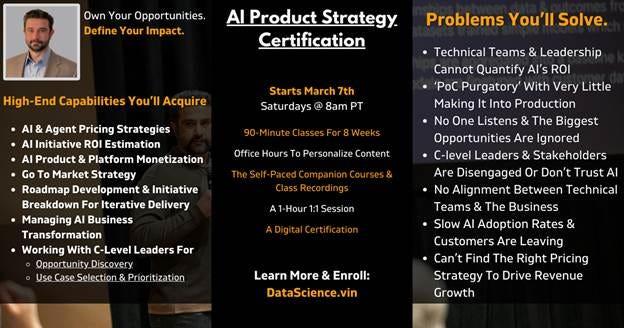
You win. It’s back. I’m offering my instructor-led AI Product & Platform Strategy course again in March. Learn everything you need to monetize AI from someone who’s been doing it for the last 14 years.
This is the most significant challenge facing businesses today. Not how to build or how to adopt; how do we grow revenue with AI and agents? I teach the frameworks and how to apply them so you own AI monetization, from 0 to ROI.