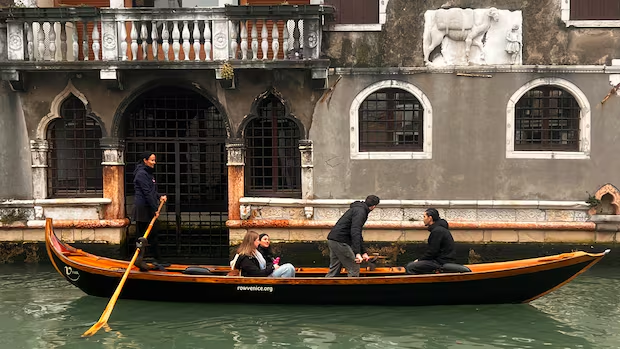
Venice is often described as a city frozen in time. Elaborate centuries-old palazzos are reflected in echoey, narrow canals. Water, not streets, sets the rhythm of daily life.
It is also a city overwhelmed by tourism. Most of the more than 25 million people who visit the historic Italian city are daytrippers, spending just a few hours in Piazza San Marco after stepping off a cruise ship, snapping photos and lining up for a gondola ride.
But a few canals away from the square, the scene is quieter. Female rowers dip wooden oars into green water, guiding a batèla a coa de gambero — a long “shrimp-tailed” boat past laundry strung between windows.
Unlike the gondola, which evolved into a symbol of elegance and aristocratic transport, the batela was the workhorse of the lagoon city: stable, wide, built to ferry goods and people through its shallow canals.
“The bottom of the boat is flat, with no keel, because the average depth of the canal is just one metre,” said Elena Almansi, standing steady at the stern.
Almansi, 34, was born and raised in Venice. The daughter of two Venetian rowing champions, she learned to row from her mother as a child. Today she is herself a decorated competitor, winning third place in the city’s prestigious Regata Storica and a national champion in standup rowing.

She is also part of Row Venice, a non-profit association of female rowers dedicated to preserving the Venetian style of rowing. Founded almost two decades ago, it now counts about two dozen members among its ranks, offering lessons to tourists and local women wanting to race.
Most are competitive regatanti, while others row amatoriali — for the love of it. All are trained in voga alla veneta, the traditional Venetian technique that gondoliers use, too.
In this style, rowers stand facing forward, grasping a single oar set into a curved wooden oarlock called a forcola. With a smooth figure-eight motion, they propel and steer at once.
It looks effortless. It is not.
“Twist, drop it in, go straight, drop it in, go again…” instructs Beatrice Santoro, 51, a Venetian transplant from Rome. She joined the group 15 years ago after she broke a leg and says rowing was the key to regaining her strength.
“We come from different backgrounds, ages and needs,” she said. “We try to help each other and are very linked to the tradition.”
For centuries, knowledge of the lagoon’s currents and rowing techniques was passed down quietly within families. Even today, rowing culture in Venice — long dominated by male gondoliers and rowers — can feel closed and protective.
“People here are not very happy to teach other people to row,” Almansi said. “It’s something like a secret. The older champions say you have to steal with your eyes — look at me and try to understand why I’m so good.”

When Row Venice first started out, Almansi said the female rowers were hassled in the canals.
“Older Venetian men would yell at us, ‘What are you doing? Go back home! My boat is moored over there and you’re destroying it.’ I would say, ‘I never touched your boat,'” recalled Almansi. “We were doing what the men were not: teaching people how to row properly.”
The association flourished and now operates several rare batela replicas, helping revive the small wooden crafts that had largely disappeared after the Second World War, when private outboard motors began buzzing throughout Venice.
The women have also fought for greater equality in the sport. Almansi says women once received only a fraction of men’s prize money in regattas — about 13 per cent.
“We started complaining,” she said, and over time, prize parity was reached.

University student Viola Ghigi, 25, is part of a new generation carrying the tradition forward. Raised in the Venetian neighbourhood of Cannaregio, she says she was “born in a boat.”
“When I was born, our mothers were already rowing together,” she said.
Today, she races alongside her mother, Almansi and Almansi’s mother in local regattas, including an annual women’s event around the island of Giudecca on March 8 for International Women’s Day. Six women share one boat: two champions, two former rowers and two who have never raced before.
“It’s a beautiful event,” she said.
For Ghigi, rowing is not nostalgia — it’s identity.
“Venice is unique because it doesn’t have cars,” she said. “But it’s those who actually move along these canals, who make them an active part of their lives, that really make Venice what it is. If that tradition and techniques get lost, then it’s nothing more than an amusement park.”

The warning resonates in a city whose resident population has shrunk dramatically over the past decades, while millions of visitors continue to pour in each year. Gondolas, once numbering in the thousands in the 16th century, now total about 430. The profession, once exclusively male, has only recently welcomed women, with 16 or so now practising.
Row Venice does not see itself as competing with gondoliers, who are licensed professionals in a regulated public transport system. A batela rower is not a job title, but a craft — and for these women, a calling.
As athletes, the association’s instructors are recognized by Italy’s national Olympic committee, and profits from the lessons are reinvested to help female racers remain visible in a tradition long dominated by men.
Standing at the stern, Almansi plants her oar and pushes off. The batela glides forward, cutting through the reflection of crumbling facades.
In a city often accused of standing still, these women are choosing to keep moving.