
Follow Winter Olympic SportsPersonalize Your Feed
Chris Jones reports from Milan.
Maxime Laoun, a member of Canada’s ascendant short track speed skating team, owns 12 sets of blades, each assigned a number. He brought five to Milan. They are allegedly identical in every respect, hand-hewn but machine measured. Laoun can still feel the invisible differences between them. Two are his co-favourites.
“Numbers 8 and 9,” he said before practice on Saturday.
Those will be his competition blades.
Athletes are famously fetishistic about their equipment. Tiger Woods once found a two-gram discrepancy in his driver; British cycling great Mark Cavendish threw his bike in a ditch during a training ride after his saddle was less than a degree out of level.
Even among true obsessives, the 29-year-old Laoun is more fine-eyed than most. When Marc Schryburt, the team’s director of high performance, was asked which member was most particular about his skates, he didn’t hesitate: “That’s Max,” he said.

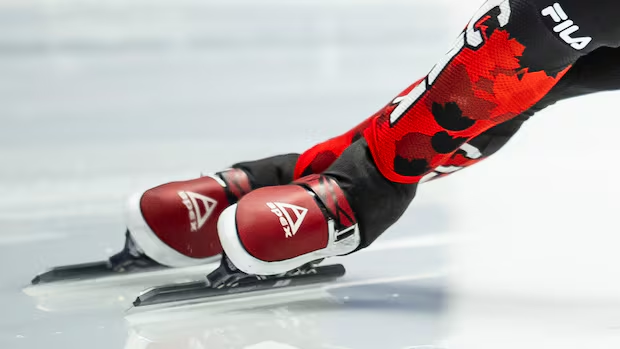
A speed skate begins with the boot, which is custom made for each athlete. Their feet are scanned by a computer and cast in plaster for good measure. Layers of carbon fibre are wrapped around that mould with enough care to include a pocket for the knuckle of each toe.
Laoun has only one pair of boots, which he’s worn for about 18 months, always without socks. For a pathological tinkerer, that’s a relative eternity. “I love them,” he said. “It took a few times for me to find my perfect fit. I like to be really, really close to my skates.”
For his long journey to Milan, he kept his precious boots in his carry-on bag. He put two sets of his blades in his checked bag. He gave one set to a friend, and two more to Laurent Daignault, the team’s skate tech. “We spread them apart and hope they’re okay,” Laoun said, as though his blades were traveling members of the royal family.
Long track speed skaters wear clap skates, with a hinge to allow the blade to stay on the ice longer during each stride. Short track speed skaters wear fixed blades, mounted to the left of their boots to allow for steeper cornering.

Even if they wanted to turn right, they couldn’t. “Everything is made to turn left,” Laoun said.
There are still variables, and Laoun is making constant adjustments to them, depending on his feel of the ice. “It changes every day,” he said.
So far, the ice at the Milano Arena is proving neither hard nor soft. Because it’s shared with the figure skaters, it’s a compromise pour — leaving it feeling to Laoun like the ice at Maurice Richard Arena in Montreal, where he trains.
“It’s not the perfect ice for us,” he said, “but I’m kind of excited about that.”
Like soccer tactics, every blade tweak has its advantages and counterarguments. A long blade, for instance, is more stable because there’s more contact with the ice. That’s critical in the relay, when short track’s already chaotic energy becomes heightened on a torn-up surface.
But the same friction that makes them stable also makes them harder to push, and long blades are more likely to trip up their wearers.
Laoun, like towering teammate William Dandjinou, wears 19-inch blades, the longest anyone might wear and a relatively recent change for both.

When Laoun was a member of the 5,000-metre relay team that won gold in 2022, he wore 17.5-inch blades. Dandjinou once wore 18-inch blades; his emergence as a world champion and contender for multiple medals has come, in part, since he switched to 19s.
Daignault, who was a relay silver medallist in 1992 before becoming the team’s full-time skate tech, has helped each member find what he calls “the magic touch.” The switch in length, especially for Dandjinou, was “a plus plus.” He’s so strong that his gains in stability didn’t lead to the expected decrease in glide.
Laoun’s own power has meant he’s stayed faithful to his rocker (the amount of curve along the bottom of the blade, from heel to toe) and his bend (the amount of curve along the length — to the left, of course). He’s settled on a mostly flat, straight blade. He doesn’t need help cornering and would rather stay on his feet.
“You get to a setup, and you think, Oh my God, I found it,” he said.

From a family-inspired love of skating to the heartbreak of missing Beijing 2022, William Dandjinou shares his determined path to Milano Cortina 2026.
Now — or today, at least — Laoun’s search for the perfect skate has been reduced to an exercise in maintenance. Not surprisingly, he prefers to do his own sharpening. Speed skate blades are 1.1 millimetres thick, about half as thick as hockey blades, and sharpened with a succession of stones to a buttery 90 degrees.
“The edge is super soft and really sharp,” Laoun said. “They’re like Japanese knives.”
His eyes shined when he was asked to describe the sensation of wearing a blade like that — his feet turned into swords, into weapons. He never did find the right words.
“It’s hard to explain,” he said. “But I can feel it.”