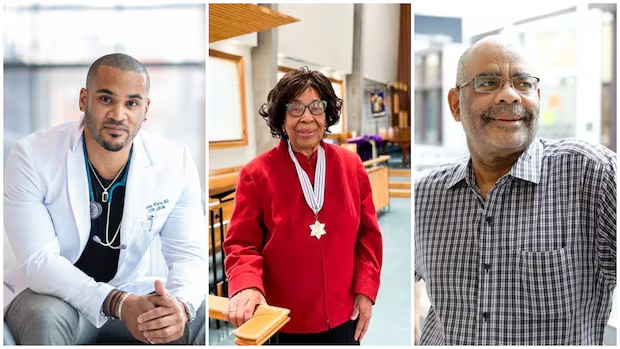
As emergency rooms across Canada strain under staff shortages, long wait times, and what some call preventable deaths, questions of trust, access, and equity have moved to the centre of public debate. For many Black physicians, however, these concerns are not new.
Long before race was widely discussed as a factor in health outcomes, Black doctors in Canada were practising medicine with an understanding that health is shaped not only by biology, but by infrastructure, policy and power. Often working in communities underserved by government and institutions, their work extended far beyond the clinic walls.
From rural public health advocacy in the pre-Confederation West to contemporary research on the health impacts of racism, Black physicians have helped shape Canadian health care for more than a century. Yet many of their contributions remain largely absent from public memory, even as conversations about equity, access and representation continue to evolve.
This Black History Month, their stories offer historical context for today’s debates, and a clearer understanding of how Canadian medicine has been shaped by practitioners whose influence reached well beyond patient care.
Early public health leadership in the West
One of the earliest examples is Dr. Alfred Schmitz Shadd, a physician whose career bridged medicine, agriculture, politics and public advocacy during Canada’s pioneer era.
Born in 1870 in Raleigh Township, Kent County, Ont., Shadd came from a distinguished Black family known for abolitionist and equal rights activism. His aunt, Mary Ann Shadd Cary, was a prominent activist and the first Black woman in North America to publish a newspaper. The Provincial Freeman promoted abolitionism, encouraged Black settlement in the West, and published general literature for Black readers.
In 1896, Shadd moved to Kinistino in what was then the North-West Territories to teach, before returning to the University of Toronto to complete his medical degree in 1898. After graduating, he established a medical practice in Kinistino and Melfort, serving settlers and Indigenous residents across Saskatchewan’s Carrot River park belt.
Known locally as a trusted “country doctor,” Shadd practised what would now be considered a holistic, public-health approach. He operated a drugstore, engaged in mixed farming and served on town council and civic boards. He also edited the local newspaper, recognizing the role of information, governance and community engagement in improving health outcomes.
His political ambitions reflected the same philosophy. Shadd ran in the 1901 territorial election and narrowly lost a 1905 bid for the new provincial legislature as an Equal Rights Party candidate, missing victory by just 52 votes. His platform focused on railway taxation, stronger provincial government and local control of schools — issues that directly affected food access, infrastructure, education and community health.
Had he won, Shadd would have become the first Black person elected to a provincial legislature in Canada.
Shadd died in 1915 in Winnipeg and is buried in Melfort, Sask., where a black granite headstone commemorates his contributions to medicine, politics and public life in Western Canada.
A medical first in Manitoba
That connection between clinical work and institutional leadership would later be embodied by Dr. June Marion James.
James was the first Black woman admitted to the University of Manitoba’s faculty of medicine, a milestone that marked a significant shift in access to medical education in the province. She graduated from the faculty of science in 1967 and went on to specialize in pediatrics, allergy, asthma and immunology, becoming a leader in those fields.

Her influence extended beyond patient care. James later served as president of the College of Physicians and Surgeons of Manitoba, placing a Black woman at the centre of medical regulation in a province where racialized physicians had long been excluded from decision-making roles.
Alongside her professional achievements, James remained active in community organizations, including the Congress of Black Women in Manitoba. She received the Queen Elizabeth II Golden Jubilee Medal in recognition of her contributions.
“She’s done a lot for the field,” said Dr. Nikolai Whyte, a family physician practising in Mississauga.
Historians and colleagues caution against romanticizing the barriers Shadd and James faced. For much of the 20th century, Black physicians were significantly underrepresented in Canadian medicine, often navigating exclusion from training programs, leadership roles and professional networks.
Contemporary practice and representation
Whyte’s own work reflects how those challenges persist, even as representation improves.
A family physician, Whyte is also a co-founder of the Black Healthcare Professionals Network, which supports Black doctors, nurses and allied health professionals across Canada. The organization works to address professional isolation and build national networks in a health-care system where Black practitioners remain underrepresented.
“It’s great that we have organizations like the Black Physicians of Canada, the Black Physicians’ Association of Ontario, and the Black Healthcare Professionals Network,” Whyte said. “So we can actually see others, build relationships and realize that we are not alone.”
That visibility, he says, is not symbolic. It has clinical implications.

“There is evidence that health-care outcomes can actually change depending on whether there is congruency between the provider and the patient,” Whyte explained.
Research shows Black patients who access care from Black providers often report better outcomes, improved understanding and stronger adherence to treatment plans. Cultural competency, communication styles and an awareness of historical mistrust can influence care in meaningful ways.
“Dermatology, for example,” Whyte said. “It does make a difference when you have a provider who understands and comes from that same cultural background.”
Despite progress, representation remains uneven, particularly in leadership, he says.
“There’s still a gap within governing bodies, health-care agencies and executive spaces,” Whyte said. “And with that comes challenges. People may not get the opportunity to advance within health-care administration.”
Researching the health impacts of racism
Dr. David Este, a retired professor in the University of Calgary’s Faculty of Social Work, has spent decades examining how racism affects health and social systems.

Before entering academia in 1992, Este worked as a medical social worker and researcher. Over his career he taught at undergraduate, graduate and doctoral levels. He participated in national, multi-site research projects examining racism, violence, mental health and family dynamics.
One of those projects examined the experiences of Black residents in cities including Toronto, Halifax and Calgary. The study collected both qualitative and quantitative data and produced a book called Race and Well Being: the Lives, Hopes and Activism of African Canadians (2010).
The findings showed participants experienced measurable physical health effects from anti-Black racism, including insomnia, hypertension, ulcers and gastrointestinal disorders, as well as psychosocial and emotional impacts including despair, hopelessness, suicidal ideations and lack of self-worth.
Este said translating research findings into long-term institutional change remains a challenge.
He has been openly critical of diversity, equity and inclusion initiatives introduced in response to the high-profile incidents of anti-Black violence in the United States, arguing that many lack sustainability and accountability.
“Without long-term commitment, this work risks becoming symbolic,” Este said, emphasizing the importance of translating research into curriculum changes, institutional reform and meaningful interventions that benefit Black communities.
Progress and unanswered questions
While acknowledging progress in representation and professional networks, both Whyte and Este point to ongoing gaps, including the absence of comprehensive national race-based health data in Canada.
Public health experts say such data could help identify disparities in outcomes and inform more targeted interventions, though its collection remains inconsistent across provinces.
Whyte believes earlier pioneers would recognize both how far the system has come and how much remains unresolved.
More than a century after Dr. Alfred Schmitz Shadd travelled rural Alberta and Saskatchewan to deliver care where infrastructure was scarce, many of the same questions remain: who gets access, who is heard and whose health is treated as urgent.
As Canada debates how to rebuild trust in a strained health-care system, the legacy of Black physicians suggests the answers may lie not just in new ideas, but in long-ignored ones, rooted in community, equity and the understanding that health is inseparable from justice.