

Last week I talked about the models for robotics manipulation from Physical Intelligence and Figure. This week I’ve talked to some other companies who are promising some even better models soon, and NVIDIA just published Dream Zero, a robot foundation model that can do zero-shot, open-world prompting for new verbs, nouns, and environments.
According to Jim Fan ”DreamZero is our first “World Action Model” (WAM): if the world model backbone can “dream” the right future in video pixels, then the robot can execute well in motors.”
Discoveries:
-
Model and data recipe co-evolve. Compared to VLAs, WAMs learn best from diverse data, breaking away from the conventional wisdom that lots of repeated demos per task are the bread and butter. Diversity >> repetitions.
-
X-embodiment is extremely hard. Pixels are the answer. Different robot morphologies traditionally have a hard time sharing knowledge well. But if we put video first, pixels become the universal bridge connecting different hardware.
Waymo with Google DeepMind just announced the Waymo World Model, a frontier generative model that sets a new bar for large-scale, hyper-realistic autonomous driving simulation. The Waymo World Model is built upon Genie 3—Google DeepMind’s most advanced general-purpose world model that generates photorealistic and interactive 3D environments—and is adapted for the rigors of the driving domain.
By leveraging Genie’s immense world knowledge, it can simulate exceedingly rare events—from a tornado to a casual encounter with an elephant—that are almost impossible to capture at scale in reality. The model’s architecture offers high controllability, allowing our engineers to modify simulations with simple language prompts, driving inputs, and scene layouts. Notably, the Waymo World Model generates high-fidelity, multi-sensor outputs that include both camera and lidar data.
Meanwhile, Max Battacharya from TRI talks about the open unsolved problems in robotics and TRI’s overarching strategy, which leverages access to Toyota’s factories and manufacturing lines to deeply explore solutions.
Also another hat tip to Oliver Tsu at a16z ventures for his essay on the physical AI deployment gap, “the consistent chasm between the bleeding edge of robotics research and robots deployed at scale in production environments. We will discuss where the research frontier is, where the deployment reality is, and the specific technical and operational challenges that separate them.”
Do you have the skills to solve a complex bottleneck in modern manufacturing?
Brought to us by Intrinsic, Open Robotics, NVIDIA, and Google DeepMind, the AI for Industry Challenge includes $180K in prizes for the winning teams.
This global competition aims to push the boundaries of electronics assembly, using AI for time-intensive, repetitive, and complex dexterous manipulation tasks. Train a model in sim, and gain access to Intrinsic’s benchmark-winning vision models and the Intrinsic Flowstate digital-twin developer environment.
Is your team ready to develop a complete cable-handling solution? Finalists will deploy their models in a physical workcell at Intrinsic’s headquarters
Deadline of April 17th! Learn more and sign up your team here! Then, get ready to showcase the potential for AI to bridge the digital and physical worlds.
With KinetIQ, a single system can coordinate robots with different embodiments — wheeled and bipedal — across industrial, service, and home environments. KinetIQ manages both fleet-level operations and individual robot behaviour within one multi-layer architecture.
The architecture is cross-timescale: four layers operate simultaneously, from fleet-level goal assignment to millisecond-level joint control. Each layer treats the layer below as a set of tools, orchestrating them via prompting and tool use to achieve goals set from above. This agentic pattern, proven in frontier AI systems, allows components to improve independently while the overall system scales naturally to larger fleets and more complex tasks.
A Japanese ROS developer going by the name Ninagawa123 just released the second beta version of URDF Kitchen, a tool that allows users to quickly import, tweak, and export robot models so they can be used in different simulators.
🍲 URDF Kitchen includes the following features:
🍲 Robot assembly via node-based connections
🍲 Supports STL, OBJ, and DAE mesh files
🍲 Export to URDF and MJCF
🍲 Import URDF, xacro, SDF, and MJCF (Gazebo, MuJoCo, etc)
🍲 Automatic mirroring to generate the right side from a left-side assembly
🍲 GUI-based configuration of connection points and colliders
🍲 Supports setting only the minimum required joint parameters
🍲 Available on Windows, macOS, and Ubuntu
🍲 Free to use (GPL v3.0)
🍲 Written in Python, making it easy to extend or modify features with AI-assisted coding
Open Robotics Discourse post and source code on Github and cool demo video:
Are you a startup fundraising atm? Fill out our “For Investors Eyes Only” sheet.
These investors write checks anywhere from angel and seed stage to $5-50 million.
If you’re an accredited investor and haven’t already signed up for the spreadsheet – Sign up here for great robotics deal flow!
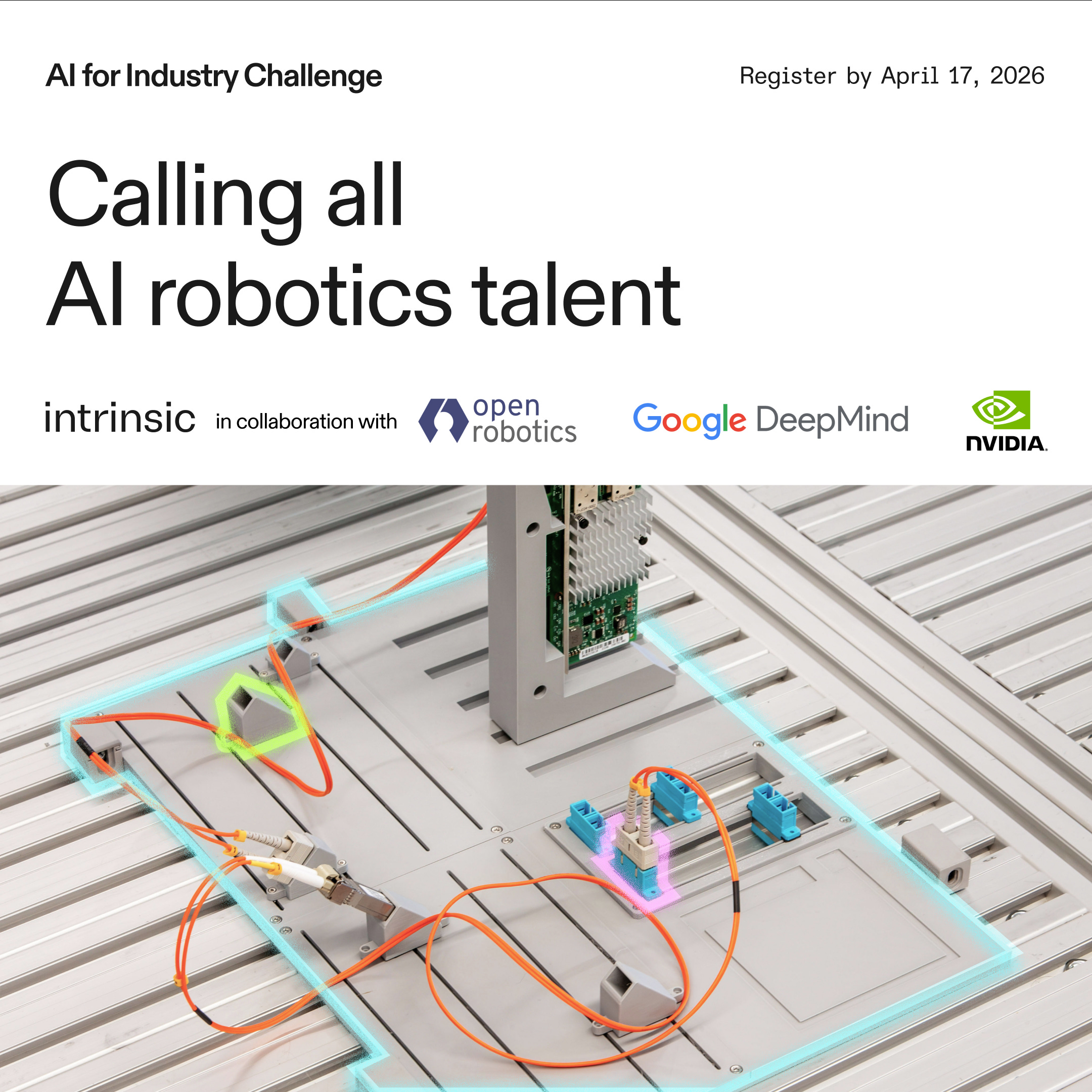
Brought to us by Intrinsic, Open Robotics, NVIDIA, and Google DeepMind, registrations are open now for teams of roboticists and AI developers to push the boundaries of electronics assembly and help solve a complex, high-impact bottleneck in modern manufacturing, with $180K in prizes!
Deadline of April 17th! Learn more and sign up your team here!
On Feb 3, Congresswoman Jennifer McClellan (VA-04), alongside Rep. Jay Obernolte (CA-23) and Rep. Bob Latta (OH-05), introduced the National Commission on Robotics Act, bipartisan legislation to establish a national commission tasked with evaluating the United States’ competitiveness in robotics and providing policy recommendations to strengthen American leadership in this critical technology sector.
The National Commission on Robotics Act would direct the Department of Commerce to establish an independent, temporary commission composed of 18 recognized experts in robotics and robotics applications. Commission members would be appointed by congressional leadership from both parties and by the President. The Commission would examine domestic and international developments in robotics, workforce and talent challenges, supply chain risks, manufacturing competitiveness, and the role of robotics in economic growth and national security. via the Office of Congresswoman Jennifer McClellan
In its Q4 & Full-Year 2025 earnings call, Teradyne reported that its Robotics Group grew 19% quarter over quarter, marking the third consecutive quarter of growth. More importantly, management clearly articulated why they believe that growth will continue.
“From a Robotics Group perspective, we expect growth tied to physical AI expanding SAM, reducing implementation complexity and continued persistent labor shortages. Our strategic pivot toward large accounts, along with a sharper focus on Ecommerce, Logistics, Semiconductor and Electronics verticals is expected to further support growth.” via Robert Little, Chief of Robotics Strategy at Novanta
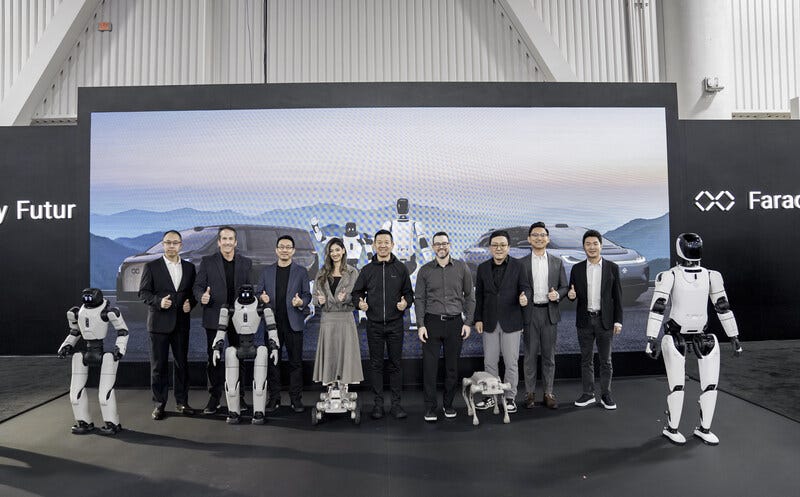
On Feb 4, Faraday Future announced the establishment of FF EAI-Robotics Inc., headquartered in California and officially launched its first batch of Embodied AI (EAI) humanoid and bionic robots —FF Futurist (full-size professional humanoid), FF Master (athletic “action master” humanoid), and FX Aegis (quadruped security/companion), and the first batch of deliveries planned for end of February, with the target to be the first in North America to deliver both humanoid and quadruped robots simultaneously. Details at Faraday Future
Can robots ever be graceful? – BBC
Hail our new robot overlords! Amazon warehouse tour offers glimpse of future – The Guardian
China is running the EV playbook on humanoid robots – and it’s working – rest of world
German AI robotics company raises $100 million for US growth – Reuters
AI powered robots are coming for your jobs – Politico
Why do we feel empathy for robots? – Bloomberg
“Robots Need Your Body”: New Site Lets AI Rent Human Labour – NDTV
Send me your 2025 progress and 2026 plans for potential inclusion in Robots&Startups.
The next SVR Robotics Leadership Event is coming in early 2026 followed by another IEEE Hard Tech Venture Summit in Silicon Valley!
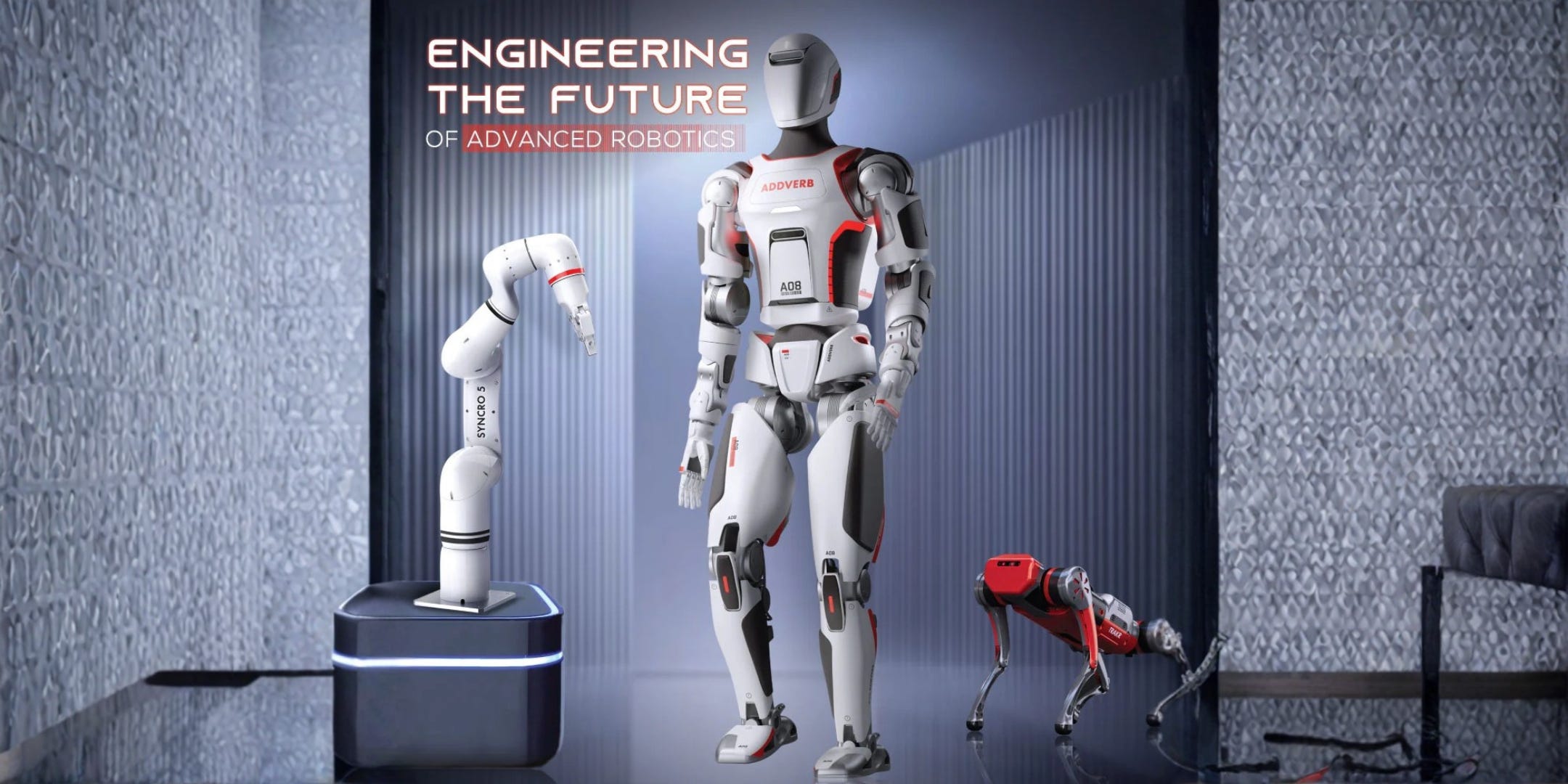
Bots, Bevs & Devs at Addverb in Fremont on Feb 11
!! NOT the first Wednesday this month !!
Drones and Robotics AI Summit – New York – March 26
European Robotics Forum – Norway – Mar 23 – Mar 27
IEEE Haptics Symposium – Reno – March 29 to Apr 1
IEEE Hard Tech Venture Summit and Robotics Manufacturing Workshop (with Silicon Valley Robotics) – SRI International – April 16-17
SVR Robotics Leadership Event – TBC April
Robotics Invest – Boston – May 26-27
ICRA 2026 – Vienna, Austria – Jun 01 – Jun 05
Deep Tech Week – SF – Jun 21 – Jun 25
Robotics: Science and Systems – Sydney, Australia – Jul 13 – Jul 16
IROS 2026 – Pittsburgh – Sep 27 – Oct 1
IEEE Humanoids 2026 – Silicon Valley – Dec 6-9
The annual IEEE-RAS International Conference on Humanoid Robots is the internationally recognized prime event of the humanoid robotics community. The conference is sponsored by the IEEE Robotics and Automation Society and coordinated by the Technical Committee on Humanoids.
Join the organizing team at Silicon Valley Robotics – bots&beer@svrobo.org

