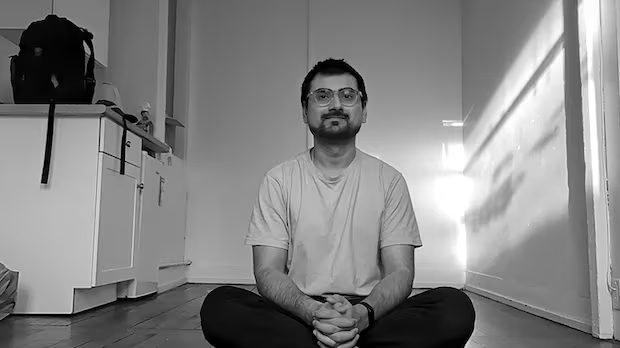
This First Person column is the experience of Pari Mokradi, who lives in Vancouver. For more information about CBC’s First Person stories, please see the FAQ.
I hesitated at first — the room didn’t look inviting — but then convinced myself I could live in a “SRO,” even though I wasn’t sure what that meant. I’d lived like this before in Edmonton, in a dorm as an international student. I figured I could make this work, too.
But the DTES is different, and so is life in a single-room occupancy (SRO) building. Here, poverty isn’t hidden. It’s outside your window, under your feet.
No one forced me to live there, but I felt I was out of options. The realization hit hard because I felt I’d done everything “right” since arriving in Canada.
Chasing dreams as an immigrant
I had left India when I was 20, chasing the stories that Canada was a place where everyone was welcome and the belief that hard work would be rewarded with stability.
This faith was tested on my first night in Edmonton as an international student at the University of Alberta where I didn’t even have a pillow to sleep on. One of the resident assistants, Alycia, noticed and brought me a blanket and pillow. A small gesture, but it meant everything.
I threw myself into university life. My days began at 5 a.m. and often ended after 10 p.m. I was studying, volunteering, working part-time and building my resumé. I believed every sacrifice would matter.
The building manager unlocked the door to a tiny room in Vancouver’s Downtown Eastside (DTES). The floorboards were grimy and creaked underfoot. A mini refrigerator hummed in the corner. Out in the hall was a kitchen and bathroom shared by everyone on the floor.

But when it was time for my graduation ceremony, I didn’t attend. I felt I hadn’t earned the right to celebrate graduation.
Despite all my efforts, I hadn’t landed a full-time job. The silences to job applications felt loud. For four years as a student, I had done a lot of unpaid labour — the kind of volunteering you were interviewed for to prove you were a good fit. But when it came to paid work, I heard nothing back.
Every month without work meant draining my savings and facing the guilt of calling home to ask for help.
So after another six months of my job search going nowhere, I boarded a bus to Vancouver and crashed on a friend’s couch. I found shifts at a warehouse through a pay-by-the-hour agency. This meant steel-toed boots, heavy lifting and two-hour commutes, but at least it paid the bills.
A few months later, I got a job at a call centre. On paper, it was a step up: a desk job for a telecom company. The reality was more complicated.
I remember one call. A man, furious about his bill, asked about my accent. “You’re calling me from India, aren’t you?”
I froze. “Yes,” I lied.
I was right here in Vancouver on an open work permit. But at that moment, I wanted to hide. I didn’t want to explain how an international student from India ended up working at a call centre in Canada. I did not want to stand out. I was just trying to make it through the day.
My manager Karun overheard my conversation. He pulled me aside later.
“Never be afraid to be who you are,” he said.
I nodded, but on the way home I kept turning it over in my mind. I had nothing to hide, yet I hid.
Reclaiming my story
During that time, I was sharing a basement unit with another international student. He was a talented man who wanted to start his own business in Canada. We bonded over what we missed back home: families, food, birthdays and weddings we couldn’t attend. The funerals cut the deepest because we knew we’d never see those loved ones again.
Somewhere in that heaviness, we found connection. Then our landlord tried to raise the rent during the COVID-19 pandemic. We pushed back, citing the province’s rental freeze, but soon he began showing up unannounced under the pretext of renovations. It stopped feeling like a home. Soon after, we left and went our separate ways.
A year later, as stability grew harder to sustain, my friend’s mental health began to fray. He decided to leave the country for a time and asked me to hold onto some of his belongings until he returned. But he never came back. Even now I wonder if I could have done more for someone who had so much to offer Canada.
Alone again, and now in the DTES, I was on guard. Life in an SRO was a mix of survival and convenience. Outsiders often speak of the Downtown Eastside with pity or fear. Too often reduced to headlines about overdoses or crime, V6A used to carry the label of Canada’s’s poorest postal code.


But living there, I started to see something else entirely: a richness most other neighbourhoods didn’t seem to have. On evening walks, I met neighbours organizing on issues from housing rights and harm reduction to food security and Indigenous sovereignty. These weren’t your city-run service centres but diverse community-led sanctuaries.
One of them was the Downtown Eastside Writers’ Collective. The organizer, Gilles, invited me to drop in and write, without any pressure. At first, I showed up quietly and listened to people from all walks of life share their stories. Slowly, I began to share my writings, too. Each time I felt a little less invisible and a little more at home in my own story. I never imagined this journey, but I’m proud of where it has brought me. Looking back, I realize the more I bent myself to fit what I thought was expected of me — at work, in conversations, in how I carried myself — the more fragmented I became. It was like standing in front of a mirror that didn’t shatter, but cracked slowly, splintering into smaller and smaller reflections until you could no longer recognize the whole.
But in that writing collective — surrounded by voices speaking their truths, putting pen to paper — I confronted the cracks I had long learned to live around. Through sharing, I began to unfracture parts of myself.
The more I reclaimed my own story, the more I began to see how many others in the DTES had been pushed to the margins without realizing it. One might think I’m writing this to draw attention to the communities resisting the ongoing gentrification of DTES or perhaps to confront the growing hostility toward new immigrants, so often blamed for housing shortages while being quietly overworked and underprotected. And yes, I’m writing for all those reasons.
But I’m also writing because I became a Canadian citizen in 2025.

Looking back on my journey, I felt like I had done everything by the book and yet was left unseen when it mattered most.
What carried me through weren’t the milestones of earning a degree, landing a job or receiving my citizenship. It was the small acts of care: Alycia, who gave me a pillow; Karun, who told me to own my story; Gilles and the Writers’ Collective, who showed me I didn’t have to erase myself to belong.

In a Canada that can increasingly feel unaffordable and unwelcoming, those small acts gave me more than shelter. They gave me room to return to myself.
Do you have a compelling personal story that can bring understanding or help others? We want to hear from you. Here’s more info on how to pitch to us.