
Listen to this article
Estimated 5 minutes
The audio version of this article is generated by AI-based technology. Mispronunciations can occur. We are working with our partners to continually review and improve the results.
Satellite images showing recent activity around two Iranian nuclear sites bombed last year by Israel and the U.S. suggest Iran may be trying to recover materials from the area.
But experts say that, whatever salvage operations Iran is undertaking, there has been no significant recovery for its nuclear program since the attacks.
There has been some rehabilitation after the damage the U.S caused, but “there haven’t been any indicators of significant resumption of work,” said Joseph Rodgers, deputy director and fellow with the Project on Nuclear Issues at the Center for Strategic and International Studies (CSIS).
“There are no scientists going in and working significantly at these sites. There’s not a lot of activity. And what activity we do see is not significant in a nuclear program.”
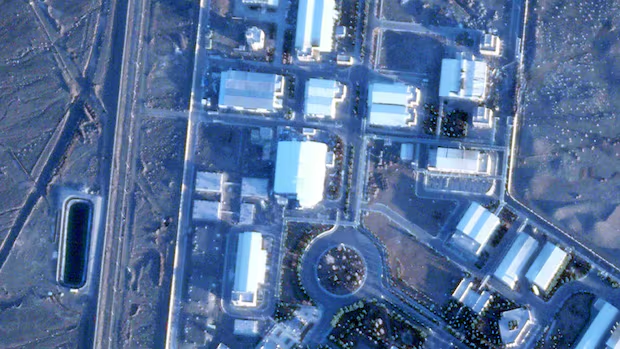
New satellite images from Earth-imaging company Planet Labs PBC show roofs have been built over two damaged buildings at the Isfahan and Natanz facilities. It’s the first major activity visible by satellite at any of the country’s stricken nuclear sites since Israel’s 12-day war with Iran in June.

The Natanz site, about 220 kilometres south of the capital, is a mix of above- and below-ground laboratories that carried out the majority of Iran’s uranium enrichment.
At this site, images show that Iran covered the anti-drone cage of the Pilot Fuel Enrichment Plant with a panel roof, said Spencer Faragasso, a senior fellow with the Institute for Science and International Security.
“We assessed that this was done to basically hide activities that they’re doing inside. To block out peering eyes as part of a salvaging and recovery operation,” he said.
Faragasso said Iran is likely looking for any material or equipment that survived the attacks, including any highly enriched uranium that could be recovered.

The second site, outside the city of Isfahan, was mainly known for producing the uranium gas fed into centrifuges for enrichment.
A Jan. 29 report co-written by Faragasso for the Institute said satellite images show vehicle activity on the road leading to tunnel entrances at the complex has “increased notably.”
The report, based on satellite images, said that most recent activity appeared related to re-burying the southernmost and the middle entrances with soil.
The report said a new roof built on the surviving steel framework of a destroyed building could indicate Iran had decided the structure was worth preserving and that the work could be related to centrifuge manufacturing.
Faragasso told CBC News the activity appears to be “another effort to recover leftover equipment to try to potentially reconstitute an enrichment capability.”
He said Iran may be determined to rebuild its nuclear capabilities, but returning the facilities to their former state would require significant time, resources and investment.
‘Severely set back’
That includes the Fordo site, a hardened enrichment facility built under a mountain.
Based on the scale of the damage from the attacks — the rubble and destroyed infrastructure — Faragasso said that it is possible to make a fairly accurate assessment that the facilities are not operating.
“Iran’s nuclear program has been severely set back. Its enrichment program is effectively non-existent,” he said.

Joseph S. Bermudez Jr., a senior fellow for imagery analysis at CSIS, said Iran appears to be at a stage where it has not even cleared the debris.
He said he does not view the reconstructed roofs as particularly significant. The limited vehicle and personnel activity he has seen suggests the sites sustained considerable damage.
“There’s no significant evidence at the three locations of a reconstitution of a significant scientific effort or weapons effort,” he said.
However, Bermudez Jr. said satellites can’t show what is happening underground, so it’s unclear what activity may be taking place there.
Rodgers, from CSIS, also said there is a lot that satellite imagery cannot show.
For example, Iran is believed to have a stockpile of 460.9 kilograms of 60 per cent enriched uranium but “it’s unclear where that uranium is stored,” he said.

Iran’s foreign minister called the first round of indirect talks with U.S. officials over Iran’s nuclear program ‘a good start.’ But neighbouring countries continue to worry about a possible U.S. military strike triggering a broader regional war.
Rodgers said that before the U.S. strikes in June, Iran was going to let the International Atomic Energy Agency inspect a third enrichment site — believed to be near Isfahan — in addition to Fordo and Natanz.
“The key takeaway is that Iran still has a stockpile of [highly enriched uranium] and is at some stage of completion for a third enrichment site,” he said.
“We don’t know … how close to being operational it is. It might not be ready at all. It might be under construction. It’s pretty unclear.”