Panu Wongcha-um and Devjyot Ghoshal
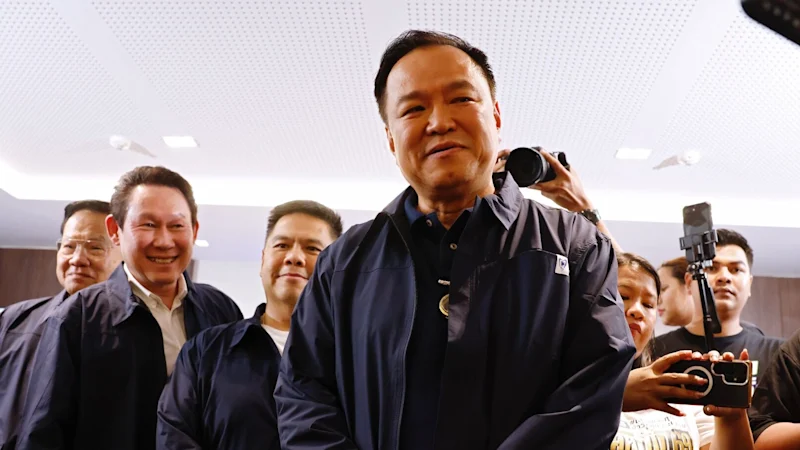
Bangkok: Prime Minister Anutin Charnvirakul’s Bhumjaithai Party has won a clear victory in Thailand’s general election, raising the prospect that a more stable coalition may now succeed in bringing an end to a period of prolonged political instability.
Anutin set the stage for Sunday’s snap election in mid-December during a border conflict between Thailand and Cambodia, a move political analysts said appeared to be timed by the conservative
leader to cash in on surging nationalism.
It was a gamble that paid off for a prime minister who, after premier Paetongtarn Shinawatra of the populist Pheu Thai Party was ousted over the Cambodian crisis, then dissolved parliament fewer than 100 days later.
“Bhumjaithai’s victory today is a victory for all Thais, whether you voted for Bhumjaithai Party or not,” Anutin told a press briefing. “We have to do the utmost to serve the Thai people to our full ability.”
With more than 90 per cent of polling stations reporting, preliminary results released by the election commission showed the Bhumjaithai Party had a sizeable lead over the progressive People’s Party in second place, followed by the once-dominant Pheu Thai Party.
‘Power to govern’
When Anutin dissolved parliament in December, he cited dysfunction and infighting between rival parties as making it impossible to lead a minority government.
While the Bhumjaithai Party was unlikely to win a majority outright, the results suggest it is in a strong position to push through campaign pledges, said Napon Jatusripitak, a political scientist at the Bangkok-based Thailand Future think-tank.
Those include implementing a consumer subsidy program and ditching an agreement with Cambodia over maritime claims.
“For the first time in a long time, we will likely have a government that has sufficient effective power to govern,” he said. “We are seeing what I would describe as a marriage of convenience between technocrats, conservative elites and traditional politicians.”
Critical to Anutin’s success were his embrace of nationalism and Bhumjaithai’s strategy of winning over politicians from rival parties in rural areas, analysts said.
“The scale of its victory was unanticipated, perhaps demonstrating that the more nationalist political environment and its ability to consolidate the conservative electorate all worked in its favour,” said Mathis Lohatepanont, an independent political analyst.
People’s Party rules out coalition
Speaking even as results were trickling in, People’s Party leader Natthaphong Ruengpanyawut conceded that, while some votes had yet to be counted, his party did not look likely to win.
Natthaphong said the party would not join a Bhumjaithai-led government but nor would it form a competing coalition.
“If Bhumjaithai can form a government, then we have to be the opposition,” he told a press conference.
With a message of structural change and reforms to South-East Asia’s second-largest economy, the People’s Party had led most opinion polls during the campaign season.
But in a survey conducted during the campaign’s final week and released on Sunday, the National Institute for Development Administration projected that Bhumjaithai would be the winner with between 140 and 150 seats in the 500-member House of Representatives, ahead of 125-135 for the People’s Party.
The progressive party’s earlier support for Anutin as prime minister was probably a severe miscalculation, undermining its own ideological purity and allowing Bhumjaithai to attain the
benefits of incumbency, Mathis said.
Speaking to Reuters, Natthaphong said he did not see the election as the result of any mistakes by his party, but instead highlighted that its opponents had not been complacent.
“I’m not blaming any factors. Our responsibility now has to be to focus on the grassroots,” he said. “We’ve done a lot already, but haven’t been able to crack what they have. It wasn’t good enough.”
Reuters
Get a note directly from our foreign correspondents on what’s making headlines around the world. Sign up for our weekly What in the World newsletter.