
Listen to this article
Estimated 5 minutes
The audio version of this article is generated by AI-based technology. Mispronunciations can occur. We are working with our partners to continually review and improve the results.
Central Alberta’s emergency rooms can be loud, busy places.
But a new model of care for victims of sexual assault is redirecting cases away from those hospitals.
Not only does that reduce the burden on those spaces — it’s helping to change lives, according to sexual assault nurse examiner Ronnie Biletsky, who has about 20 years of experience.
“When someone … hugs you at the end of a sexual assault exam and says, ‘Thank you. I would have never had the courage to go to a hospital to tell my story. I was so scared. You made me feel safe’ … those are some things that you wouldn’t expect to hear about a sexual assault experience.”
Based out of Red Deer, the 24/7 program at the Truant Family Medical Suite sees people of all ages in central Alberta and provides forensic and medical care. It has been running for just over a year.
Julie Hanson, a public health manager with Primary Care Alberta, said of the overall amount of people needing this care in the catchment, they were able to take on “around 37 per cent diversion out of a busy emergency department.”

How it helps
Biletsky said privacy is one of the biggest benefits in such an emotional time, utilizing a separate entrance to the area, while only one patient is seen at a time.
“Nobody wants to come to a place where … you’re always afraid you’re gonna run into your neighbour, someone that you know,” she said. “There’s not a waiting room full of people. It’s literally one person and one nurse and an advocate.”

Hanson said another benefit to the suite was the quiet and calm environment, because “there’s busy aspects to emergency departments that sometimes can feel chaotic.”
While at the centre, patients are given an assortment of comforts, including handmade blankets they can pick out, which are then warmed.
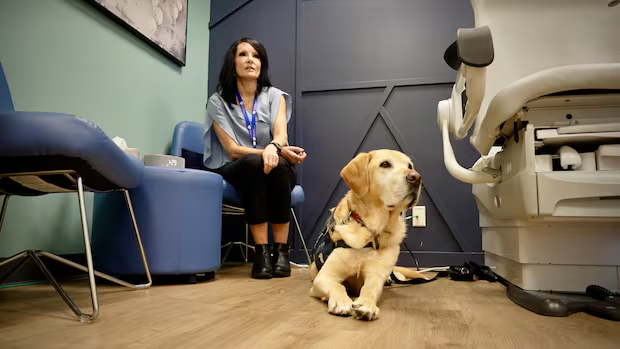
There are also T-shirts with positive sayings, dolls, snacks and toys to take home. Therapy dogs can be brought in as well, if available.

The centre also has one of two new specialized cameras in Alberta, for improved forensic imaging of injury sites.
The result
Patients were asked for feedback as part of discharge, and Biletsky said “we have had 100 per cent patient satisfaction.”
“That’s exactly what we were going for … for patients to feel safe.
“[It’s] the most proud I’ve ever been in … my career.”

That feedback is also being used to help improve the model of care in an emergency room too, said Hanson.
“As an example … they brought in a comfort dog into the emergency department.”
‘First of its kind’
Before a patient is admitted to the facility, they must meet certain criteria, including being in a stable condition. Otherwise their case may be seen in the emergency room instead.
The facility operates as a satellite campus. Although patients are seen by a nurse, they’re still under the care of an emergency physician at the nearby Red Deer Regional Hospital Centre. All testing and treatment can be done on site at the suite.
“It’s the first of its kind,” said Hanson. “There’s other ambulatory clinics for sexual assault, but there’s been none to our knowledge across Canada that are a virtual hospital or emergency department.”

That came with its own set of challenges in getting the idea off its feet.
Many teams got involved, including Hanson’s. She added the program was pioneering unseen levels of collaboration across the AHS, RCMP, Primary Care, social services, the Central Alberta Child Advocacy Centre and other groups. That includes working together in regards to financing.
“We work in a really interesting hybrid model. Part of the programming piece falls under a current budget that’s out of Primary Care Alberta in public health. And then the Alberta Health Services emergency department also funds this program through staffing, so they would support the nurse time. And then we’ve also had community donation of the facility itself.”

To Biletsky, the program was a dream come true.
“The more people you brought in, it just started to grow because people saw the importance of it, and they realized that this could really happen,” she said.
But now that it’s been done, there are hopes to see other places adapt this model too.
“We’re just on that horizon of where we’re going to see more of this, I believe,” said Hanson.