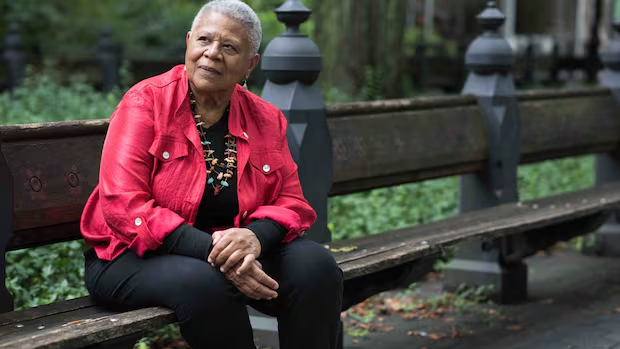
At 84, Minnijean Brown-Trickey says she has “done it all.”
Long before her work as an anti-racist educator and environmental campaigner in Canada, she demonstrated enormous courage as one of the Little Rock Nine — a group of Black teenagers who integrated Little Rock Central High School in Little Rock, Ark., in 1957.
Minnijean Brown was 15 years old when she decided that she wanted to attend the all-white school, which was closer to her home, instead of Horace Mann High School — the one for Black students.
Speaking with CBC News from her home in Vancouver, Brown-Trickey said while people might say she and the eight other Black students were “paragons of virtue” and decided to do something that was “world shaking,” to the students, it was a matter of convenience.
“My two best friends and I said, ‘Oh my goodness, if we go to Central, we can walk, we don’t have to take a bus,'” she said, adding that “Central High School was in the centre of town.”
“Those of us who became known as the Nine, we all sort of casually mentioned it to our parents, and our parents casually said, ‘Oh, OK,'” Brown-Trickey said. “I think my mom said, ‘We’ll see.'”
Enduring racist Jim Crow laws
According to Brown-Trickey, Black parents had shielded their children from some of the effects of the Jim Crow laws that enforced racial segregation in the United States. These laws legalized separation in transportation, schools and public facilities.
“Our parents, at least my parents, tried to make sure I didn’t encounter it — for instance, [by] making my clothes,” she said.
“Lots of parents, mothers, made their children’s clothes so they wouldn’t be embarrassed.”

By making clothes for their children, Black parents saved them from feeling hurt and denigrated in shops where only white people were allowed to use the changing rooms.
“So, there was a lot of effort — now that I’m older and can look back, to shield us from the truth of Jim Crow South — and so we were kind of blindly living happy lives within the framework of a horrific system.”
Once it became known that the nine Black students were set to start classes at Central High School in September 1957 — following the landmark 1954 U.S. Supreme Court decision in Brown v. Board of Education outlawing segregation in public schools — there were rallies and mass meetings, led primarily by white women who were furious about the possibility of desegregation, Brown-Trickey said.
Behind us was this mob of screaming, insane, out of control, mindless, violent people screaming ‘kill them, hang them, send them back.’– Minnijean Brown-Trickey
Days before school was due to open, white residents were showing up in the hundreds at the gate in protest. Things got so bad, Brown-Trickey said, that Orval Faubus, the Arkansas governor at the time, placed the state’s National Guard around the building.
“His statement pretty much said if integration happens, blood will run in the streets,” Brown-Trickey said.
On the first day, she said, her mom drove and dropped her off about half a block from the school, and four ministers — two of them white and two of them Black — walked with the students to the entrance.

When nine Black students signed up to attend Little Rock Central High School in Arkansas 1957, they were met by a hateful mob and were turned away by state guardsmen. Minnijean Brown-Trickey is one of the so-called Little Rock Nine. She has lived in B.C. for much of her adult life, and joins Janella Hamilton in conversation.
As they’re walking toward the school, Brown-Trickey said, they could hear what sounded like a football game.
“We could hear this huge roar, and as we got there to go in, the Arkansas National Guard was lined up. And when we moved to walk in, they closed ranks, but they moved aside for white kids,” she said.
“Then behind us was this mob of screaming, insane, out-of-control, mindless, violent people screaming ‘kill them, hang them, send them back’ … really simple-minded things that people say, and it was very scary … and that was the first day.”
The presence of the daily mob of protesters and the Arkansas National Guard prevented the nine Black students from entering the school for three weeks. They were allowed in only after the intervention of then-president Dwight Eisenhower, who deployed more than 1,000 army troops to Little Rock to end the daily protests outside the school.
The guards sent in by the president also provided a daily escort for the Black students and were by their side as they moved from one class to the next.
Inside the school, Brown-Trickey said, there were 20 “nice kids” who would speak to, and walk with the Black students in the hallways, but there were also 200 “American terrorists at their finest” and about 1,700 “silent witnesses.” The latter group, she said, were those who stood by and said nothing.
A lot of violence in every different kind of way, both psychological and physical.– Minnijean Brown-Trickey
Even with the presence of the armed guards, Brown-Trickey said that “it was horrible,” and there was “a lot of violence in every different kind of way, both psychological and physical.”
The nine students were on the receiving end of racist shouts. They were also spat on, kicked until their legs and heels were bruised and often had food from the school’s cafeteria thrown on them.
Only three of the nine completed classes at Central High School. Brown-Trickey was expelled from the school in February 1958. She moved to New York to complete her high school education at the New Lincoln School, a private, progressive school in Manhattan, graduating in 1959.
Seven of the Little Rock Nine are still alive — Brown-Trickey, Melba Pattillo Beals, Elizabeth Eckford, Ernest Green, Gloria Ray Karlmark, Carlotta Walls LaNier and Terrence Roberts. Jefferson Thomas died in 2010, and Thelma Mothershed Wair died in October 2024.
Moving to Canada
In November 1967, Minnijean Brown and her then fiancé, Roy Trickey, drove to Canada after he was called up to fight in Vietnam.
“We got to Toronto and … I think we were ideal immigrants because we were college educated, we were of child-bearing age, and I really think that those of us who came as draft dodgers really contributed to the country in a positive way,” Brown-Trickey said.
The couple had six children. During the 1980s and 1990s Brown-Trickey lived in Sudbury, Ont., and in Ottawa. She moved back to the U.S. for a while to work for the Bill Clinton administration from 1999 to 2001 as deputy secretary for workforce diversity at the Department of the Interior.

Story ‘resonates with young people’
Even though almost 70 years have passed since her “experience” at Central High School, Brown-Trickey said “it’s resonant” for many reasons.
“We’re seeing some of the same things happen now, and it has quite a number of places where people could learn something from that event and the part that has to do with me,” she said. “Even though it’s quite an old story, it resonates with young people in different parts of the world, maybe even more outside than in Canada and the U.S.”
It’s also young people who give her hope today. “If you’re looking out on an audience of eager young faces who are living hard lives for all different reasons, [you’re] thinking that maybe in a couple of them there will be a spark,” Brown-Trickey said.
“I run into them later in life and they say, ‘Oh my goodness, you changed my life.’ And I say, ‘Good, I’m happy about that.'”

For a long time, Brown-Trickey said, she didn’t tell her children about her experience at Central High School.
When Crisis at Central High — a TV movie about the Little Rock integration crisis, based on a draft of the memoir with the same name by former assistant principal Elizabeth Huckaby — was released in 1981, “I told my [15-year-old] daughter, ‘We’re going to watch this together and then we’ll talk about it.'”
The year 1987 saw the premiere of the television series Eyes on the Prize, which documents the history of the civil rights movement in the U.S. and includes a segment on school desegregation in 1957 Arkansas.
“The first time my son saw it when he was 14, he just kept watching it and watching it and watching it,” Brown-Trickey said.
“So it became a lot easier to tell them when there was all this visual footage to explain it, because otherwise … if you’re trying to explain it, it doesn’t make sense, it’s just outrageous.”
Brown-Trickey also appeared on the Oprah Winfrey Show in 1992, and according to her children, “people were blown away by that,” because it was only then that even some of her close friends learned her true identity.
An influence on her daughters
Leila Trickey, the youngest of her six children, said while she could see her mother’s strength as a young child growing up, she “didn’t necessarily know where it came from.” So learning about her story “helped me to understand her more.”
“We’re adults now, but we’re still learning things about what she experienced from her. Every time she speaks, we hear something different,” Trickey said.
“But what it also did for us, and for me anyway, it helped me to understand my own experiences with racism in Canada.”
While noting that her siblings also experienced racism in school, Trickey said she “can’t imagine having the strength that my mother did to stand up to that.”
Trickey said her mom sometimes talks about her expulsion from Central High School, and “it’s something that pains her” — and to some degree, “she feels like a failure for having been expelled” and leaving the other students there.
“You are not a failure,” Trickey said of her mother, adding that standing up for herself made her “the powerful woman” that she is and an “example” for her children. “I respect her so much for the fact that she stood up for herself and was consequently expelled.”
It helped me to understand my own experiences with racism in Canada.– Leila Trickey, Brown-Trickey’s daughter
For Spirit Tawfiq, learning about her mom’s story “evolved over time.”
In 1987, then-governor Bill Clinton hosted the Little Rock Nine for the 30-year commemoration at the governor’s mansion in Little Rock.
“My little sister Leila and I were playing with this little girl at the governor’s mansion, which we didn’t know at the time … but it turned out to be Chelsea Clinton,” Tawfiq told CBC News, referring to the daughter of Bill and Hillary Clinton.
“She explained to my sister and I just kind of the nature of the event and how Black and white children couldn’t go to school together 30 years prior and that her father wanted to honour the Little Rock Nine.”

A braided memoir
Tawfiq worked for 10 years at the historic site in Little Rock that her mother desegregated, something she said gave her the opportunity to see “in real time the evolution of this story and its magnitude rippling.”
Having learned about her mom’s story, Tawfiq said if she could have talked with 15-year-old Minnijean Brown as she was going through those painful experiences, she would feel compelled to shower her with the love that Minnijean’s mother gave her.
“I would just say, ‘Minnijean, you are exquisite, you are extraordinary, you are beautiful, not just, like, glorious to look at, but your spirit is magnificent,'” Tawfiq said.
She is writing a braided memoir with her mom, who, Tawfiq said, is “excited in how we’re telling this story so that we can bridge generations and inspire a whole new generation to keep this story alive.”
For more stories about the experiences of Black Canadians — from anti-Black racism to success stories within the Black community — check out Being Black in Canada, a CBC project Black Canadians can be proud of. You can read more stories here.
