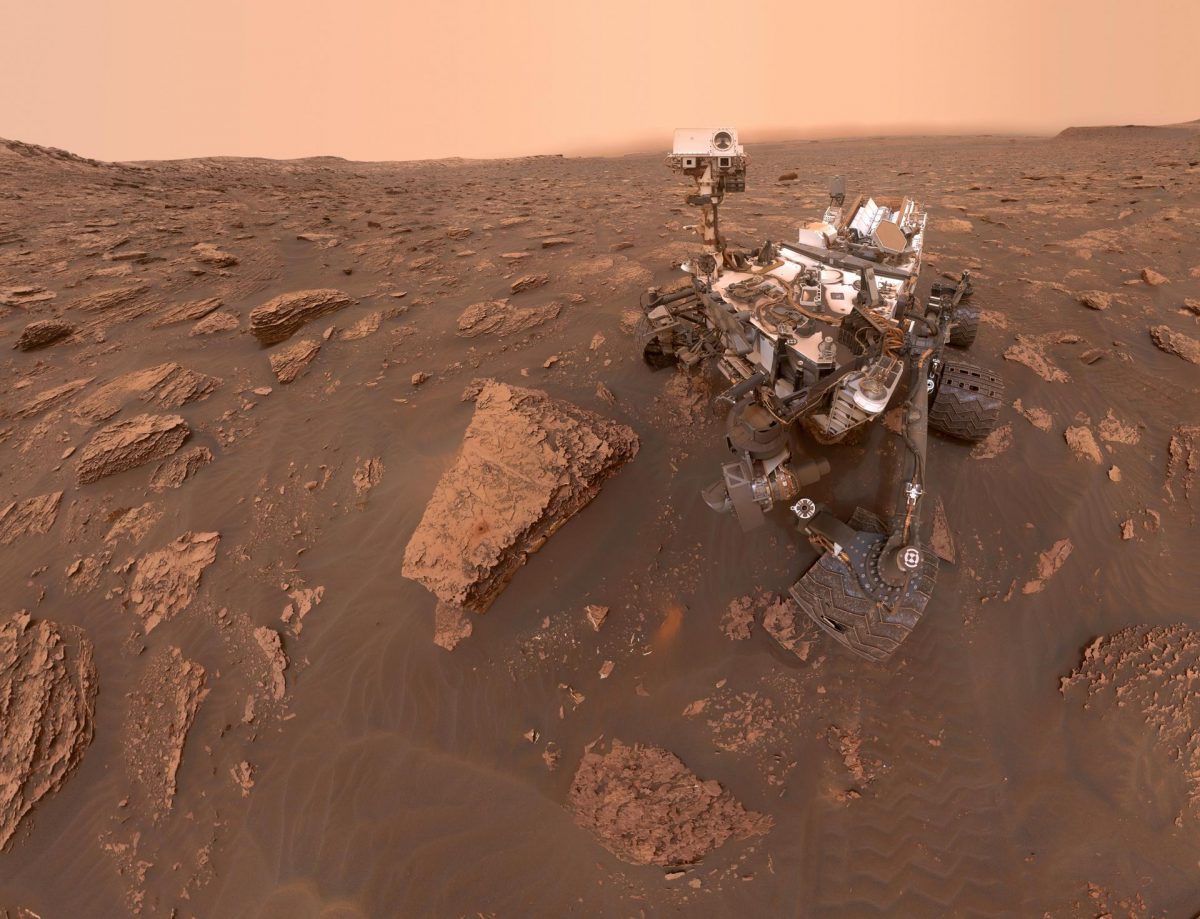
In a new study, researchers say that non-biological sources they considered could not fully account for the abundance of organic compounds in a sample collected on Mars by NASA’s Curiosity rover.
In March 2025, scientists reported identifying small amounts of decane, undecane, and dodecane in a rock sample analyzed in the chemistry lab aboard Curiosity. These were the largest organic compounds found on Mars, with researchers hypothesizing that they could be fragments of fatty acids preserved in the ancient mudstone in Gale Crater. On Earth, fatty acids are produced mostly by life, though they can be made through geologic processes, too.
It was not possible to determine from Curiosity’s data alone whether or not the molecules they found were made by living things, which led to a follow-on study that evaluated known non-biological sources of these organic molecules — such as delivery by meteorites smashing into the Martian surface — to see if they could account for the amounts previously found.
Reporting on Feb. 4 in the journal Astrobiology, researchers say that as the non-biological sources they considered could not fully explain the abundance of organic compounds, it is therefore reasonable to hypothesize that living things could have formed them.
To reach their conclusion, scientists combined lab radiation experiments, mathematical modeling, and Curiosity data to “rewind the clock” about 80 million years — the length of time the rock would have been exposed on the Martian surface. This allowed them to estimate how much organic material would have been present before being destroyed by long-term exposure to cosmic radiation: far more than typical non-biological processes could produce.
The team says more study is needed to better understand how quickly organic molecules break down in Mars-like rock under Mars-like conditions — and before any conclusions can be reached about the absence or presence of life.
By Lonnie Shekhtman
NASA’s Goddard Space Flight Center, Greenbelt, Md.
