While the United States has intensified its immigration crackdown and deportation efforts and European countries are closing their borders one after the other, Spain continues to act as an outlier.
Spain’s left-wing government in late January approved a royal decree — without a vote in parliament, where it has no majority — to regularize several hundred thousand undocumented people who already live and work in the country.
To be eligible to apply for a one-year renewable residence permit, applicants must have no criminal record and prove they have been present in Spain for at least five consecutive months prior to Dec. 31, 2025.
Even if there are no official figures on the exact number of undocumented people living in Spain, it is estimated that half a million to one million people could be affected by this measure, which Spain is promoting as a way to alleviate an employment shortage in its booming economy.
“I still can’t believe it. I’m torn between joy and the feeling that it can’t be real,” said a 36-year-old Honduran, who has been living in Madrid for almost a year and a half without papers. CBC is not naming him because he does not yet have legal status in Spain and fears reprisal from employers.
He says he has already submitted an asylum application but is still waiting. He plans to apply to this new program for which he is eligible. Until then, he continues to take on odd jobs under the table to send money to his wife and five-year-old daughter, who remain in Honduras.
“During the week I work in construction, and on weekends I’m a dishwasher at a restaurant. It’s not easy every day, we’re often exploited and have to accept everything we’re asked to do. We have no rights and a very low salary,” he said.

Nearly 90 per cent of undocumented migrants in Spain are believed to be from Latin America, primarily Colombia, Peru and Honduras. Since they do not need a visa to enter as tourists, many use this pathway to then stay illegally in the country, where they speak the same language and share cultural affinities. Since U.S. President Donald Trump’s return to the White House, Spain has seen an increase in the arrival of Latin Americans who are avoiding the United States.
Economic impact
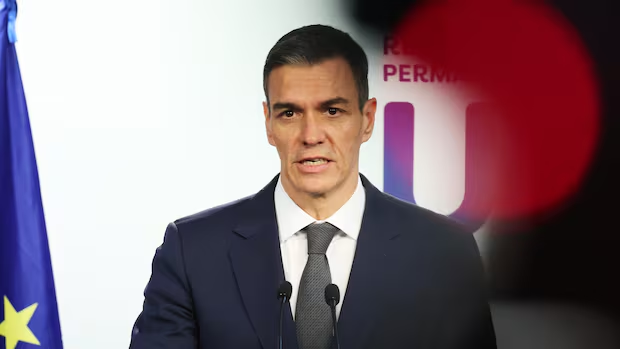
There are nearly seven million foreign nationals living in Spain — almost 15 per cent of its population — according to the most recent data. Spanish Prime Minister Pedro Sánchez regularly praises the benefits of immigration to explain Spain’s booming economy.
The country recorded 2.8 per cent growth in 2025 and saw its unemployment rate fall below 10 per cent, a first since the severe economic crisis the country experienced. After a housing bubble burst, Spain had a crisis from 2008 to 2014 that resulted in bankruptcies, widespread unemployment, the need for government bailouts, and long-lasting social and economic harm.
“Immigration is indeed one of the reasons for this good economic health,” said Raymond Torres, an economist at the Spanish think-tank Funcas. “The tourism, services and construction sectors are in high demand and depend on immigration.”

The new regularization plan was welcomed by employers facing a persistent labour shortage. “This is a reality that we have been denouncing for a long time in the construction sector,” said Juan Antonio Gómez-Pintado, president of Vía Agora, a real estate development and property management company.
“The needs are urgent,” he said, referring to Spain’s construction sector, which would need 700,000 more workers to meet current demand. Gómez-Pintado says that this measure could greatly help the industry.
In 2005, the country had already regularized for economic reasons nearly 600,000 undocumented people. This regularization improved migrants’ job opportunities, mobility, and tax contributions but did not trigger a “call effect” or impact workers of different skills and wages equally, according to studies.
The pressure to regularize undocumented migrants grew during the pandemic, when many migrants continued to work in precarious conditions. Subsequently, more than 700,000 citizens signed a legislative initiative to request their regularization.

In addition to helping alleviate the labour shortage, the measure is also intended to help bail out public finances. Undocumented people have access to health care, which is universal in Spain, even though they don’t contribute to social security, Torres explained. “There is therefore an expense on the one hand and no income on the other,” said Torres. Various studies have indeed shown that an undocumented person costs a state more annually than a person with legal status.
This massive regularization could lead to other positive effects, Torres said, in particular by limiting unfair competition between companies — whose costs vary depending on whether their workforce is declared or not — while offering new professional opportunities.
“Some of these immigrant workers have much broader skills. They are sometimes doctors but work as domestic workers due to their irregular status. Regularization can allow them to change this,” he said.
‘Overloaded’ system
The Spanish government announced that regularization applications would begin in April and would extend until the end of June, ensuring that administrative procedures would not exceed three months. The government wants to be reassuring, while officials have already warned in recent months of a lack of resources to deal with all the requests received by the Spanish immigration system.
“The system is already overloaded. Procedures that should take a few months sometimes take up to a year. It’s going to be a big challenge,” said Eva María Navarrete Parrondo, an immigration lawyer in Madrid.
She says she’s been receiving nearly 400 requests per day since last week’s announcement. “The majority of my undocumented clients are already working without proper documentation, mostly in the construction industry. They have high expectations, hoping to free themselves from the burden of insecurity and obtain better working and living conditions,” she said.

Parrondo says she thinks Trump’s mass deportation policies accelerated Spain’s decision to show its contrast.
However, it is not making everyone happy in Spain. The right-wing opposition has expressed fears that public services will be overwhelmed, while the far right describes the announcement as an “invasion” of the country. They raised this issue at the EU level, which has since replied that it falls under the jurisdiction of the member states.
Prime Minister Sánchez responded to critics in a video posted on social media, saying that Spain chose the path of “dignity, community, and justice,” and asking, “When did recognizing rights become something radical?”
Although the Honduran worker CBC spoke with says he sometimes receives remarks about not being Spanish and being undocumented, he says the reception he generally receives in Spain is quite good because people know they need him.
“We are not stealing jobs from Spaniards, we are simply doing jobs they don’t want to do,” he said. He now places a lot of hope in this regularization plan. “I can’t wait for this whole nightmare to end. I hope that afterwards I’ll be able to bring my daughter and wife here. This is my ultimate dream.”