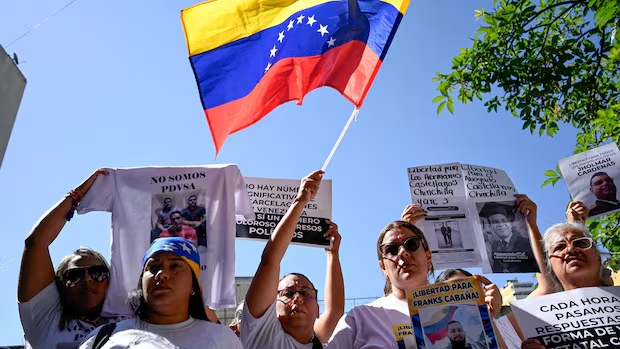
In a functioning democracy, a similar public confrontation might barely register.
But in Venezuela, widely regarded as one of Latin America’s most authoritarian states, student leader Miguelangel Suarez’s face-to-face demands of acting President Delcy Rodriguez quickly drew international attention.
During a visit by Rodriguez to his university, Suarez, accompanied by dozens of other students, approached Venezuela’s new leader and demanded that she release the “hundreds of young political prisoners.” In a video of the encounter, Rodriguez initially appears taken aback before engaging in a brief debate.
Just over one month after the United States captured then-President Nicolas Maduro, some Venezuelans opposed to the government have become increasingly bold in challenging the new authorities.
Others remain wary and worry that any democratic opening will only be temporary.

After the U.S. operation, Rodriguez, who had served as Maduro’s vice president, assumed power, and most of Maduro’s allies have retained their positions.
In a sign that the new authorities may be moving to enact concrete reforms to protect dissent, on Thursday the legislature unanimously approved an amnesty law that could grant broad pardons to hundreds considered political prisoners by human rights groups. Lawmakers are expected to conduct a mandatory second vote on the measure on Tuesday.
Around 350 political prisoners have already been released in the month following Maduro’s capture, according to Foro Penal, an NGO that monitors political prisoners in the country. Still, 680 remain jailed. The government has claimed more than 800 have been freed since December.
“When my adrenaline came down a bit, I started to think what it meant to do this in an authoritarian country,” Suarez said of his exchange with Rodriguez. “I had a very weird feeling for about three hours.”

Despite those concerns, Suarez said he has not received any threats or indications that he could face retaliation following the incident.
Suarez said he was stopped at a police checkpoint a few days later and officers briefly detained him before a superior instructed them by phone to let him go.
‘You can feel the change’
The confrontation between Suarez and Rodriguez has become a test case for a question Venezuelans are asking in whispers: is the country entering a genuine political opening or just a brief, carefully-managed pause in repression?
Like Suarez, some aren’t waiting for permission to test the new boundaries.
Following a crackdown on protests and dissent in the aftermath of the July 2024 presidential election, “people had stopped even talking about politics in the street,” according to Jesus Piñero, a history teacher at a private Caracas high school.

Many would erase messages and photos in their phones before leaving home, in fear that anti-government propaganda could be discovered during a checkpoint search.
In one case that gained widespread attention, a 65 year-old doctor was sentenced to 30 years in prison after sending a message in a neighborhood WhatsApp group critical of the Maduro government.
Piñero said he has started to speak openly and post on social media about the U.S. operation, making comparisons between the current moment and the fall of a Venezuelan dictator in 1935.
He has also started speaking more about politics in his classes, where he says the children of some top government officials attend.
“You can feel the change, and I think we’re freer today than we were yesterday,” he said.
Regime red lines
The question now is how much dissent the authorities will tolerate and for how long. Some signs of the government’s red lines have already emerged.
On the same day of the U.S. operation, Rodriguez issued a decree declaring a state of emergency, which ordered the “search for and immediate arrest” of anyone celebrating Maduro’s capture.
A private TV channel with national reach recently aired footage of opposition leader Maria Corina Machado, who has applauded the U.S. actions, after she met with officials in Washington.
Interior Minister Diosdado Cabello, seen as the government’s main enforcer, later criticized the channel on his weekly TV program. For many Venezuelans, being named on his show is seen as a warning that can be followed by a knock on the door from state security.
Some other forms of activism are being tolerated — for now.

The U.S. capture of Nicolás Maduro unlocked new hope for the hundreds of political dissidents lost in Venezuela’s notorious prisons. For The National, CBC’s Evan Dyer speaks to Venezuelans now living in Canada who say they want to see the Trump administration do more to free their family and friends.
Hundreds of family members of those considered political prisoners by human rights groups have gathered outside of jails, many of them sleeping in tents as they demand their family members’ release.
In one incident outside of a facility, opposition youth leader Marysabel Centeno reprimanded a line of police officers for “following orders” and “harming Venezuelans.” A video of the encounter spread quickly online. Centeno is seen yelling directly in front of the officers as they stare blankly ahead.
“I received a lot of warnings, and there were people telling me that intelligence services had already put me on a list,” she said. “But up until today, thank God, nothing has happened.”

At least three opposition politicians who had remained in hiding within the country have emerged in the past month and made public statements.
Former opposition lawmaker Delsa Solorzano says she went into hiding shortly after a failed attempt by security forces to detain her in August of 2024. She spent 17 months “completely alone” in a safe house and “unable to even peek out a window to see the sun.”
She appeared recently at the headquarters of her political party to cheers.
“It’s undeniable that a new stage has begun in the country and if somebody is a politician, it’s because they want to serve their country, and it’s time,” she said, while admitting that she will still face risks.
‘New political moment’: Rodriguez
Acting President Rodriguez has spoken of a “new political moment.” But aside from the amnesty law, there have been few concrete steps to guarantee freedom of expression or protect dissent from retaliation going forward.
Some of those already freed from the country’s jails have also appeared newly emboldened, speaking openly to the media.
Typically, political prisoners released in Venezuela are given strict conditions — barred from speaking publicly about their cases, prohibited from leaving the country, and required to report periodically to court.

“There was that timidness, that fear, and that has slowly been removed,” said Ramon Centeno, a Venezuelan journalist who spent four years in prison and was released in the days following the U.S. operation.
He said he hopes speaking out helps build a new “culture of dialogue without violence” in Venezuela — though he added he is still careful not to discuss the details of his case or what he experienced behind bars.
The new political culture points to signs of a democratic opening, according to John Magdaleno, a political scientist based in Caracas. But he warns that without concrete guarantees to protect rights and dissent, the momentum could quickly fade.

The son of Dave Sawatzky, a southern Manitoba man who has been jailed in Venezuela for more than a decade, says he hopes the current political turmoil in the South American country could result in his release.
A true transition towards democracy would entail “political liberalization,” that formally reinstates civil liberties. The amnesty law could be the first step in that direction, he said.
“The largest part of democratic transitions that have happened in the world tend to revert, meaning liberalization begins and then backslides,” he said. “No transition is irreversible, and all we’ve seen so far are gestures in that direction.”