Almost every foreign diplomat you run across lately simply gushes about Prime Minister Mark Carney’s Davos speech, and how his remarks about middle powers banding together went viral in Europe.
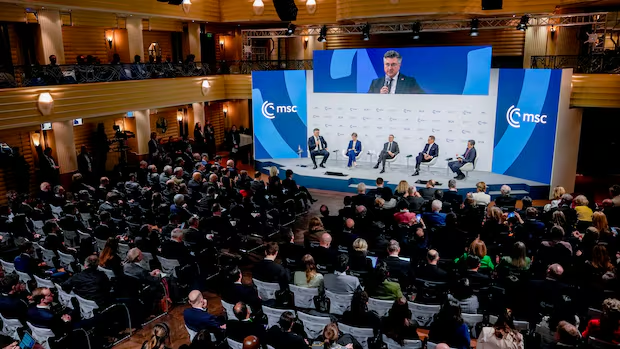
As much as the speech represented a wake-up call for Canada and its allies, a new report that sets up the annual Munich Security Conference extends and sharpens Carney’s argument and delivers a series of stark warnings.
One of them is fairly straightforward — if not somewhat uncomfortable — for Canadians.
Where allies are concerned, it’s not enough to just show up. You’ve got to bring something useful.
The report, which serves as the foundation of discussion at the world’s largest security conference, suggests going forward alliances require sustained investment, credibility and trust — commodities that must be actively maintained, not assumed.
The conference will be held in the Bavarian city later this week and the report by researchers Tobias Bunde and Sophie Eisentraut argues that countries unwilling or unable to adapt to a more coercive global environment risk being run over in an international system increasingly shaped by power rather than consensus.
“International rules are only as strong as the democratic states willing to defend them,” the report says.
For Canada, that assessment cuts close to the bone.
Ottawa has spent decades operating on the assumption that the rules-based order would endure — that institutions would hold, alliances would remain reliable and norms would restrain excess.
The Munich conference report suggests those assumptions no longer apply and wonders whether we’re witnessing the end of an era, rather than the retrenchment of the United States.
“The new leadership of the United States, the country that has long acted as the guardian of the post-1945 international order, has concluded that upholding that is no longer in America’s interest,” said Bunde at a briefing prior to the release of the report.
“More than that, it has begun to actively dismantle it, at least in several key dimensions. So when bulldozers tore down the East Wing of the White House in October, we felt this offered a fitting metaphor for the moment we are living in.”
Last year’s gathering in Munich was marked by a speech from U.S. Vice-President JD Vance, who delivered a scalding attack on European democracies. He said the greatest threat to the continent was not from Russia and China, but “from within.”
Eisentraut said, however, the sentiment is not restricted to Washington.

At the Munich Security Conference, U.S. Vice-President J.D. Vance berated European allies for allegedly suppressing free speech, a threat he called bigger than Russia or China. Vance also accused host country Germany of silencing right-wing political voices.
“We are currently seeing the rise of political actors who do not promise reform or repair, but who are very explicit about wanting to tear down existing institutions, and we call them the demolition men,” Eisentraut said at the same briefing.
“What drives many of them is frustration with the liberal trajectories their societies have followed, and which they argue put their countries at risk of civilizational decline.”
And with the guardrails weakening, the report suggests credibility now matters as much as principle, and commitment must be demonstrated, not simply declared.
The report describes a world in which economic interdependence no longer guarantees stability, trade is routinely weaponized and security guarantees are increasingly conditional. In that environment, middle powers without hard leverage face a shrinking margin for influence.
Canada is one of them, something Carney acknowledged at the World Economic Forum.
“For decades, countries like Canada prospered under what we called the rules-based international order .… this bargain no longer works.” the prime minister said.
“Stop invoking the rules-based international order as though it still functions as advertised. Call it what it is — a system of intensifying great power rivalry where the most powerful pursue their interests using economic integration as coercion.”
Disillusioned democracies
The Munich report sharpens that point, saying without material capability and sustained investment, even well-intentioned countries will find their influence steadily diminished.
“Effectively defending institutions, rules and norms requires actual material power” not just rhetoric, the report said.
Eisentraut said the gap between rhetoric and reality is feeding disillusionment in Western democracies.
“In short, if institutions are seen as failing, if meaningful reforms are not seen as credible, then why hold back those who want to demolish it all?” Eisentraut said.
“And that’s why in the report, we argued that we have ended up in a period of wrecking ball politics where those who employ the wrecking balls, the bulldozers, the chainsaws … are often cautiously admired or even openly celebrated.”

CBC News chief political correspondent Rosemary Barton asked The National’s At Issue panel to break down the significance of Mark Carney’s Davos speech.
Trust in the United States as a reliable, long-term partner is waning, especially in Canada, a survey for the security conference found. Two-thirds of respondents in Germany and absolute majorities in Canada, the United Kingdom and France say that the United States has become a less reliable ally.
“More strikingly in Canada, more respondents now view the United States as a threat than as an ally,” Bunde said.
The poll was conducted before U.S. President Donald Trump’s latest threats to annex Greenland.
Despite pessimistic findings, polling data shows Canadians remain broadly supportive of international engagement.
Thirty-five per cent say Canada should do more when other countries pull back; another 35 per cent favour maintaining current levels of involvement. Only a minority advocate disengagement.
In other words, Canadians have not turned inward.
But the report is blunt — engagement now carries a cost. Institutions do not defend themselves. Norms do not enforce themselves. Alliances do not run on intent.
Interestingly, Eisentraut noted that the policy of accommodation that many European allies and even Canada have adopted in response to the Trump administration has pretty much run its course.
Charting where to go from here will be part of the discussion at Munich this week.