
Listen to this article
Estimated 4 minutes
The audio version of this article is generated by AI-based technology. Mispronunciations can occur. We are working with our partners to continually review and improve the results.
A viejito and a jibaro in a pava walk into a bar.…
No, seriously, Bad Bunny’s 13-minute Super Bowl halftime performance was jam-packed with references to Puerto Rican life and Latino culture more broadly.
The Spanish-language performance by the 31-year-old singer — born Benito Antonio Martínez Ocasio — was highly anticipated by fans eager to see what songs, symbols and guests the artist might showcase, as well as by political watchers for any possibly charged statements, given Bad Bunny’s comments about ICE at the Grammy Awards last weekend.
There was a lot going on on the sprawling, dynamic set. Here are some of the key references the Puerto Rican superstar fit into his performance in case you missed them, as well as the meaning behind them.

Puerto Rican music sensation, and longtime Trump critic, Bad Bunny, delivered a passionate Spanish-language Super Bowl halftime show that many in the MAGA movement derided as “too woke” before it even took place.
Sugar cane fields
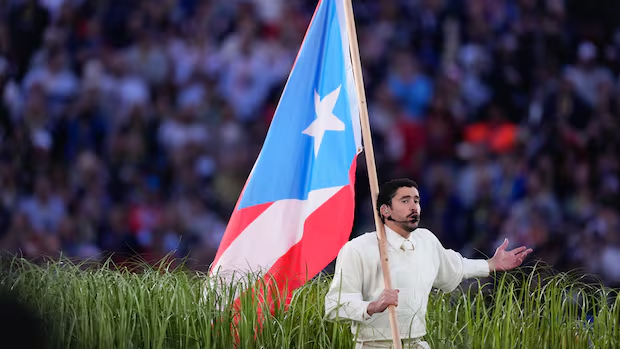
The singer and rapper opened the night in a scene resembling a field of sugar cane, surrounded by farmers hacking at the stalks.
The production and trade of sugar has coloured Puerto Rico’s history. Enslaved people were made to cultivate sugar cane starting in the 1500s, and crops were sold abroad by settlers who colonized the Caribbean islands.
Sugar cane production endured for centuries even after slavery was outlawed in the territory, and as of 1964, accounted for nearly half of all agricultural production in Puerto Rico. Viewers at home picked up on the symbolism in Bad Bunny’s performance, and took it as a reminder of the island’s colonial history.
Electricity poles
For a rendition of one of his more political songs, Benito and a handful of backup dancers climbed sparking electricity poles as the stadium lights flashed.
The song, El Apagón, which translates to “The Blackout,” reflects socioeconomic issues on the singer’s home island, especially the frequent blackouts that occur there due to an unreliable power grid. The sparks and intermittent lights in the set design helped drive home the pointed message in the song.

Lots of Latino imagery — but no Liam Ramos
Despite online speculation, Liam Ramos — the five-year-old boy in the bright blue bunny hat who made international news when he and his dad were detained by U.S. Immigration and Customs Enforcement (ICE) last month — was not, in fact, the little boy who Bad Bunny handed a Grammy award to.
Partway through the performance, Bad Bunny bent down to hand off the golden gramophone statue to a small child, who seemed to represent a younger version of the star himself, or perhaps the next generation of Puerto Rican artists.
Some viewers speculated the little boy was Liam, and shared side-by-side photos of the similar-looking children.
The kid who took part in the halftime performance was actually five-year-old Argentinian Egyptian actor Lincoln Fox. He posted a clip from the show to his Instagram, thanking Bad Bunny for including him.
“I’ll remember this day forever!” Fox wrote.
The message on the football
If you blinked, you would have missed it. Right at the end of the performance, Bad Bunny spoke a few words in English to say “God bless America ” — but it wasn’t in the usual way you’d think about the phrase.
The singer went on to list countries of the Americas: Argentina, Uruguay, Paraguay, Colombia, Venezuela and many more — plus the U.S. and Canada at the very end.
With flags of those nations in the background, Benito held out the football he’d been clutching for much of the performance, to show a message written in white — “Together, we are America.”
While “God Bless America” is usually taken to mean love for the United States alone, the performer’s message put the U.S. closer to the end of the list and highlighted the other countries that make up the North and South American continents first.
Observers online took the words as a message of unity and love to close out a high-energy show.