As Pakistan positions itself as a regional security provider, rising militancy and economic constraints continue to test the sustainability of that ambition.
From February 2 to 4, Libya’s eastern commander, renegade military commander Khalifa Haftar, visited Rawalpindi for talks at Pakistan’s army headquarters with the army chief, Asim Munir. The visit might have seemed routine, but it highlights Pakistan’s expanding defence diplomacy in the Middle East and North Africa (MENA).
Pakistan reportedly signed a $4bn defence deal with Haftar’s self-styled Libyan National Army (LNA), including 16 JF-17 fighters and 12 Super Mushak trainer aircraft, structured over roughly two and a half years. The acquisition of this 4.5-generation fighter grants the LNA a “game-changing” airpower advantage, potentially upending the military balance with its Tripoli-based rivals unless the latter secures a comparable capability in time.
Pakistan is also reportedly in the final stages of a $1.5bn package to supply the Sudanese Armed Forces (SAF) with 10 Karakoram-8 light attack aircraft, more than 200 drones and air defence systems to bolster its capabilities in the ongoing war against the paramilitary Rapid Support Forces (RSF).
In purely national-interest terms, Pakistan’s growing defence profile in MENA is not a problem automatically. A larger footprint can generate foreign exchange, expand diplomatic access, and increase Pakistan’s visibility in a region where security partnerships are being diversified. It can also strengthen longstanding military-to-military links in the Gulf and beyond.
Yet the same burst of activity raises a quieter question: is Pakistan’s foray into MENA largely transactional — focused on exporting weaponry — or part of a coherent strategy to provide security? In other words, Pakistan can export military services and equipment; the harder question is whether it can sustain a “security provider” posture when domestic militancy and border volatility keep pulling capacity inwards.
The Middle East is a useful recent example because it exposes a pattern of contingent, deal-driven activism: Pakistan can offer military cooperation and weapons, and it can gain diplomatic visibility, but the approach is being shaped less by a durable economic base and domestic security stability than by events and short-term openings.
The May 2025 India-Pakistan crisis helps explain why Pakistan’s defence industry suddenly looks more marketable in parts of MENA. Pakistan’s successful counter-air campaign against India, which reportedly included the downing of India’s premier Rafale fighter aircraft, has proved to be a windfall for the country, resulting in a surge in high-value defence partners and customers.
The crisis bolstered Pakistan’s airpower narrative, highlighting its superior training standards and operational integration when confronting a conventionally larger adversary — qualities that have increasingly drawn the interest of regional partners.
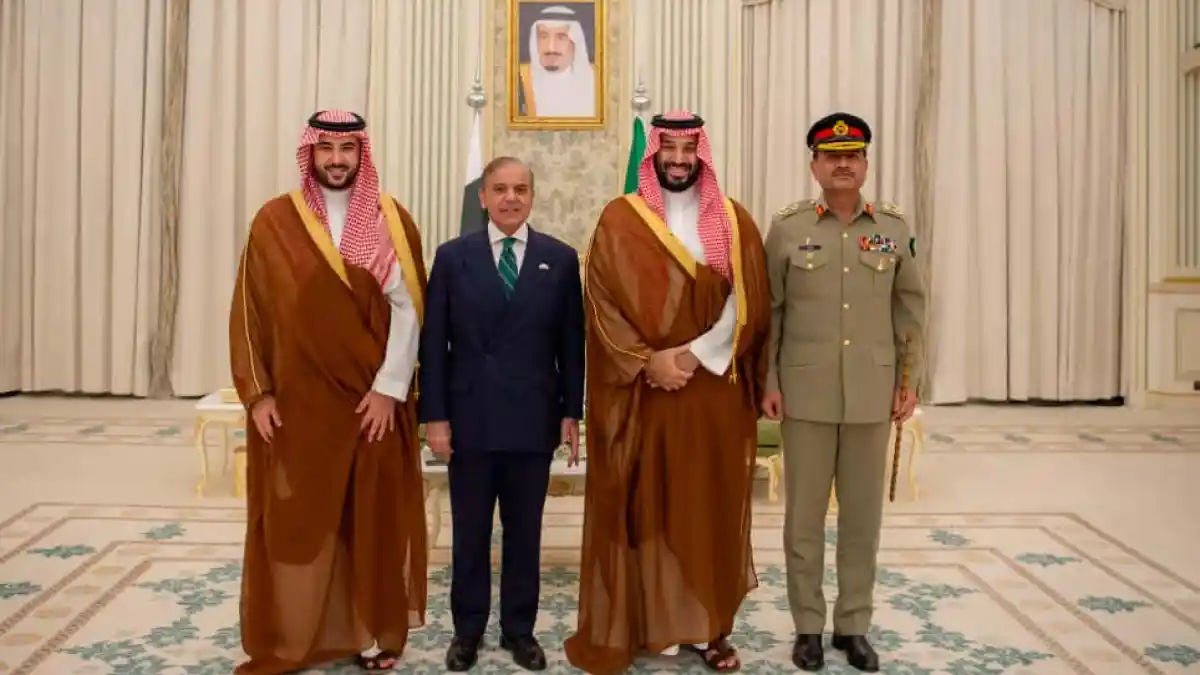
In September 2025, Saudi Arabia formalised a Strategic Mutual Defence Agreement with Pakistan, stating that an attack on one would be treated as an attack on both. The agreement is a significant diplomatic marker and reinforces Pakistan’s standing as a security partner at a time when Gulf states are diversifying their defence relationships.
But beyond airpower, training, and defence-industrial cooperation, Islamabad lacks the economic weight to anchor these relationships at scale.
In 2024-25, Pakistan’s net foreign direct investment from all countries was about $2.5bn, while its total trade with the Gulf Cooperation Council (GCC) nations was roughly $20bn. By contrast, India’s GCC-sourced investment alone was $4.7bn in 2024, and its GCC trade was about $179bn.
Moreover, Pakistan remains a net seeker of capital — relying on Gulf “rollover” loans and central bank deposits to stabilise its own economy — whereas India has transitioned into a strategic investor in Gulf infrastructure, energy, and technology. This “dependency gap” ensures that while Pakistan is a valued security guarantor, it is rarely a peer-level economic partner.
This imbalance matters because Gulf capitals increasingly treat defence cooperation as one strand within a much bigger partnership portfolio — energy, trade, investment, technology, and supply chains. India and the United Arab Emirates, for example, recently discussed deeper defence cooperation through a letter of intent to establish a strategic defence partnership, alongside a $3bn LNG supply deal and ambitious trade targets.
In that environment, Pakistan’s security value can open doors, but without comparable economic depth that fosters diverse interdependence, it is harder to convert access into durable influence.
The other constraint on the “net security provider” narrative is the condition of Pakistan’s own security environment.
Pakistan recently confronted one of its deadliest security flare-ups in years in Balochistan: a wave of simultaneous, province-wide attacks targeting administrative centres and security installations in Quetta and beyond. The resulting weeklong counteroffensive reportedly led to the death of 216 armed fighters, though at the steep cost of 22 security personnel and 36 civilian lives.
Whatever one’s preferred political explanation, the figures underline how much bandwidth the state is still expending to stabilise a key province.
Then came another signal from the Islamabad Capital Territory. On February 6, a suicide attacker struck a Shia mosque on the outskirts of the national capital during Friday prayers, killing more than 30 people and injuring about 170. A splinter faction linked to ISIL (ISIS) claimed responsibility. This was the second major attack in the capital in three months.
The western border with Afghanistan is another reminder that Pakistan’s security bandwidth is not infinite. Islamabad is now locked in a confrontation with a Taliban regime that refuses to curb cross-border militancy. This grinding conflict — which killed 1,034 people in 2025 alone — compels the state to divert critical military resources to the frontier, draining the very capacity needed for power projection abroad.
Indeed, the grim situation South Asia analyst Michael Kugelman portrays — of a Pakistan “sandwiched” between hardcore enemies — presents a strategic nightmare. He argues the Afghanistan-Pakistan situation is now more volatile than the India-Pakistan rivalry and could spur global terrorism.
None of these is to argue for retreat. Pakistan’s defence diplomacy in MENA can be good for the country, especially economically and diplomatically. But it does suggest a strategic tension: expanding security partnerships abroad is easier to sustain when internal stabilisation is more durable, and when foreign influence rests on a broader economic base as well as military capability. If Pakistan wants to be seen as exporting security, not just selling equipment, it will need a clearer doctrine, firmer internal stabilisation, and a wider economic foundation — so that events do not keep dictating its foreign policy priorities.
The views expressed in this article are the author’s own and do not necessarily reflect Al Jazeera’s editorial stance.