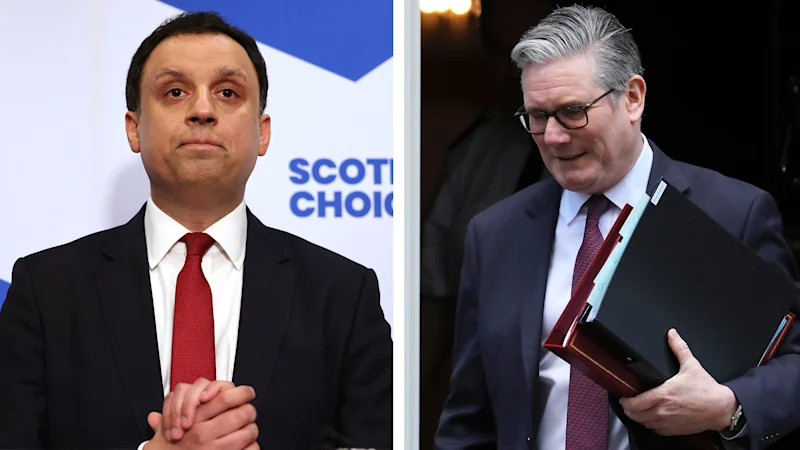

London: British Prime Minister Keir Starmer is fighting a Labour rebellion over his leadership after the head of the party’s Scottish wing called on him to stand down, sharply escalating the pressure for a new leader and ministry.
Cabinet ministers rallied behind Starmer in a bid to halt the challenge before it could gain momentum, while the prime minister’s closest allies insisted he had a mandate from voters and would stay in office.
The leader of the Scottish Labour Party, Anas Sawar, took the internal war into the public domain on Tuesday by holding a press conference to declare that he had to be “honest about failure” and call for Starmer to resign.
The leadership manoeuvres come barely 19 months after Labour swept into power and heighten the crisis within the governing party, as Labour MPs complain in public about their poor polling and lack of direction.
Two resignations have also shaken confidence in the prime minister’s office, with Starmer’s communications chief, Tim Allan, quitting on Tuesday, a day after chief of staff Morgan McSweeney stepped down.
Sawar, a centrist like Starmer, is lagging in the opinion polls ahead of an election for the Scottish parliament in May, and he said he spoke out to prevent the Scottish National Party defeating Labour at the polls.
“That’s why I have to be honest about failure wherever I see it. The situation in Downing Street is not good enough. There have been too many mistakes.
“They promised they were going to be different, but too much has happened.
“Have there been good things? Of course, there have – many of them, but no one knows them, and no one can hear them because they’re being drowned out. That’s why they cannot continue.”
The leader of the Labour Party in Wales, Eluned Morgan, remained silent on the leadership question on Tuesday (early Wednesday, AEDT); she is also contesting a parliamentary election in May and faces an uphill battle against Welsh governing party Plaid Cymru.
While Sawar did not name the scandal over Jeffrey Epstein as a factor in his decision, the pressure on Starmer has intensified in part because of questions over his judgement in appointing Peter Mandelson, a close associate of the sex offender, as the UK ambassador to the US.
Starmer last week apologised for that decision, five months after removing Mandelson from the post. He admitted that he knew of Mandelson’s ties to Epstein but said Mandelson lied and pretended the pair were not close.
The prime minister’s team at 10 Downing Street argued that he had won the general election in July 2024 and therefore held authority from the votes of the British public.
“He has a clear five-year mandate from the British people to deliver change, and that is what he will do,” said a Downing Street spokesperson.
The UK has 21 cabinet ministers excluding Starmer, and a majority of them backed the prime minister with public endorsements while Sawar was speaking or soon after he finished.
“The British public gave Keir a huge mandate only 18 months ago,” said Defence Minister John Healey.
“They wanted a Labour government. They want us to deliver the change we promised. They expect us to get on with the job… The PM has my fullest support in leading this government and this country.”
Home Secretary Shabana Mahmood said: “The PM has my full support. Let’s get on with changing the country for the better.”
Similar statements came from Chancellor of the Exchequer Rachel Reeves, Foreign Secretary Yvette Cooper, Justice Minister David Lammy, Education Minister Bridget Phillipson, Housing Minister Steve Reed, Trade Minister Peter Kyle and Pensions Minister Pat McFadden.
Health Minister Wes Streeting, whose supporters have positioned him as a contender for the leadership, told a media podcast the prime minister should stay on, but his support did not appear to be emphatic.
“Keir Starmer doesn’t need to resign,” he told the Electoral Dysfunction podcast.
Streeting said the last week had not been the best for the government, but he added: “Give Keir a chance.”
The revolt ahead of the Scottish election highlights the concern about Labour’s slump in the polls across the UK and the rise of populist leader Nigel Farage and his Reform UK party, which would win a general election on current polling.
Even so, one of the key Scottish ministers in the national government, Douglas Alexander, who is secretary of state for Scotland, did not endorse Sarwar’s call.
“The prime minister has recognised not just that lessons have to be learned but also that we change how we do government,” he said. “He is right about that and has my support.”
Hilary Benn, the secretary of state for Northern Ireland, urged MPs to stop the unrest.
“Now is the time for calm heads and seriousness of purpose,” he said. “That is why the prime minister has my full support.”
Get a note directly from our foreign correspondents on what’s making headlines around the world. Sign up for our weekly What in the World newsletter.
 David Crowe is Europe correspondent for The Sydney Morning Herald and The Age.Connect via X or email.